

Retirement Age Is Not Immediately Rising to 65: Current Status of the Government’s ‘Intergenerationally Balanced Retirement Age Extension’ Initiative in 2026
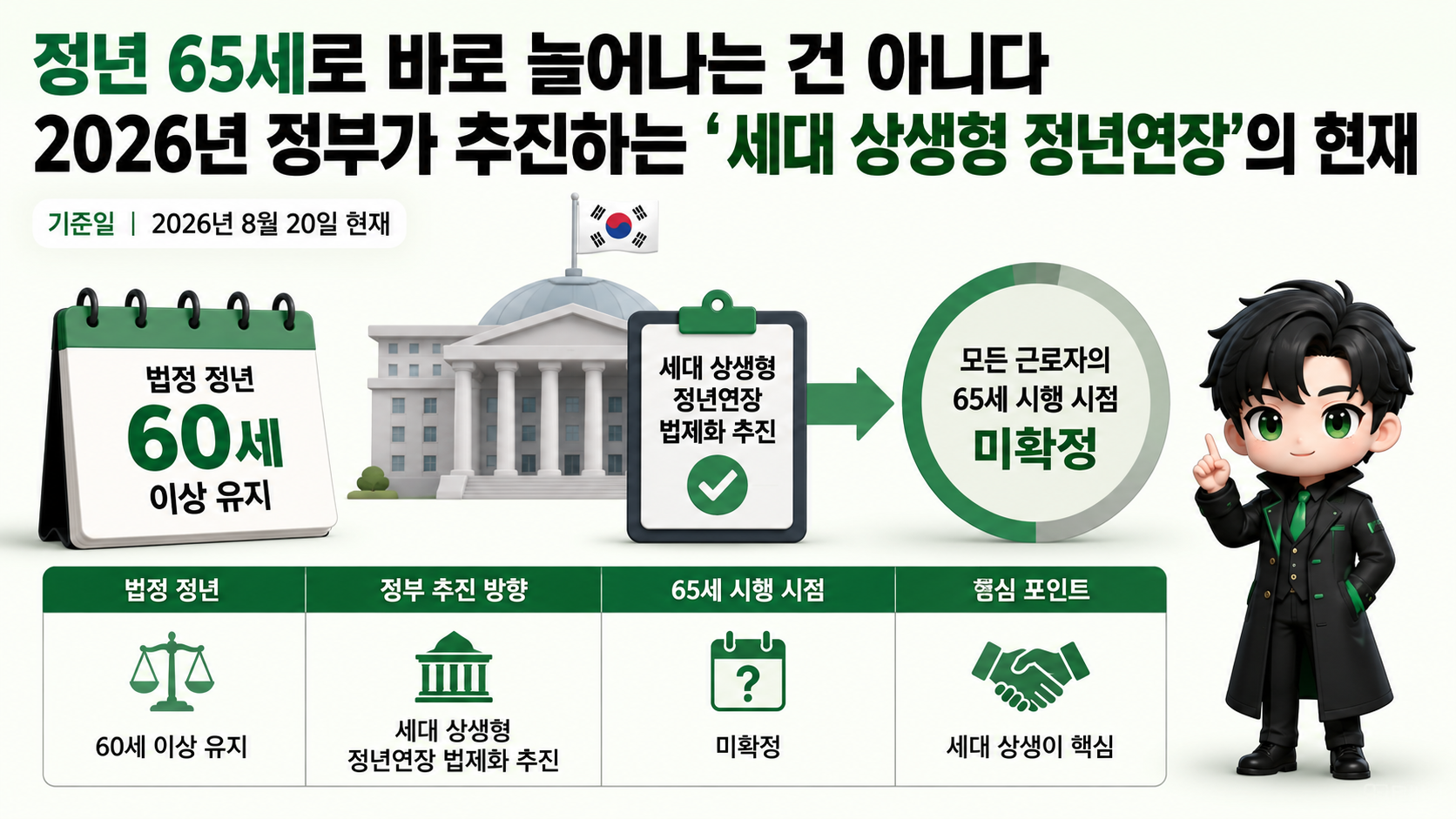
As of 2026-08-20, the statutory retirement age remains at least 60. The government recently officially announced plans to pursue legislation for an ‘intergenerationally balanced retirement age extension,’ but this does not mean that the retirement age for all workers has already changed to 65 or that an implementation date for 65 has been finalized.
The key issue in the current discussion is not simply changing one number from 60 to 65. The real substance of the proposed reforms lies in how to address the income gap between retirement and the start of National Pension payments, how companies will retain older employees, and how wage structures, job classifications, and new hiring opportunities for young people will be designed together.
The information was verified as of 2026-08-20 at 7:4 a.m. Korea Standard Time.
What Is the Current Statutory Retirement Age?
Under the current Act on Prohibition of Age Discrimination in Employment and Elderly Employment Promotion, employers who establish a mandatory retirement age must set it at 60 or older. Even if a company sets its retirement age below 60, the law treats that retirement age as 60. Therefore, it would be incorrect to assume that a statutory retirement age of 65 already applies.
The wording ‘60 or older’ is also important. Rather than fixing the retirement age at exactly 60 for every workplace, the law establishes a minimum threshold that employers cannot set below 60 when operating a mandatory retirement system.
Accordingly, if a company's employment rules or collective bargaining agreement already specify a higher retirement age, such as 61 or 62, that standard may apply. Conversely, the fact that a company's regulations still state 58 does not mean that the statutory retirement age becomes 58.
This is the first distinction to make when reading current news about retirement age policies. Existing law requires a retirement age of at least 60, while the government is pursuing legislation to extend the retirement age beyond that threshold.
What Changed in the Retirement Age Extension Announced by the Government on August?
In its policy implementation priorities for the second half of 2026-08-04, the Ministry of Employment and Labor announced that it would pursue legislation for an ‘intergenerationally balanced retirement age extension’ based on social dialogue. Its official policy report also included a commitment to address retirement age extension and youth employment together.
What the government announcement confirms is a policy direction toward legislation, going one step beyond merely stating that discussions about extending the retirement age would take place.
However, the government's official press release dated August 4 does not specify an implementation date for immediately raising the statutory retirement age of all workers to 65. Nor does it provide a finalized phased age schedule indicating which retirement age would apply starting in which year. Therefore, various age-based implementation proposals circulating online should not be confused with a system that the government has definitively approved.
The Ministry of Employment and Labor's officially announced policy direction also includes measures to promote youth employment. These involve consulting with relevant ministries on improvements to how public institutions manage staffing quotas and total personnel expenses, as well as strengthening the effectiveness of mandatory youth employment requirements to encourage public institutions to hire more young workers.
In other words, when evaluating future reforms, it will be necessary to examine not only ‘how old people can work until’ but also how the retirement age extension mechanism and new youth hiring measures are incorporated together into legislation.
Why Does the Gap Between 60 and National Pension Eligibility Keep Coming Up?
The normal eligibility age for National Pension old-age benefits varies by birth year. According to the National Pension Service, people born between 1961 and 1964 can begin receiving old-age pension benefits at 63, those born between 1965 and 1968 at 64, and those born in 1969 or later at 65. In principle, individuals must also have contributed to the pension system for at least 10 years.
Therefore, the minimum statutory retirement age of 60 does not always coincide with the normal starting age for National Pension benefits.
A simple comparison for people born in 1969 or later makes the difference clearer.
Author's calculation: 65 - 60 = up to 5 years
Assuming a worker retires at 60 and begins receiving normal National Pension benefits at 65, there is a difference of up to 5 years between the two age thresholds. However, the actual period without income may vary depending on the individual's company retirement rules, retirement date, reemployment status, National Pension contribution period, and whether they choose early old-age pension benefits.
The National Pension system also offers an early old-age pension option that allows eligible individuals to receive benefits up to 5 years before the normal eligibility age, although separate requirements, including income-related conditions, apply. This is why it would be misleading to assume that everyone who retires at 60 can immediately begin receiving National Pension benefits.
Are Retirement Age Extension and Continued Employment the Same Thing?
Although both systems can ultimately allow people to work longer, their structures differ.
Retirement age extension involves raising the mandatory retirement age established by an employer. By contrast, continued employment may include not only extending or abolishing the mandatory retirement age but also rehiring workers after they have formally retired. The Ministry of Employment and Labor already operates programs supporting continued employment for older workers and also published a separate guidebook on continued employment subsidies in 2026.
This distinction is important for employees as well.
Extending the existing retirement age and terminating an employment relationship at 60 before rehiring the worker under new conditions cannot be assumed to produce the same outcomes in terms of wages, job duties, and working hours. That is why, as legislation takes shape, workers should look beyond the number ‘65’ and check whether the retirement age itself will be extended or whether reemployment arrangements will be used alongside the extension for a specified period.
The government's current official policy report sets out its intention to pursue legislation for an ‘intergenerationally balanced retirement age extension,’ but the specific legal provisions and implementation mechanisms will need to be confirmed through the future legislative process.
Can I Calculate How Long I Will Be Able to Work Right Now?
At this stage, it is not possible to enter only a birth year and definitively conclude, ‘I will be able to work until 64’ or ‘I will automatically remain employed until 65.’ Although the policy direction for legislating a retirement age extension has been announced, the final legislation and its effective date have not yet been enacted and implemented under current law.
For people who are currently employed, it is more accurate to check three matters separately.
First, check the current retirement age specified in your company's employment rules or collective bargaining agreement. Although the statutory minimum retirement age is 60, your company may have established a higher age.
Second, check the normal starting age for National Pension benefits based on your birth year. For example, the applicable age is 64 for people born between 1965 and 1968, and 65 for those born in 1969 or later.
Third, check the effective date and scope of application of any retirement-related amendments that eventually pass the National Assembly. Even if the law is amended, the age groups actually affected may differ depending on when the amendments take effect and how they apply to individual workplaces. Therefore, age schedules discussed during the legislative proposal stage should not be treated as definitive retirement ages for individual workers.
The First Thing to Watch Is Not a Headline Claiming ‘65 Confirmed’
As of 2026-08-20, the most accurate description is that the statutory retirement age remains at least 60, while the government is pursuing legislation for an intergenerationally balanced retirement age extension based on social dialogue.
In particular, when related legislation is introduced, four issues should be examined together: the final target retirement age, the year in which phased implementation would begin, whether reemployment arrangements would be included during the extension period, and how provisions concerning wages, job duties, working hours, and new youth hiring would be designed. These details will have greater practical significance for employees.
The National Pension eligibility age must also be considered. Under the current system, people born in 1969 or later become eligible for normal old-age pension benefits at 65, meaning that changes to the retirement system could also change the period between retirement and the start of pension payments.
Even when a retirement-related article mentions ‘65,’ considerable confusion can be avoided by first distinguishing whether the figure represents the government's policy direction, a bill submitted to the National Assembly, or legislation that has actually passed the National Assembly and taken effect.
※ This article is provided for reference purposes to help readers understand market trends and does not constitute an investment recommendation concerning any particular stock or asset. Final investment decisions and responsibility for those decisions rest with the individual.