

Intel to Continue Supplying DDR4-Compatible LGA 1700 Processors, Keeping Raptor Lake Available for Years
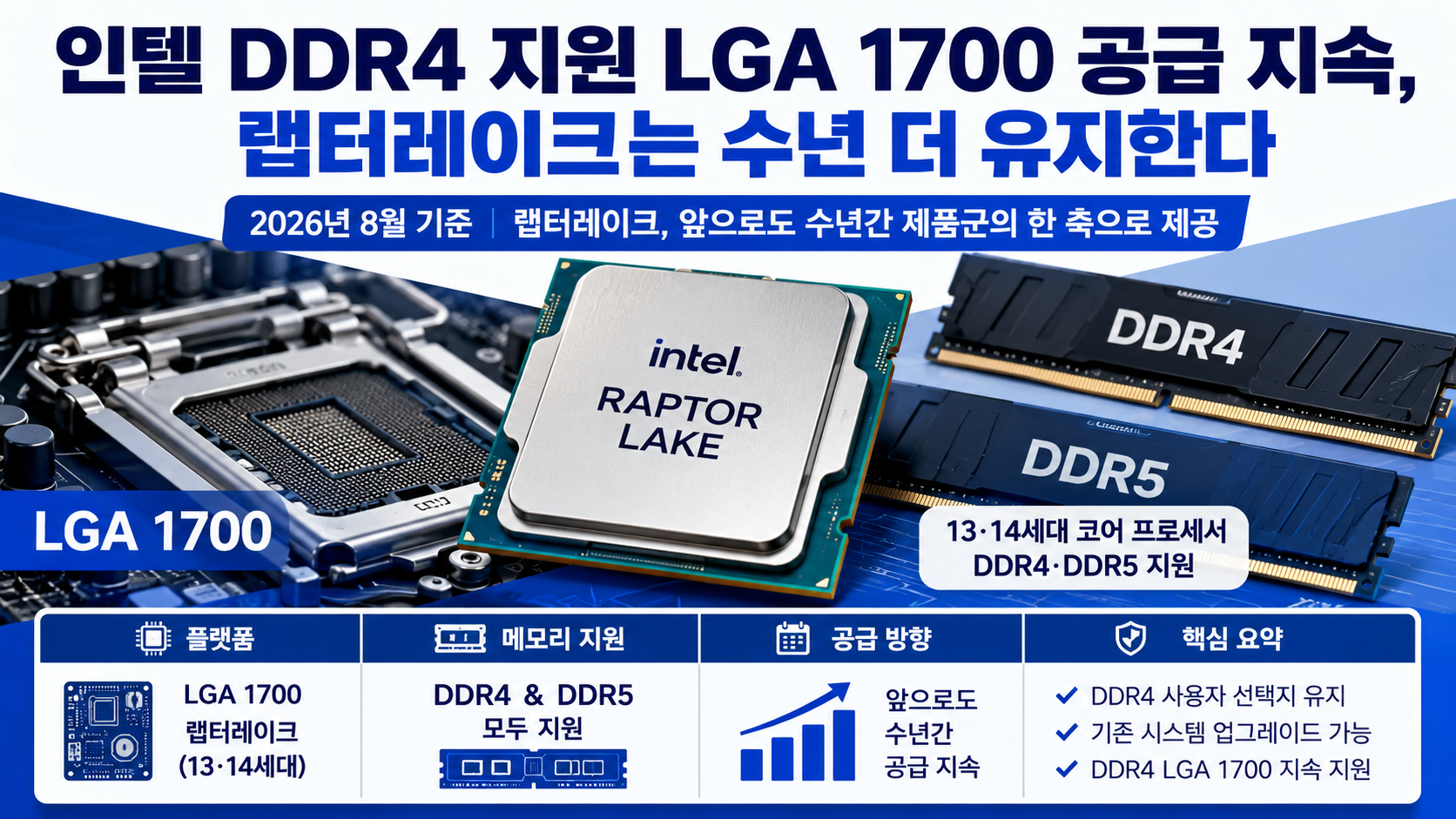
Intel has reaffirmed that it does not intend to discontinue its DDR4-compatible, LGA 1700-based Raptor Lake processors in the near term. As of August 2026, Intel said it plans to keep Raptor Lake as part of its product lineup for several more years, while 13th- and 14th-generation desktop Core processors support both DDR4 and DDR5.
This means users do not necessarily have to move to a DDR5 platform when buying or upgrading a PC. In particular, those who already own DDR4 memory and an LGA 1700 motherboard still have options worth considering for CPU upgrades and maintaining their existing systems.
Which Products Has Intel Committed to Keeping Available?
The product family Intel has discussed maintaining over the long term is Raptor Lake. On August 2026, Intel's Robert Hallock said the company wants to continue offering products such as Raptor Lake for years to come. He also acknowledged that some users still want LGA 1700 and DDR4 support.
It is important to understand the exact scope of this statement. Intel has not announced that every older LGA 1700 processor will remain available for the same period. The central message of its publicly disclosed remarks is that Raptor Lake will remain part of Intel's product portfolio.
Raptor Lake is the codename used for 13th-generation Intel Core desktop processors, and 14th-generation desktop products are also based on this family. Intel's official product information confirms that 14th-generation desktop Core processors use the LGA 1700 socket.
Intel made similar comments in April. At that time, Hallock said Raptor Lake remained a major part of Intel's strategy and would continue to be supplied in sufficient quantities. However, when asked whether production of specific models would increase, he said he could not provide details about supply or demand.
Therefore, rather than interpreting the latest statement as confirmation of an immediate production increase for a particular CPU, it is more accurate to understand it as Intel's intention not to phase out the DDR4-compatible Raptor Lake platform in the near term.
Why DDR4 Remains Usable on LGA 1700
13th- and 14th-generation Intel Core desktop processors support both DDR4 and DDR5. According to Intel's official support documentation, 13th- and 14th-generation desktop products support DDR4 speeds of up to 3200 MT/s.
14th-generation desktop processors use the LGA 1700 socket and are compatible with motherboards based on Intel 600-series and 700-series desktop chipsets. However, the actual memory standard is not determined by the CPU alone.
LGA 1700 motherboards come in DDR4 and DDR5 versions, depending on the product. Simply having an LGA 1700 socket does not mean a motherboard can accommodate existing DDR4 memory.
For example, users who want to continue using their current DDR4 memory must have a motherboard that supports DDR4 DIMMs. DDR4 modules cannot be installed in DDR5-only LGA 1700 motherboards.
Some products have also appeared with both DDR4 and DDR5 slots on the same board, but their specific slot configurations and operating requirements must still be checked. This should not be interpreted as meaning DDR4 and DDR5 can be used together simultaneously in one system.
Ultimately, anyone hoping to reuse existing components should first check the exact motherboard model and memory standard, even before selecting a CPU.
What Changes for 13th- and 14th-Generation Users?
If you already use an 13th- or 14th-generation processor in a DDR4-based LGA 1700 system, Intel's latest statement gives you no immediate reason to change your configuration. Since Intel has said Raptor Lake will remain in its lineup, the platform is far from disappearing overnight.
Users considering a CPU upgrade from an 12th-generation LGA 1700 system should also check their motherboard's support list first. Even though 600-series and 700-series chipsets are associated with 13th- and 14th-generation processors, actual compatibility can depend on the motherboard manufacturer's BIOS and CPU support list.
The verification process is straightforward.
1. Identify the exact model of your current motherboard.
2. Check whether it is the DDR4 or DDR5 version.
3. Find the processor you want to install on the motherboard manufacturer's CPU support list.
4. Check the required BIOS version.
5. If a BIOS update is necessary, confirm the update procedure before removing your existing CPU.
When upgrading between CPU generations, it is especially important not to assume compatibility simply because the socket has the same physical design.
How Does Raptor Lake Compare With the Latest Platform?
One of the most noticeable differences between Intel's current Core Ultra desktop lineup and Raptor Lake is the choice of memory standards. 13th- and 14th-generation Core desktop processors support both DDR4 and DDR5, while Core Ultra desktop processors use DDR5.
This changes the upgrade process for users who already own DDR4 memory.
With a compatible DDR4 LGA 1700 Raptor Lake system, users may be able to replace only the CPU while retaining their existing memory and motherboard, provided all compatibility requirements are met. Moving to a DDR5-only platform, however, may require replacing the motherboard and memory along with the CPU.
That does not mean DDR4 is the better platform for every user. Intel's long-term supply statement means that Raptor Lake and DDR4 will remain available as options, not that they offer better performance or features than newer platforms.
Anyone building a completely new system should compare more than CPU prices. Motherboard costs, memory costs, and future upgrade plans should also be considered. Conversely, users whose priority is reusing as many existing DDR4 components as possible benefit from the continued availability of LGA 1700.
Will More DDR4-Compatible LGA 1700 Motherboards Become Available Again?
In 2026, there have been concrete signs of renewed efforts to expand the availability of DDR4-compatible motherboards. At June, multiple motherboard manufacturers disclosed plans to increase production of DDR4-compatible products or reintroduce existing models from the second half of the year through 2027.
Intel also said at the time that it would continue working to ensure products supporting older memory technology remained available. Later, in August, the company outlined a longer-term direction by stating that Raptor Lake would remain available for several years.
Taken together, these statements establish one clear point: DDR4-compatible LGA 1700 is not being immediately relegated to a platform consisting only of discontinued components.
However, this does not mean every desired model will always be available at the same price. Intel has recently indicated that it intends to ease supply and price fluctuations affecting Raptor Lake products, but it has not disclosed shipment volumes for individual models or a specific timeline for normalization.
Therefore, when actually purchasing a CPU, buyers should not rely solely on Intel's commitment to continued supply. They should check current stock availability for the model they need and verify motherboard compatibility at the time of purchase.
What Should Users Check Before Keeping Their DDR4 Systems?
The users most directly affected by this announcement are those who already own DDR4 memory or an LGA 1700 motherboard. Reusing existing components may allow them to upgrade without replacing the entire platform.
However, three issues need to be evaluated separately.
DDR4 support
13th- and 14th-generation desktop Core processors support DDR4, but the motherboard must also be a DDR4-compatible version.
CPU compatibility
Having an LGA 1700 socket does not automatically mean every CPU and motherboard combination will work. Users must check both chipset compatibility and the BIOS support list.
Continued supply and stable prices are different issues
Intel has outlined plans to keep Raptor Lake available over the long term and stabilize supply and pricing conditions, but it has not guaranteed the price or inventory level of any particular model.
Ultimately, the main takeaway is not that DDR4 has become the latest memory standard again. More importantly, users who already own DDR4 memory will retain the option of using LGA 1700 and Raptor Lake for longer than they might have expected.
Users planning to replace their entire PC should compare the total cost of a newer DDR5 platform. Those who want to extend the life of their existing DDR4 systems should start by checking their motherboard's CPU support list and BIOS requirements.
Information verified as of: 2026-08-16 Korea Standard Time