

William O'Neil's CAN SLIM: Three Conditions That Distinguish Taking Profits at 20~25% from Holding for 8 Weeks
Under William O'Neil's CAN SLIM selling rules, taking profits at 20~25% is the general guideline, while holding for 8 weeks is an exception for stocks with strong breakouts. This does not mean you should automatically sell just because your return exceeds 20%, or, conversely, hold for 8 weeks regardless of what happens. Three factors distinguish the two rules: whether the overall market is in a bull market,
This post contains Coupang Partners affiliate links. We may earn a commission from qualifying purchases.

Under William O'Neil's CAN SLIM selling rules, taking profits at 20~25% is the general guideline, while holding for 8 weeks is an exception for stocks with strong breakouts. This does not mean you should automatically sell just because your return exceeds 20%, or, conversely, hold for 8 weeks regardless of what happens.
Three factors distinguish the two rules: whether the overall market is in a bull market, whether the stock is a high-quality growth stock and an industry leader, and whether it rose at least 20% on above-average volume within 1~3 weeks of a proper buy point.
The reference date is 2026-11-06. This is a historical investing rule for making trading decisions; it does not guarantee returns on any individual stock or its future share price.
Why taking profits at 20~25% is the general rule
Based on his observation that many stocks may undergo a correction around 20~25% after rising from a proper breakout buy point, O'Neil proposed a general rule for taking profits.
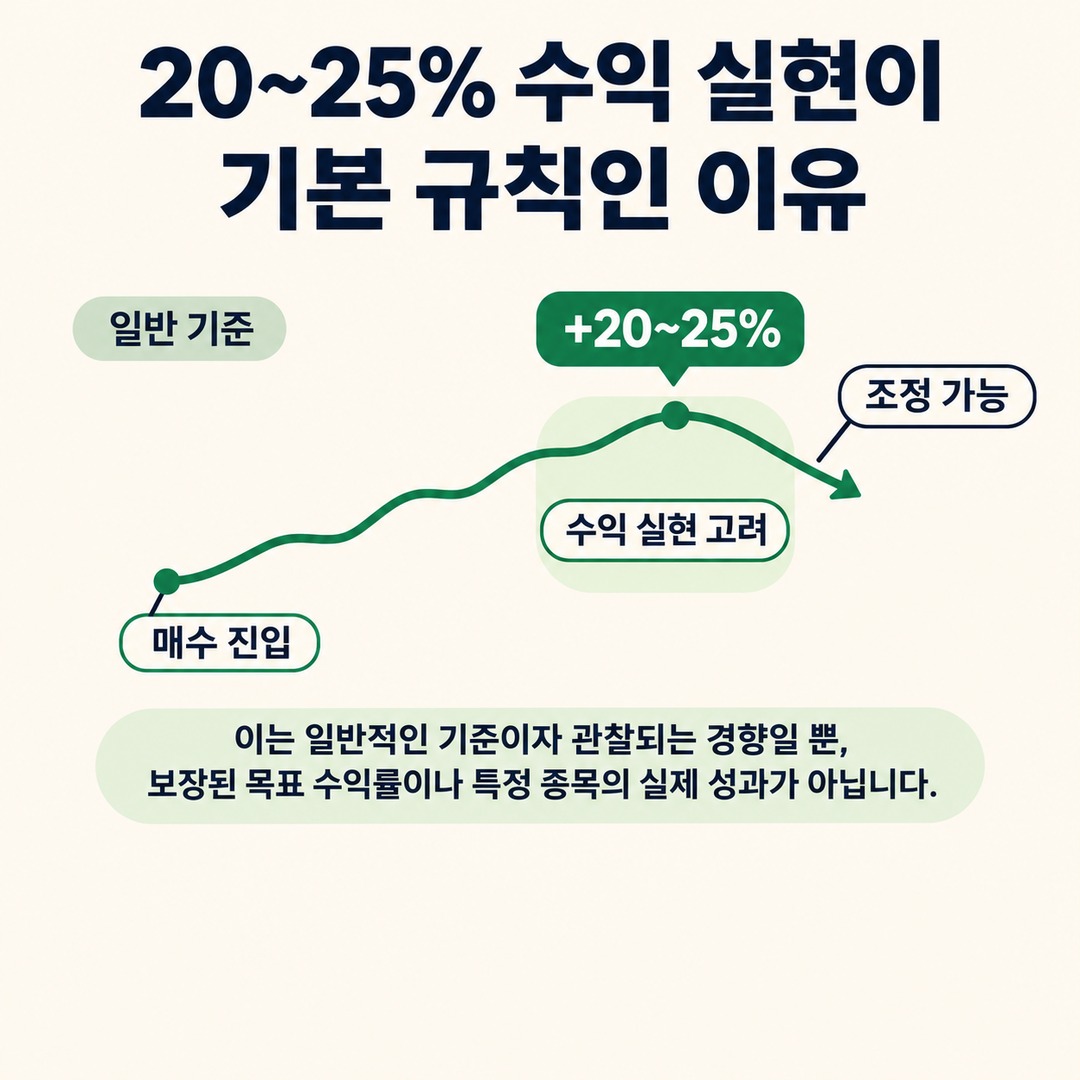
In an article by William O'Neil himself published in January 2004 AAII Journal, he also explained that investors should consider taking profits when most stocks rise 20~25% above their purchase price, while making an exception for stocks that meet all of certain specific conditions.
The important point is that 20~25% is not an absolute price target that applies to every stock.
For typical advancing stocks, the emphasis is on securing profits. For industry leaders showing exceptionally strong advances, the holding period may be extended to see whether they can rise further.
Apply the 8-week holding rule only when all three conditions are met
O'Neil's 8-week holding exception does not apply simply because a stock has gained 20%. Based on O'Neil's explanation in 2004-year-old AAII Journal, all three of the following conditions must be met.

| Condition | What to check |
|---|---|
| Market environment | Is the overall market in a strong uptrend? |
| Company quality | Does the company have earnings growth, a strong return on equity (ROE), institutional investor participation, and a leading position in its industry? |
| Pace of the advance | After breaking out of a proper base, did the stock gain 20% on good volume within 1~3 weeks? |
When all three conditions are met, O'Neil's exception rule is to hold for at least 8 weeks from the breakout buy point.
The key point is not to judge by the third condition alone. Even if a stock gains 20% in a short period, there may not be enough basis to automatically apply the 8-week holding exception if the market is weak or the company's growth and institutional demand do not support the move.
The official MarketSmith page introducing William O'Neil's investing principles also distinguishes between the general 20~25% profit-taking guideline and the exception for stocks with strong institutional demand that gain 20% in 1~3 weeks.
Which stocks fall under which rule in practice?
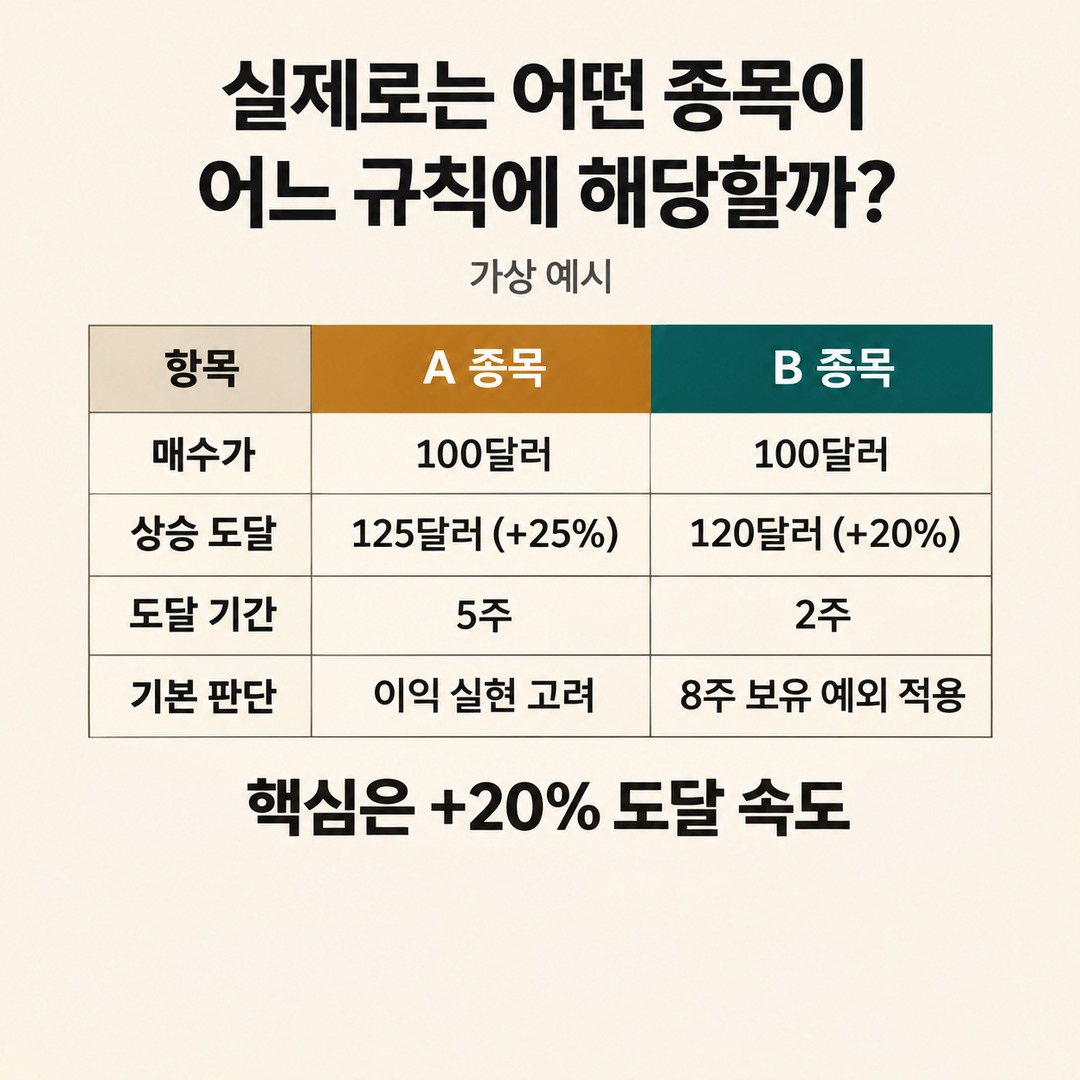
Suppose two stocks have both risen at least 20% above their purchase prices. The difference lies not in the return itself, but in how quickly each stock reached that gain and in the quality of the stock.
This is a hypothetical example, not a historical profit example involving an actual stock.
| Category | Stock A | Stock B |
|---|---|---|
| Breakout buy price | USD 100 | USD 100 |
| Price reached after the advance | USD 125 | USD 120 |
| Gain | +25% | +20% |
| Time to reach that gain | 5 weeks | 2 weeks |
| Market conditions | Bull market status unclear | Strong bull market |
| Company criteria | Whether it is an industry leader is unclear | Assumed to meet the criteria for a leading growth stock |
| General assessment | Consider taking profits | Apply the 8-week holding exception |
Stock A gained 25% in 5 weeks. Its return is higher, but it does not meet the condition of gaining 20% within 1~3 weeks.
Therefore, the general 20~25% profit-taking rule should be considered first.
Stock B gained 20% in 2 weeks, and we assume that the strong market, company quality, and institutional demand have also been confirmed. In this case, the 8-week holding rule may apply.
The key point in this comparison is not whether the stock rose by 25%, but how quickly it achieved a 20% gain. That is the starting point for considering whether the exception applies.
When does the 8-week period start, and what should you assess when it ends?
The 8-week period does not begin anew on the day the stock reaches a 20% gain. O'Neil described a rule of holding for at least 8 weeks from a proper breakout buy point.

So, distinguish between these two points in time:
Breakout buy point: the starting point for the 8-week holding period
The point when the stock reaches a 20% gain: when to check whether the exception applies
For example, if the stock gains 20% within 2 weeks of the breakout, you do not start waiting for another 8 weeks from that day.
The rule does not mean you must sell as soon as 8 weeks have passed. O'Neil explained that investors should look for other sell signals to assess the stock's potential for further gains after that point.
Examples include:
A climactic advance in which the stock rises too steeply
A price-to-earnings ratio (P/E) that becomes excessive relative to the stock's rise
A break above the upper boundary of a long-term rising channel
Weakening relative strength
Weakness among major industry leaders in the same sector
In O'Neil's AAII article published in 2004, he explained that sell decisions after 8 weeks should take into account factors such as climactic tops, relative strength, and industry trends.
In other words, holding for 8 weeks is not an unconditional declaration of long-term investment. It is closer to a minimum holding rule intended to avoid cutting short the early advance of a strong stock.
The loss limit rule to keep in mind when making trading decisions
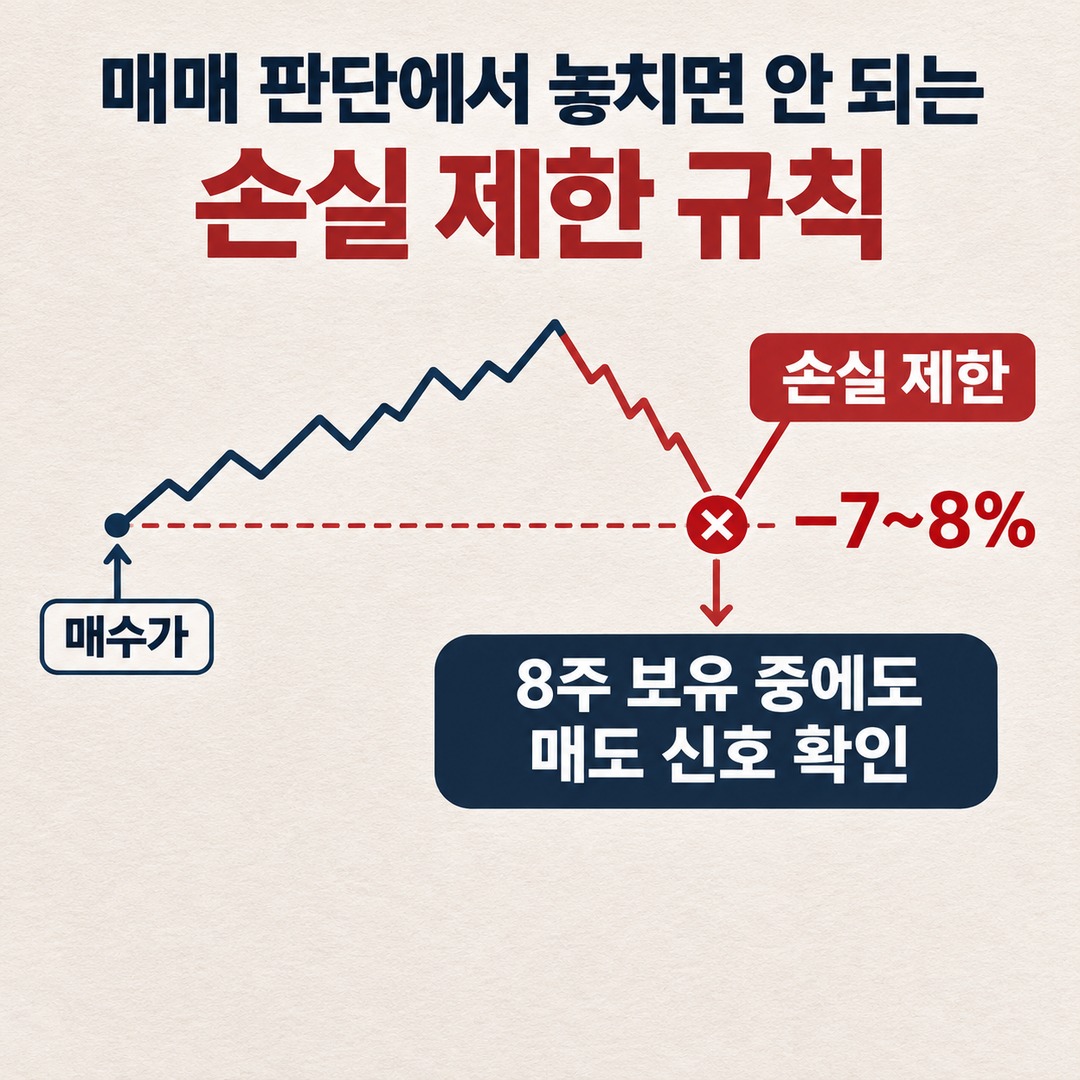
Applying the 8-week holding rule does not eliminate the need to manage losses.
In his AAII article, O'Neil also set out a loss limit of 7~8% below the purchase price. MarketSmith's official investing principles likewise describe a rule for limiting losses when a stock falls 7~8% below the purchase price.
So do not focus only on the 8-week period and ignore changes in price and volume.
In particular, distinguish between these situations:
1. Stocks that do not meet the 20% gain condition: Consider the general profit-taking rule first.
2. Stocks that reach 20% quickly but lack company quality: Do not apply the 8-week exception mechanically.
3. Leading stocks that meet all three conditions: Consider holding for 8 weeks while continuing to watch for other sell signals.

4. Stocks with a loss-limit breach or a major sell signal: Do not ignore warning signs just because of the holding period.
A practical decision sequence to use before selling
Reviewing an actual chart in the following order can help reduce the chance of confusing the two rules.
First, identify the reference purchase price.
Calculate the return from the buy point at a breakout from a proper base, rather than from an ordinary recent trading price.
Second, check how long it took to reach a 20% gain.
Check whether the stock gained 20% within 1~3 weeks. Do not treat a 20~25% gain achieved after 4~5 weeks as the same exception.
Third, assess the market and the company's quality.
Consider the market's uptrend, sales and earnings growth, ROE, institutional investor participation, and whether the company leads its industry.
Fourth, check the volume.
Check whether volume supported the breakout and subsequent advance. Distinguish these stocks from those whose price surged on its own.
Fifth, check for sell signals after 8 weeks.
Check relative strength, industry trends, and whether the advance has become climactic, then decide whether there is still a basis for holding.
How to distinguish the two rules
| Question | Assessment |
|---|---|
| What if the stock gained 25% in 5 weeks? | Consider taking profits under the general rule |
| What if the stock gained 20% in 2 weeks? | Check whether it also meets the other two conditions |
| What if the bull-market and industry-leader conditions are also met? | Apply the 8-week holding exception |
| Should you automatically sell once 8 weeks have passed? | No; reassess for additional sell signals |
| Should you hold just because the gain is 20%? | No; check the market, company, and volume conditions |
Ultimately, O'Neil's selling rules are not based on return alone.
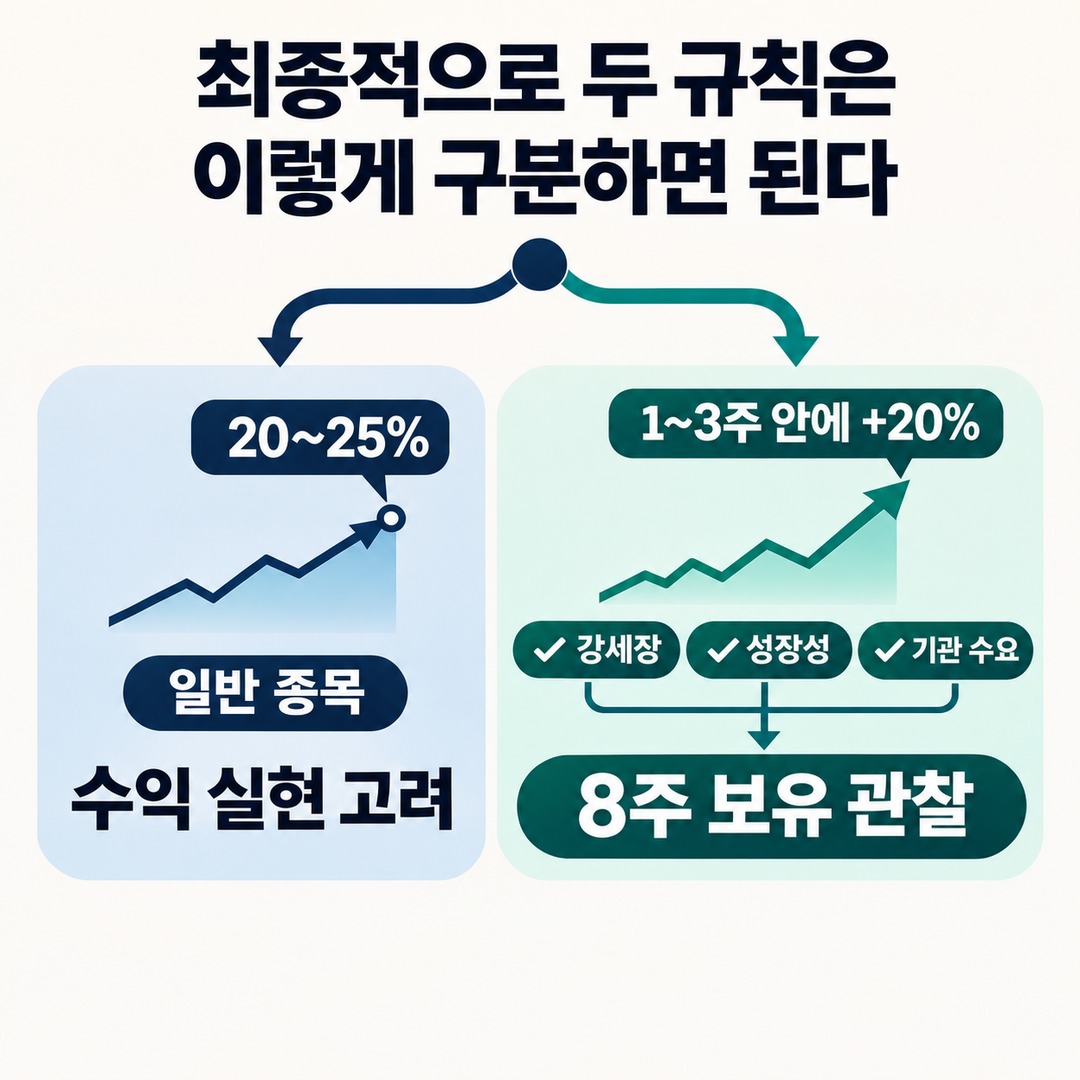
For typical stocks, secure profits at 20~25%. If a leading stock with outstanding growth and institutional demand is advancing in a strong market and gains 20% within 1~3 weeks just after breaking out, watch for the potential for further gains during 8 weeks.
That is the key distinction between the two rules.
※ This article is for informational purposes to help readers understand market trends. It is not a recommendation to invest in any particular stock or asset. You are responsible for your own decisions and investments.
This post contains Coupang Partners affiliate links. We may earn a commission from qualifying purchases.