

KRW/USD Exchange Rate Falls to the KRW 1,300 Range for the First Time in 11 Months: Can It Stabilize After Reaching the KRW 1,380 Range?
이 포스팅은 쿠팡 파트너스 활동의 일환으로, 이에 따른 일정액의 수수료를 제공받습니다.
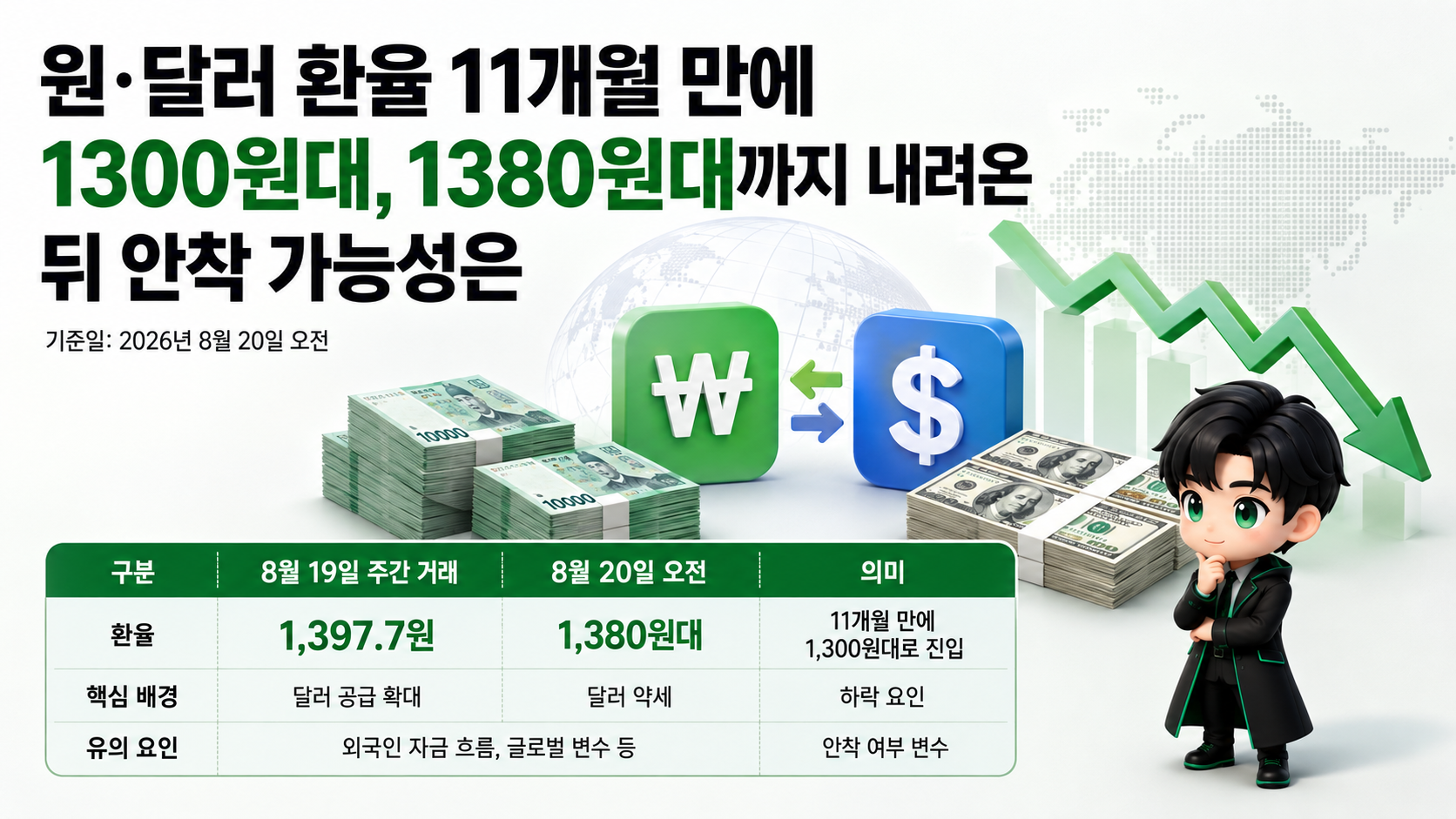
The KRW/USD exchange rate ended 2026-08-19 daytime trading at KRW 1,397.7, falling into the KRW 1,300 range for the first time in approximately 11 months. The following morning, August 20, it declined further into the KRW 1,380 range. However, entering the KRW 1,300 range is not the same as remaining there over the long term. Recent dollar supply and a weaker US dollar have supported the downward trend, but the exchange rate could also climb back into the KRW 1,400 range depending on foreign capital flows, US inflation, international oil prices, and movements in the Japanese yen.
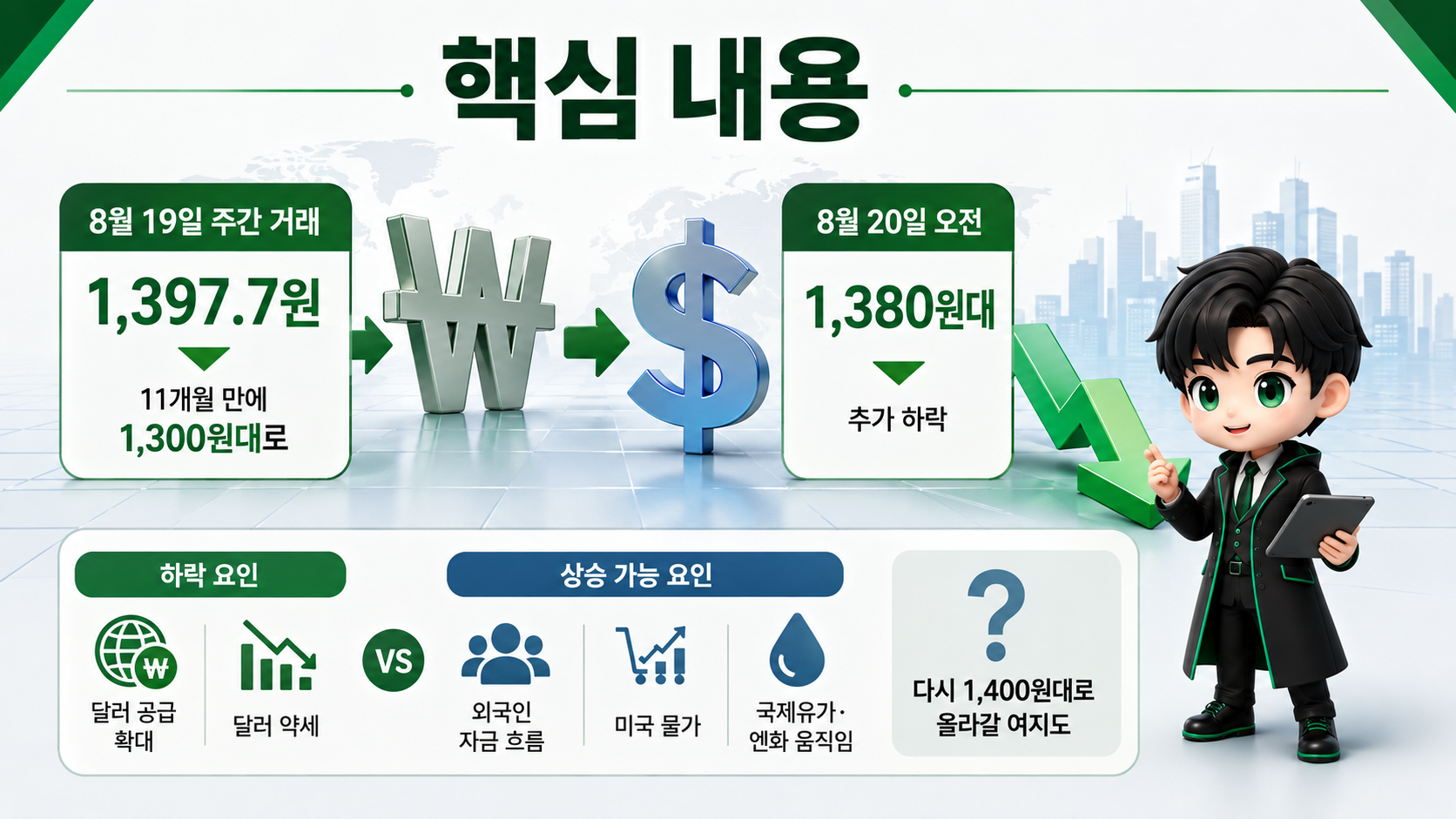
The information was verified as of 2026-08-20 at 11:29 a.m. Korea Standard Time.
When Exactly Did the Exchange Rate Enter the KRW 1,300 Range?
Based on the closing rate for daytime trading, August 19 marked the turning point. The KRW/USD exchange rate ended trading on 19 at KRW 1,397.7, down KRW 14.1 from the previous trading session. As of 3:30 p.m., this was its lowest level since September 24 KRW 1,397.5 last year.
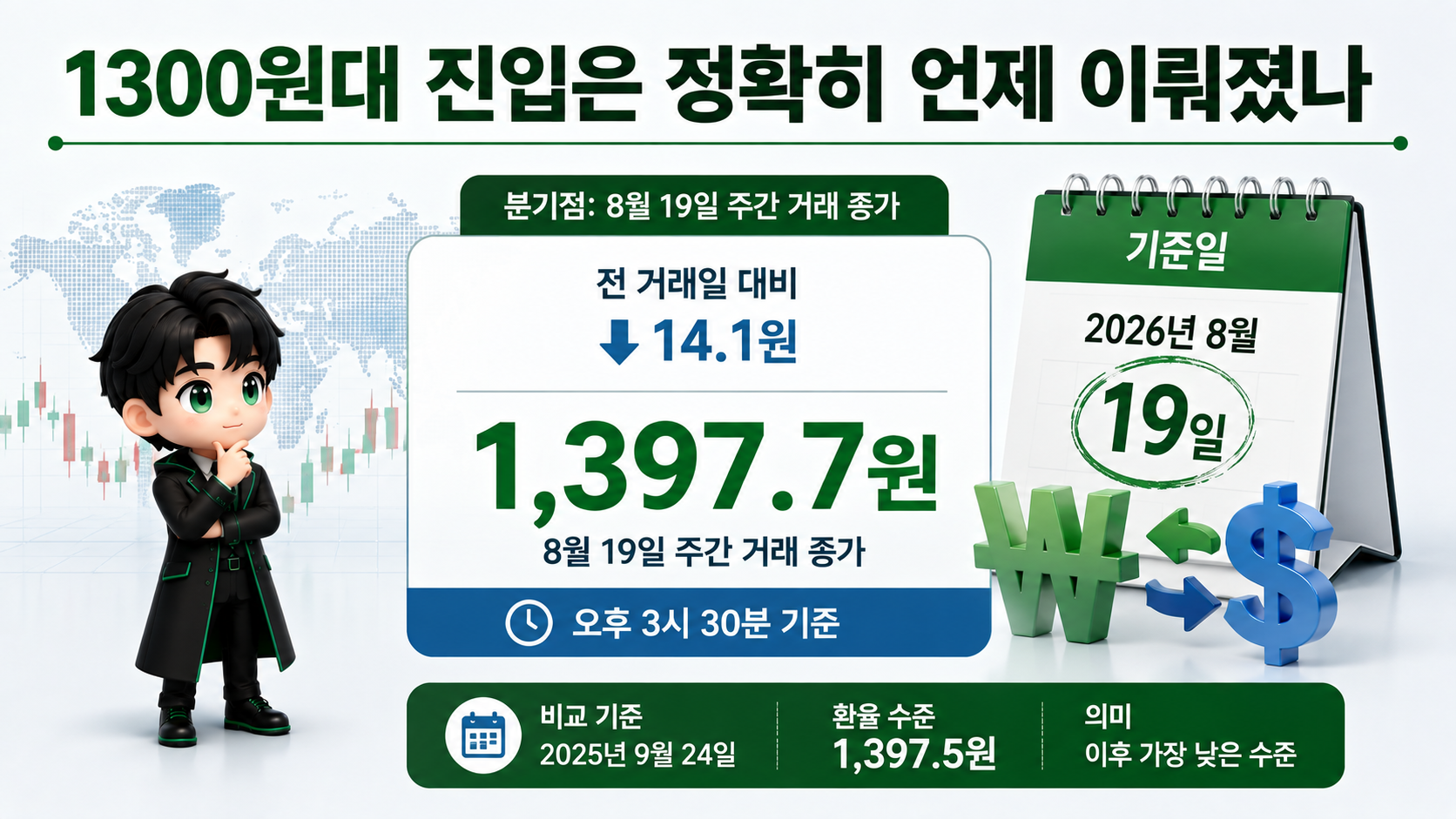
Looking specifically at the break below the KRW 1,400 threshold, it was the first such move in approximately 10 and a half months since October 2 last year. The intraday low reached KRW 1,396.0.
The decline continued into the morning of 20. The KRW/USD exchange rate opened at KRW 1,387.0 before falling to the KRW 1,384 level during intraday trading. Among the lows recorded since the previous day, KRW 1,385.2 represented the lowest level in approximately 11 months, since September 18 last year.
This was different from briefly entering the KRW 1,399 range and immediately rebounding. Daytime trading on 19 closed in the KRW 1,300 range, and the rate fell another step into the KRW 1,380 range on the morning of 20.
The movement becomes even clearer when compared with the recent peak. The intraday high on July 1 was KRW 1,559.2. Compared with KRW 1,385.2 recorded on August 20, the rate was KRW 174.0 lower. According to the author's calculation, this represents a decline of approximately 11.2%.
The calculation is `(KRW 1,559.2 - KRW 1,385.2) ÷ KRW 1,559.2 × 100`.
Why the Exchange Rate Fell Rapidly in Just Over a Month
The most directly observable factors behind the recent decline are dollar sales by exporters in the foreign exchange market and weakness in the US dollar itself. In particular, market analysts suggest that exporters, whose dollar sales previously tended to be concentrated at month-end, have recently been selling dollars more consistently throughout the month.
Put simply, when exporters convert dollars earned overseas into Korean won, they sell dollars and buy won in the foreign exchange market. If dollar selling increases without a corresponding rise in dollar buying demand, downward pressure can develop on the KRW/USD exchange rate.
The US dollar also showed signs of weakness. On the morning of August 20, the US Dollar Index, which measures the dollar's value against currencies from 6 major economies, fell to the 98 level. In other words, the conditions pushing the exchange rate lower were not limited to movements in the Korean won; weakness on the dollar side also contributed.
South Korea's interest rate environment has also changed compared with a month earlier. On July 16, the Bank of Korea's Monetary Policy Board raised the benchmark interest rate from 2.50% to 2.75%, an increase of 0.25% percentage points. The central bank said at the time that it had made the decision after considering economic growth, inflation, and financial stability conditions together.
However, it would be inaccurate to attribute the recent exchange rate decline to a single factor. Dollar supply, global dollar movements, expectations for US monetary policy, foreign capital flows, and the Japanese yen are all influencing the market simultaneously.
Can the Exchange Rate Remain in the KRW 1,300 Range?
Some forecasts suggest that the exchange rate could remain in the KRW 1,300 range, but it is too early to conclude that it has stabilized there. The move below KRW 1,400 and subsequent decline into the KRW 1,380 range signal that the downward trend is continuing. Nevertheless, market experts disagree on whether the KRW 1,300 range can be sustained.
Market forecasts released on August 9 included the view that stabilization in the KRW 1,300 range would be possible if the US Federal Reserve maintained interest rates and international oil prices remained stable. Conversely, other analysts warned that the Korean won could weaken again if dollar demand from overseas stock investments increased, foreign capital flowed out, or the Japanese yen resumed its decline.
Forecasts for this week also covered a relatively wide range. As of August 18, iM Securities projected a weekly KRW/USD exchange rate range of 1,380–KRW 1,430. This range includes both the KRW 1,300 and KRW 1,400 levels.
After the exchange rate fell to KRW 1,397.7 on 19, some analysts also raised the possibility of further declines. Certain market experts suggested that the rate could test lower levels within the KRW 1,380 range. Others argued that, given the dollar supply conditions among exporters, the possibility of a move toward the middle of the KRW 1,300 range should also be considered. On the other hand, forecasts warned that the exchange rate could rebound if factors supporting dollar strength, such as US inflation and international oil prices, came back into focus.
Therefore, the most accurate description of the current situation is that 'the exchange rate has successfully entered the KRW 1,300 range and declined further into the KRW 1,380 range, but whether it can remain there over the long term is still being tested.'
What Should Investors Watch for a Rebound into the KRW 1,400 Range?
From this point forward, the key question is not simply whether the exchange rate remains below KRW 1,400, but which factors could reverse the current dominance of dollar selling.
First, foreign investors' capital flows into and out of South Korean stocks deserve attention. On 19, foreign investors recorded net sales totaling 3 trillion and 5 hundred billion won in South Korea's main stock market. Currency conversion demand associated with earlier foreign stock purchases was considered a factor pushing the exchange rate lower. However, if capital flows consistently reverse direction, the balance of supply and demand in the foreign exchange market could also change.
On the US side, inflation and expectations for Federal Reserve policy remain important variables. Market participants have linked the recent weakness in the dollar to diminished expectations of Fed interest rate increases. If inflation strengthens again and changes monetary policy expectations, the dollar's direction could also shift.
International oil prices are another variable worth monitoring. Some recent forecasts suggest that a renewed sharp rise in oil prices could strengthen the US dollar.
The USD/JPY exchange rate is also difficult to ignore. Recent foreign exchange market activity has shown a relationship between movements in the yen and the Korean won. Whether the yen weakens sharply again is therefore considered one of the factors that could help determine the direction of the KRW/USD exchange rate.
Ultimately, rather than focusing exclusively on the KRW 1,400 threshold, it is more useful to examine whether changes in exporters' dollar sales → foreign capital flows → the US Dollar Index → US interest rate expectations → the Japanese yen and international oil prices continue to support the current direction.
How Should People Exchanging Currency or Holding Dollars Respond Now?
It would be risky to assume that the exchange rate will continue falling simply because it has entered the KRW 1,300 range. The exchange rate has experienced exceptionally large fluctuations this year.
From the beginning of the year through the end of July, the average monthly fluctuation in the KRW/USD exchange rate was KRW 47.0, the largest since 2009. The average daily fluctuation through August 7 was also KRW 8.2, the largest since 2009.
In fact, the exchange rate exceeded the KRW 1,550 range in early July before falling into the KRW 1,380 range just over a month later. More important than correctly predicting its direction is recognizing that the rate can move by dozens of won or more within a short period.
For people who need dollars for overseas travel, studying abroad, or international remittances, a practical approach is to monitor exchange rate movements according to when the funds will be needed, rather than trying to identify the absolute bottom and exchanging the entire amount at once.
Investments in dollar-denominated assets should not be decided solely on the direction of the exchange rate. Even if the price of a dollar-denominated asset rises, a decline in the exchange rate can reduce returns when converted into Korean won. The opposite situation is also possible.
Particularly during periods of sharp exchange rate movements, it is difficult to make a definitive one-way prediction based on assumptions such as 'it has entered the KRW 1,300 range, so it will fall further' or 'it has already fallen significantly, so it will rebound immediately.'
The Next Indicators for Determining Whether the KRW 1,300 Range Will Hold
The first confirmed development is that the break below the KRW 1,400 threshold was not merely a one-day intraday movement. After daytime trading closed at KRW 1,397.7 on 19, the exchange rate fell further into the KRW 1,380 range on the morning of 20.
The next step is to check whether the downward trend continues around KRW 1,380 or whether the exchange rate climbs back above KRW 1,400. This week's projected trading range of 1,380–KRW 1,430 is also broad, indicating that several uncertainties remain before the short-term direction can be determined.
Over the medium to long term, the structure of foreign exchange supply and demand must also be considered. According to Bank of Korea research, increased overseas investment can push the KRW/USD exchange rate upward, while the repatriation of investment income earned overseas can put downward pressure on the rate. However, the research also noted that an increase in investment income does not necessarily translate directly into exchange rate stability.
Therefore, as of 2026-08-20, the KRW/USD exchange rate has not only entered the KRW 1,300 range but has also fallen into the KRW 1,380 range. Nevertheless, there is still insufficient evidence to conclude that the KRW 1,300 range has become its new established trading range. In the short term, dollar selling pressure and global dollar weakness are supporting the decline. On the other side, potential rebound factors remain, including foreign capital movements, US inflation, international oil prices, and the Japanese yen.
※ This article is provided for informational purposes to help readers understand market trends and does not constitute investment advice or a recommendation to buy or sell any particular security or asset. All final investment decisions and associated responsibilities rest with the individual.
이 포스팅은 쿠팡 파트너스 활동의 일환으로, 이에 따른 일정액의 수수료를 제공받습니다.