

Foreign Investors Net Buy 1.7 Trillion, KOSPI Closes at 6852.58…Why It Recovered 95% of the Previous Day's Loss
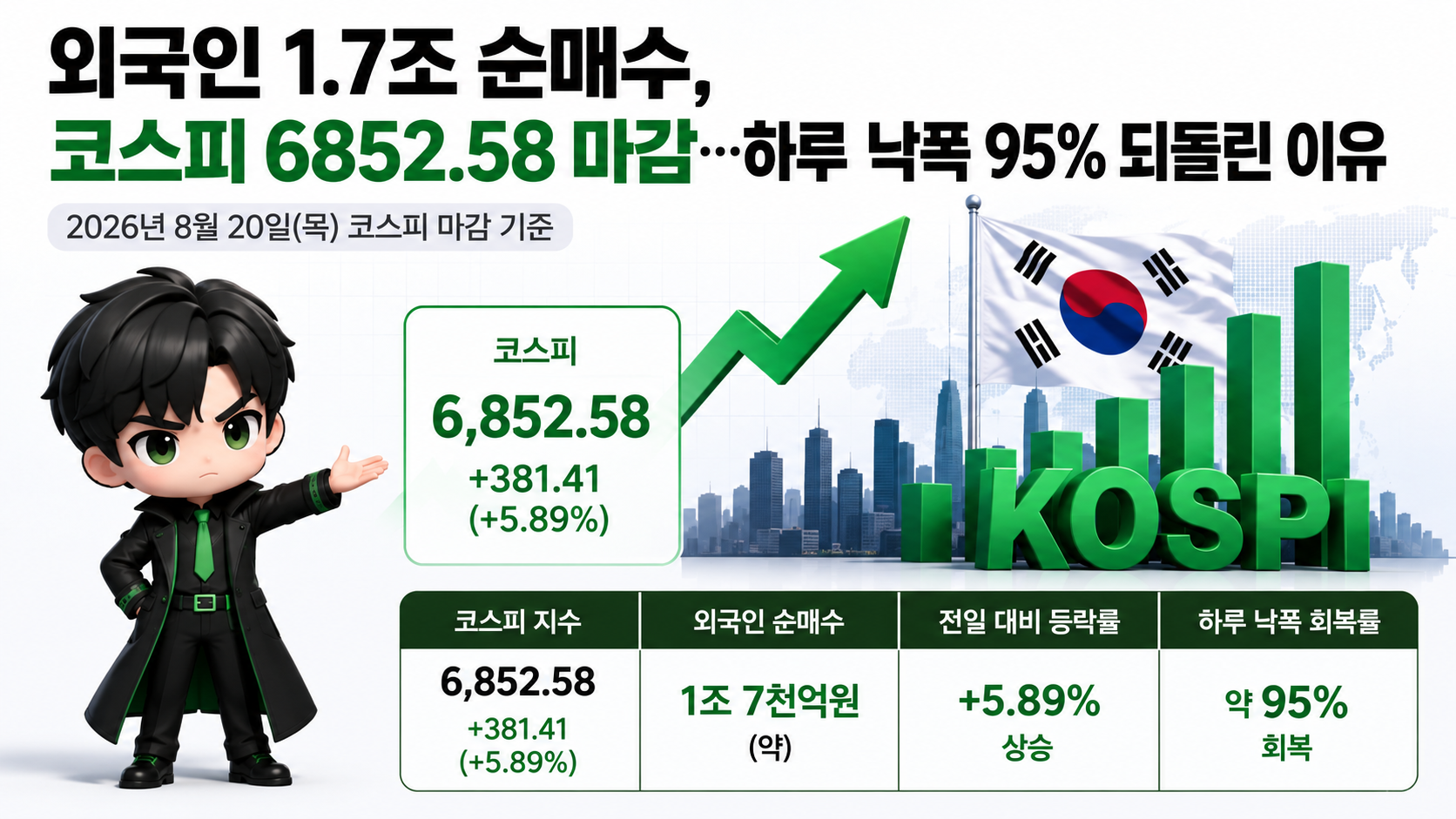
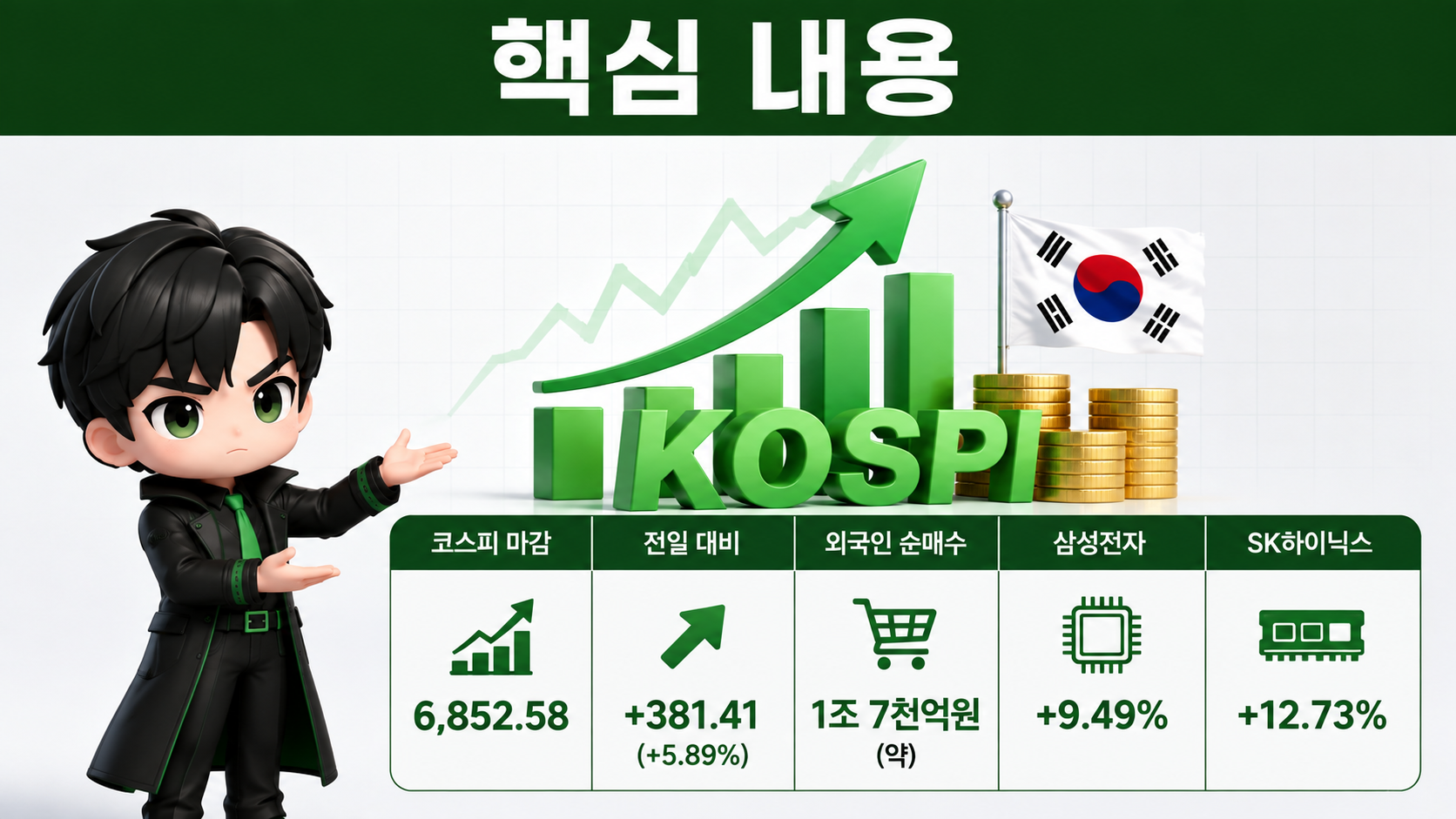
On 2026-08-20, the KOSPI closed at 6,852.58, up 381.41 points, or 5.89%, from the previous trading session. Foreign investors net bought approximately 1 trillion 7 hundred billion won in the main stock market, while Samsung Electronics and SK hynix surged 9.49% and 12.73%, respectively, significantly extending the index's gains.
Another notable development was that the market, which had plunged 5.80% the previous day, climbed back to nearly its previous level in just one session. However, foreign investors were net sellers of KOSPI 200 futures even as they bought large amounts of cash equities. Therefore, it is too early to conclude from this single day's sharp rebound that the overall direction of foreign investment flows has completely reversed.
The information was verified as of 2026-08-20 at 5:44 p.m. Korea Standard Time.
How Much Did the KOSPI Actually Rebound?
The KOSPI opened at 6,680.34 that day. It began trading 209.17 points, or 3.23%, above the previous session's closing level of 6,471.17, then extended its gains to reach an intraday high of 6,904.55.
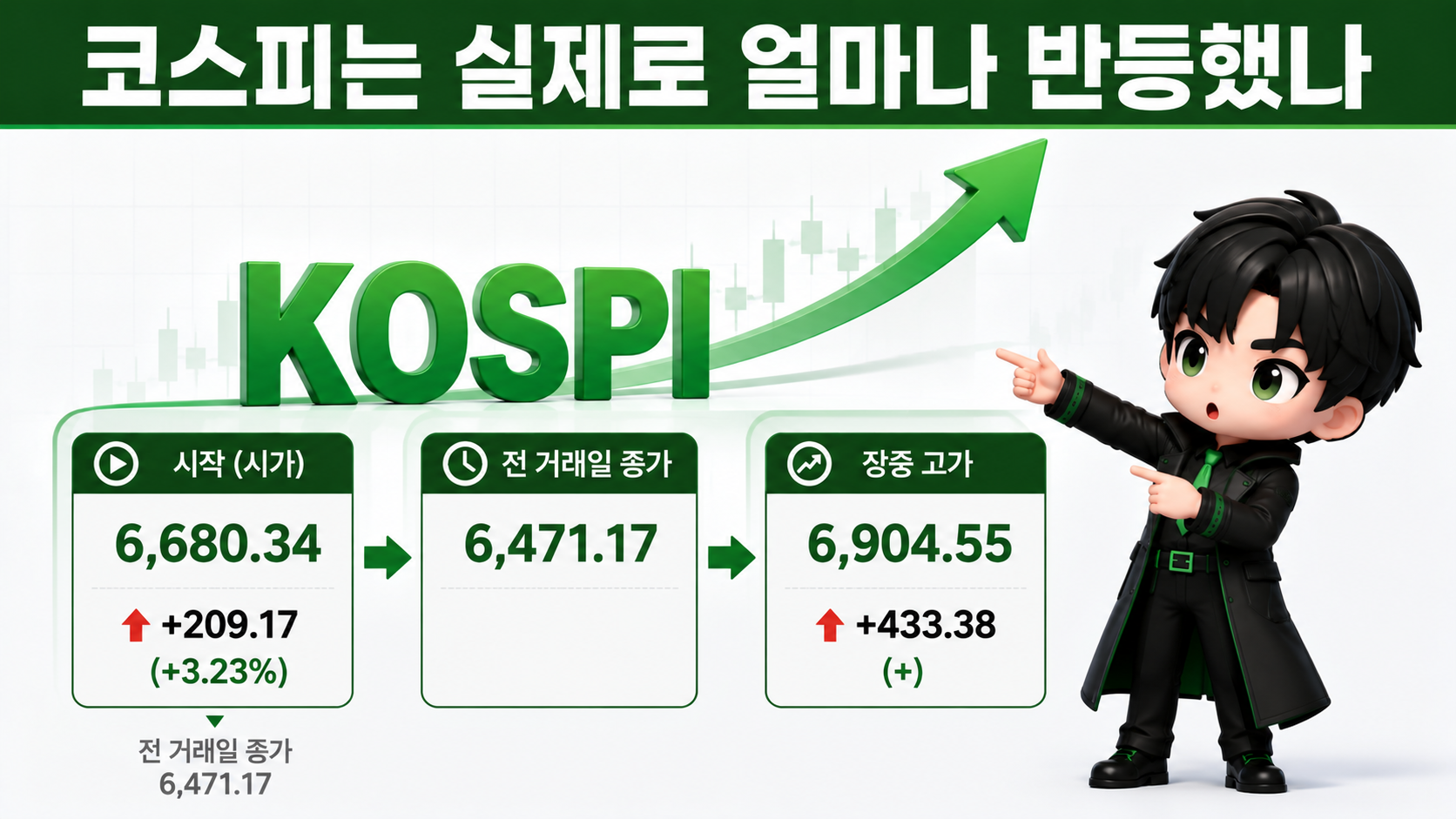
Although the closing level of 6,852.58 was below the intraday high, the index still gained 381.41 points from the previous session.
The scale of the rebound becomes clearer when compared with the preceding day's performance. On August 19, the KOSPI fell 398.66 points to close at 6,471.17. Working backward from those figures, the closing level on August 18 was 6,869.83.
Author's calculation
Decline on August 19: 398.66 points
Gain on August 20: 381.41 points
Recovery rate of the previous day's decline: 381.41 ÷ 398.66 × 100
Result: Approximately 95.7%
In other words, measured purely in index points, the KOSPI recovered approximately 95.7% of the previous day's losses in a single session.
However, compared with the August 18 closing level of 6,869.83, the August 20 closing level of 6,852.58 was still 17.25 points lower. In percentage terms, it remained approximately 0.25% below that level. The selloff was not completely erased, but a substantial portion had been recovered by the close.
At its intraday high of 6,904.55, the index surpassed the August 18 closing level. It subsequently gave back some of its gains and finished in the 6,850 range.
Why Should Foreign Investors' Purchases Be Described as '1.7 Trillion in Net Buying'?
The most significant change in trading flows behind the KOSPI's rebound on August 20 was foreign investors' net buying of cash equities. Figures compiled immediately after the market closed showed that foreign investors' net purchases on the main stock market totaled approximately 1 trillion 7 hundred billion won.
However, the detailed figures differed among reports released immediately after the close. One tally showed KRW 1,707,900,000,000, while another reported KRW 1,722,800,000,000. Because the figures do not match exactly, it is more appropriate to use the commonly supported description of 'approximately KRW 1,700,000,000,000.0 in net buying'.
Retail and institutional investors moved in the opposite direction. According to the confirmed closing figures, retail investors net sold approximately KRW 2,270,000,000,000, while institutional investors net sold approximately KRW 490,000,000,000.
Looking solely at the cash equity market, foreign investors absorbed a substantial portion of the shares sold by retail and institutional investors.
That does not mean all foreign investor transactions were on the buying side. On the same day, foreign investors were net sellers of approximately KRW 1,870,000,000,000 in KOSPI 200 futures.
Therefore, foreign investors' KRW 1,700,000,000,000.0 in net cash equity purchases alone is insufficient to conclude that their overall investment flows have decisively shifted toward buying. The divergence between cash equities and futures must also be considered.
How Much Did Samsung Electronics and SK hynix Lift the Index?
The gains in major semiconductor stocks far exceeded the broader market average. Samsung Electronics closed at KRW 271,000, up 9.49%, while SK hynix finished at KRW 1,691,000, up 12.73%.
Considering that the KOSPI rose 5.89% on the same day, both stocks substantially outperformed the overall market.
Sector performance also varied considerably. Electrical and electronics rose 9.19%, manufacturing gained 7.10%, and securities advanced 4.46%. In contrast, transportation and warehousing fell 1.57%, telecommunications declined 1.12%, and construction dropped 1.08%.
Among all KOSPI-listed stocks, 521 advanced, 338 declined, and 46 finished unchanged.
The KOSPI's 5.89% increase did not mean that every stock rose by a similar amount. Major semiconductor shares posted exceptionally strong gains, while some sectors actually declined. As a result, the index's percentage change could differ substantially from the returns experienced by investors holding individual stocks.
What Has Been Confirmed About SK hynix's KRW 40,000,000,000,000 Share Buyback Plan?
The SK hynix announcement that investors responded to during this session was more than market speculation. The company stated that its board of directors had approved a plan on August 19 to newly acquire and cancel treasury shares worth approximately KRW 40,000,000,000,000.
The planned acquisition covers 2,407 ten-thousand shares, representing approximately 3.3% of total issued shares. The calculation was based on the August 18 closing price of KRW 1,662,000, the day before the board resolution. The proposed acquisition period runs from August 20 to November 19.
An important distinction is that KRW 40,000,000,000,000 does not mean the company will necessarily purchase 2,407 ten-thousand shares at a fixed price. Because the planned number of shares was calculated using the August 18 closing price, the company indicated that the actual number acquired could change depending on future share prices.
SK hynix also announced plans to cancel all treasury shares acquired under the program.
The company additionally outlined an expansion of its shareholder return policy. It plans to allocate at least 50% of cumulative free cash flow (FCF) from 2025 through 2027 to treasury share purchases and cancellations, cash dividends, and other shareholder returns. FCF refers to cash remaining from business operations after funds required for investments and other needs have been deducted.
By contrast, as of the market close on August 20, expectations of a new large-scale shareholder return policy from Samsung Electronics could not be treated as a confirmed announcement comparable to SK hynix's. Analysts suggested that such expectations had influenced trading that day, but market expectations must be distinguished from officially confirmed disclosures.
Why Did the Market Move So Sharply Just One Day After the Selloff?
Market commentary confirmed that two developments contributed to the rebound. One was the large-scale shareholder return plan announced by SK hynix. The other was an easing of US long-term Treasury yields, which had previously weighed on the market.
On August 19, rising US long-term Treasury yields put pressure on South Korean stocks, sending the KOSPI down 5.80%. The following day, US Treasury yields had stabilized compared with the previous session, while SK hynix's shareholder return announcement provided additional support. Major semiconductor stocks, particularly Samsung Electronics and SK hynix, rebounded strongly.
However, attributing the entire rally to a single catalyst would be misleading. Semiconductor stock gains, foreign buying of cash equities, and changes in US Treasury yields all occurred during the same trading session.
The sharp intraday rally also triggered a buy-side sidecar trading curb. A sidecar is a market stabilization mechanism that temporarily suspends the effectiveness of program trading orders when futures prices move beyond a specified threshold.
A sell-side sidecar had been triggered during the market plunge on August 19, followed by a buy-side sidecar in the opposite direction on 20, just one day later. This reflected exceptionally high volatility, with the market's direction changing sharply across two consecutive sessions.
What Should Investors Watch After the Recovery Above 6850?
Based on the August 20 closing level, the KOSPI recovered most of the previous day's losses. However, whether the rebound can be sustained matters more than the single-day gain itself.
First, 6,869.83 deserves attention. This was the August 18 closing level calculated by the author. The August 20 closing level of 6,852.58 remained 17.25 points below it. Although the index surpassed that level intraday, it failed to reclaim it on a closing basis.
Next are foreign investment flows. Foreign investors net bought approximately KRW 1,700,000,000,000.0 in KOSPI cash equities that day, but were net sellers of approximately KRW 1,870,000,000,000.00 in KOSPI 200 futures. In subsequent sessions, it will be important to assess separately whether foreign buying of cash equities continues and whether cash equity and futures positions move back into alignment.
Another point to watch is whether the rally in major semiconductor stocks spreads to other sectors. Although more KOSPI stocks advanced than declined that day, certain sectors, including transportation and warehousing, telecommunications, and construction, still posted losses.
Finally, SK hynix's treasury share acquisition is not a one-day event. The company's planned acquisition period extends through November 19. The actual progress of the buyback and any additional shareholder return measures will need to be monitored through subsequent regulatory disclosures.
The key takeaway from the KOSPI's performance on August 20 is not simply that it 'rose more than 5%.' After plunging 5.80% the previous day, the index recovered approximately 95.7% of that decline in a single session. Foreign investors' net purchases of approximately KRW 1,700,000,000,000.0 in cash equities coincided with sharp gains in Samsung Electronics and SK hynix. At the same time, foreign selling of futures and divergent sector performance remained important factors to consider when assessing the next trading session.
※ This article is provided for informational purposes to help readers understand market developments and does not constitute investment advice or a recommendation to buy any particular stock or asset. Investors are responsible for their own final decisions and investment outcomes.