

SpaceX Rocket Debris to Hit the Moon at August 5 15:34…Danuri Observation Plan
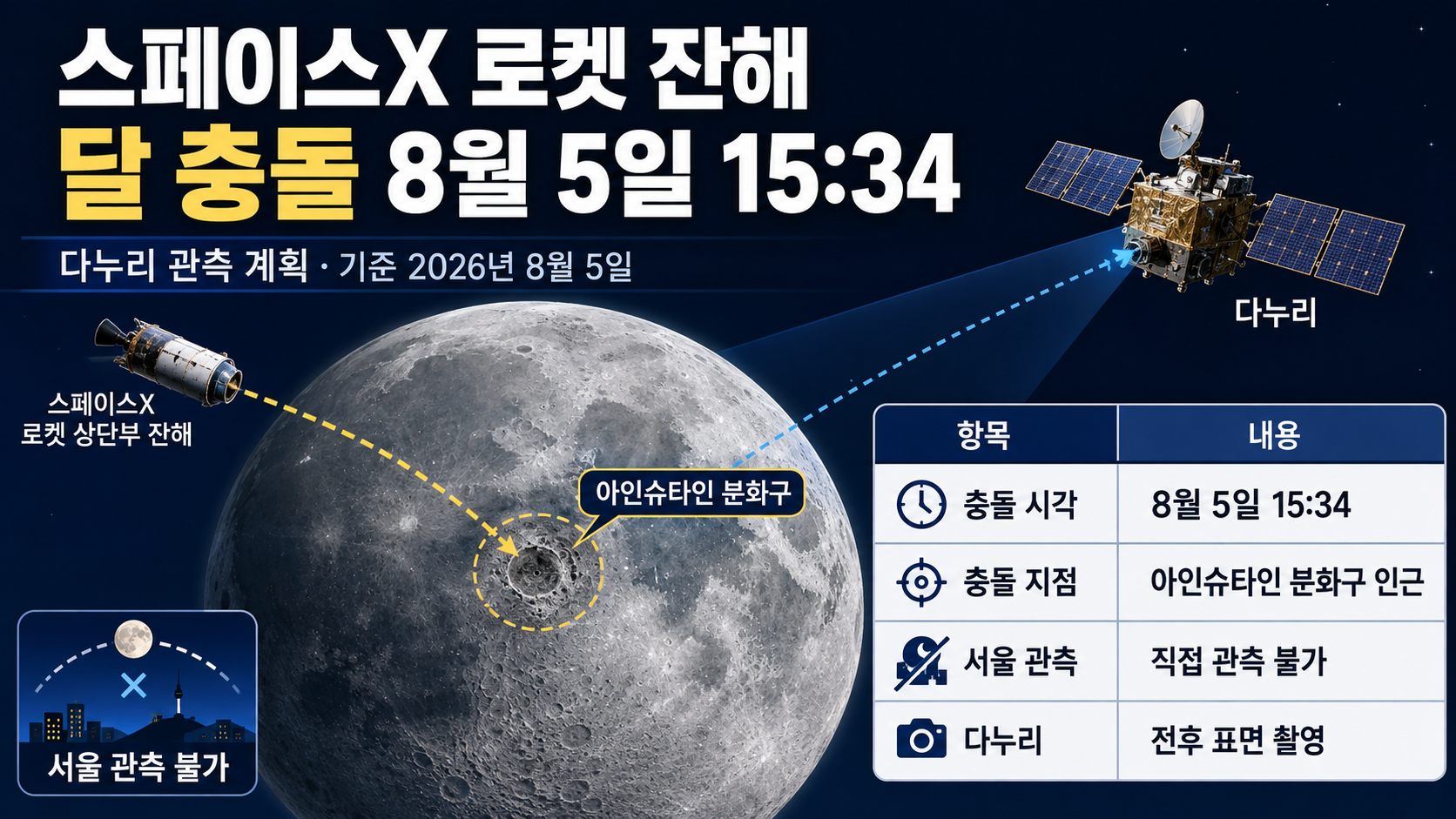
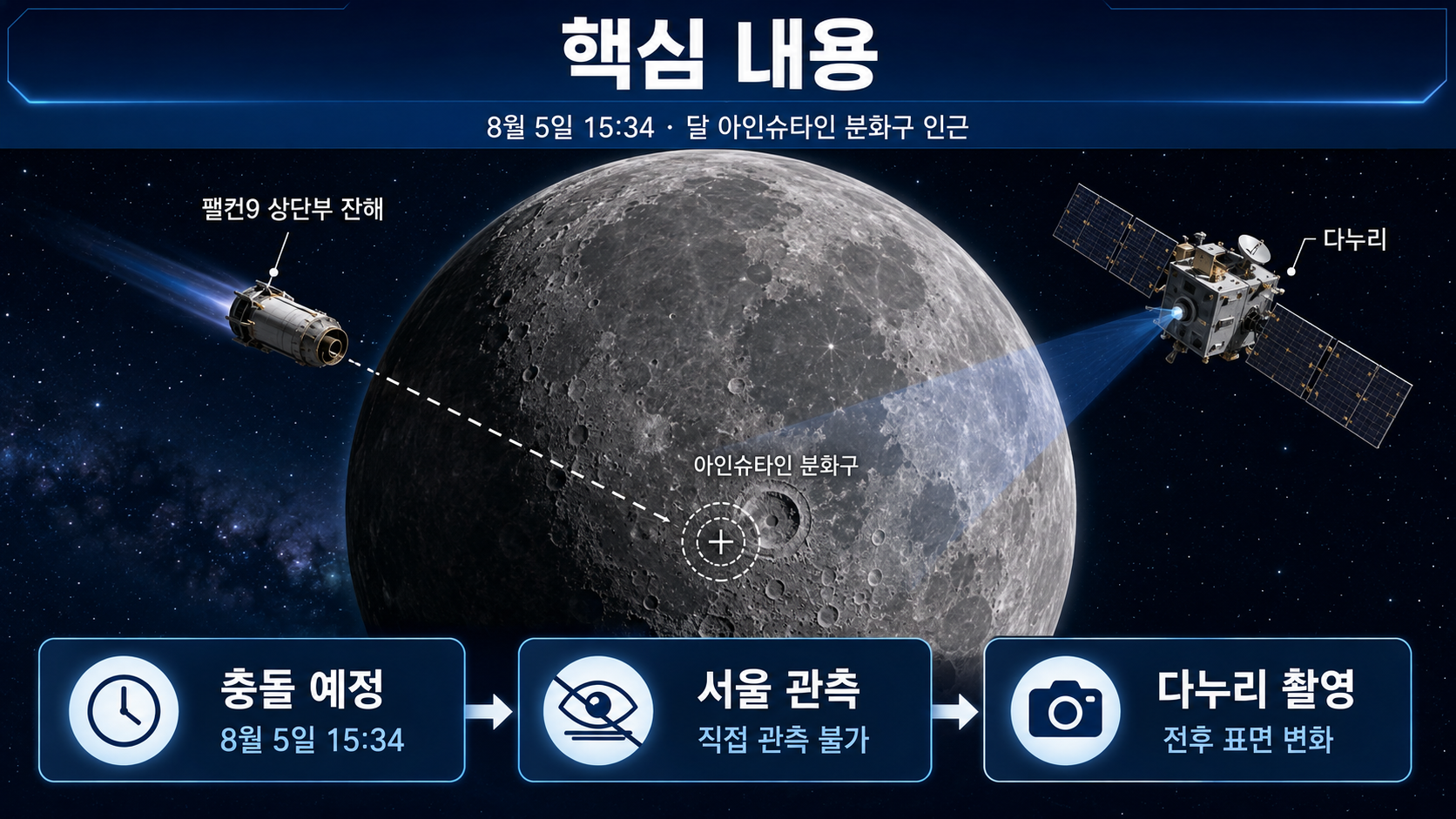
The upper-stage debris from a SpaceX Falcon9 rocket is expected to strike near the Moon's Einstein crater at approximately 2026-08-05, 3:34 p.m. The Moon will be below the horizon in Seoul at that time, making direct observation impossible. South Korea's Danuri lunar orbiter will use high-resolution and polarimetric cameras to capture changes to the lunar surface before and after the impact.
When and Where Will the Rocket Debris Hit the Moon?
The impact time currently announced by the Korea AeroSpace Administration (KASA) is 2026-08-05 at 3:34 p.m., Korea Standard Time. The predicted impact site is near Einstein crater, close to the western edge of the Moon as seen from Earth.
However, the tumbling rocket upper stage is affected by factors including solar radiation pressure. The final impact time and coordinates could be adjusted by several seconds or several kilometers based on additional observations immediately before the collision.
| Category | Currently Confirmed Information |
|---|---|
| Expected impact date | 2026-08-05 |
| Korea Standard Time | Around 3:34 p.m. |
| Coordinated Universal Time | Around 6:34~35 a.m. |
| Impacting object | SpaceX Falcon9 rocket upper stage 2025-010D |
| Expected location | Near Einstein crater on the Moon |
| Coordinates announced by KASA | 19.455° north latitude, 93.594° west longitude |
| Estimated mass | Approximately 4.9 tons |
| Estimated speed | 2.43 km/s |
| Expected impact feature | Crater approximately 20~30 m in diameter |
| Estimated impact energy | Equivalent to approximately 3 tons of TNT |
Converting 2.43 km/s into kilometers per hour gives the following result.
Author's calculation: 2.43 km × 3,600 seconds = 8,748 km/h
The commonly reported speed of 8,700 km/h is a rounded version of this figure.
The impact energy is calculated at approximately 145 hundred million joules. This is not enough to affect the Moon as a whole. Instead, the event is expected to produce a crater and ejecta in the immediate vicinity of the impact site.
Why Do Different Sources Report Different Masses and Crater Sizes?
KASA estimates the rocket upper stage's mass at approximately 4.9 tons and the resulting crater's diameter at 20~30 m. Some international reports cite approximately 4.5 tons, while certain impact simulation studies have used 3.9 tons.
These differences arise from varying estimates of the rocket's remaining mass, the components included in calculations, simulation input conditions, and rounding methods. This article uses 4.9 tons and 20~30 m as its baseline figures, following the official South Korean announcement. Simulation figures are identified separately when discussing the range of possible outcomes.
The actual crater size may vary depending on the impact angle, the rocket's rotational state, and the density and strength of the lunar surface. Comparing predictions with actual results will require follow-up imagery from Danuri and NASA's Lunar Reconnaissance Orbiter.
Why Is the Falcon9 Upper Stage Heading Toward the Moon?
This collision is not a deliberate lunar impact experiment planned by SpaceX. After delivering two lunar landers in 2025-01-15, the Falcon9 upper stage remained in an unstable orbit between Earth and the Moon. Following several close approaches, it entered a trajectory that would eventually lead to a lunar collision.
The spacecraft carried by the Falcon9 were Firefly Aerospace's Blue Ghost lander from the United States and Japanese company ispace's HAKUTO-R Mission 2 Resilience lander.
The rocket upper stage's official tracking designation is 2025-010D. Unlike ordinary space debris remaining in low Earth orbit, this object traveled as far as the Earth-Moon distance. As a result, observations from astronomical telescopes, rather than radar alone, played an important role in calculating its trajectory.
Can People in South Korea Watch the Impact Directly?
From Seoul, the Moon will be below the horizon at the expected impact time, making direct observation impossible. According to astronomical data from the Korea Astronomy and Space Science Institute, the Moon sets in Seoul at 12:13 p.m. on August 5 and rises again at 10:47 p.m.
| Time in Seoul | Moon's Status |
|---|---|
| 12:13 p.m. | Moon sets below the horizon |
| 3:34 p.m. | Expected Falcon9 upper-stage impact |
| 7:37 p.m. | Sunset |
| 10:47 p.m. | Moon rises again |
The expected impact occurs approximately 3 hours and 21 minutes after moonset. Real-time viewing from South Korea using an ordinary telescope or smartphone should therefore be considered impractical.
Even in regions where the Moon is above the horizon, the event will not resemble a bright explosion visible to the naked eye. Three possible phenomena should be distinguished.
1. Impact Flash
The flash is likely to last less than 1 second and may be relatively faint. Because the lunar surface will be illuminated by sunlight, the flash could be obscured by the surrounding brightness.
2. Dust and Debris Ejecta
If some material rises high above the lunar limb, it could become visible against the dark background of space through professional telescopes. However, its brightness and height will depend heavily on the impact angle.
3. Newly Formed Crater
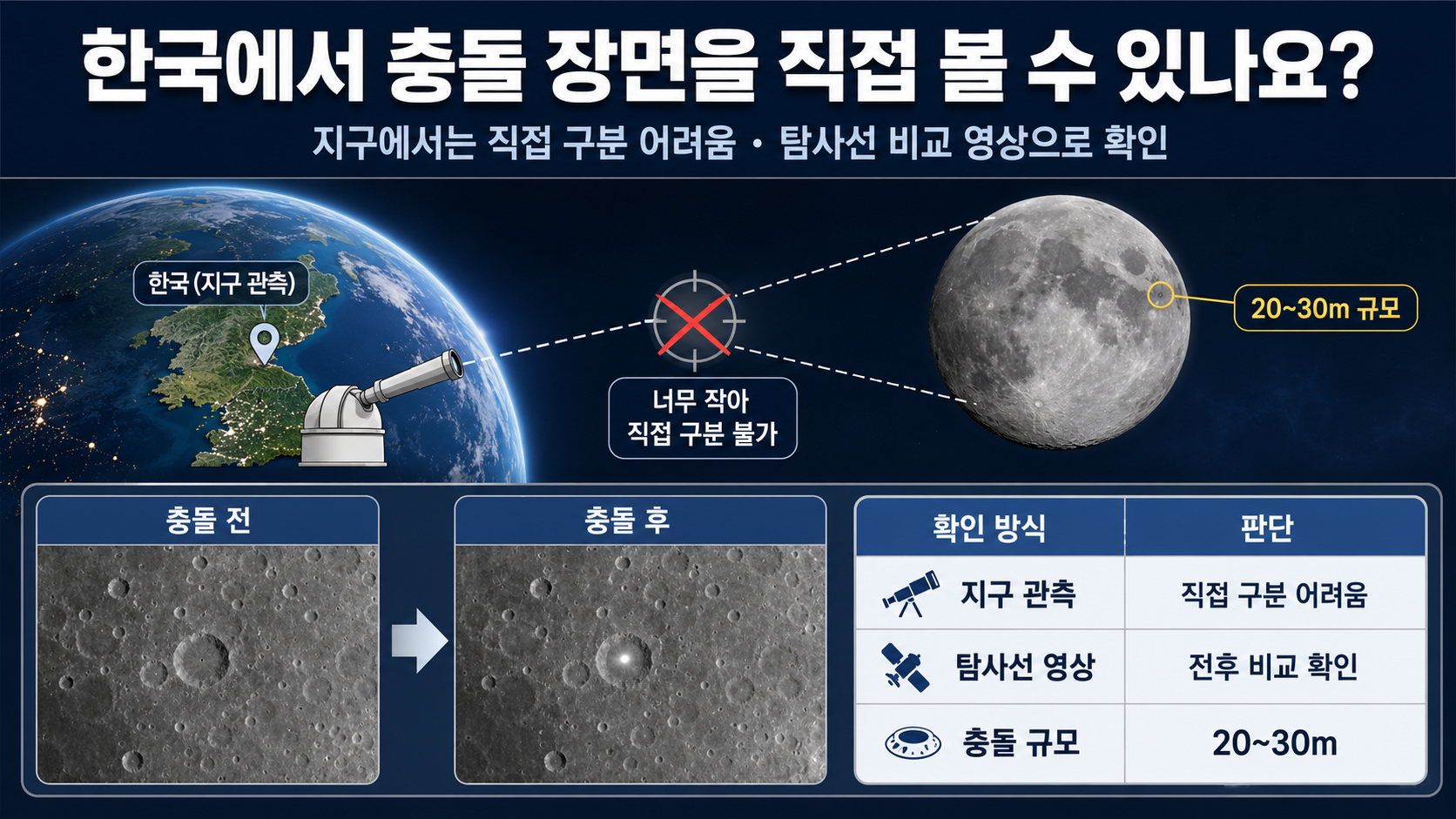
A crater measuring 20~30 m in diameter would be difficult to distinguish directly from Earth. Confirmation will require before-and-after images captured by spacecraft orbiting the Moon.
Professional observations are planned in regions where the Moon will be above the horizon at night, including eastern North America and parts of South America. Even there, stable tracking systems and highly sensitive cameras will be necessary, and successful detection of the ejecta cannot be guaranteed.
Will Danuri Livestream the Moment of Impact?
The primary objective of Danuri's observations is not to livestream an explosion as seen from Earth. Instead, it is to photograph the lunar surface under comparable conditions before and after the collision and identify any changes. Headlines suggesting that Danuri will capture the exact moment of impact should be distinguished from the spacecraft's actual observation mission.
Danuri has already photographed the expected impact region twice using its 2026-07-09 high-resolution LUTI camera. Researchers compared those images with the upper stage's predicted trajectory to identify the observation area.
On the day of the impact, Danuri plans to perform orbital maneuvers that will allow it to pass over the expected site three times.
| Observation Stage | Instrument | What Researchers Will Examine |
|---|---|---|
| Preliminary observations | LUTI high-resolution camera | Pre-impact terrain and existing crater features |
| Passes before and after impact | LUTI | Comparison of new craters and surface changes |
| Parallel observations | PolCam wide-angle polarimetric camera | Polarization characteristics of surface particles and dust |
| Follow-up analysis | South Korean research institutions and international collaborators | Crater location, size, and ejecta distribution |
LUTI stands for Lunar Terrain Imager, a high-resolution camera designed to capture detailed images of the lunar surface.
PolCam is a camera that observes polarization across wide areas. Polarization describes the tendency of light to oscillate in particular directions. It can be used to analyze the size and roughness of lunar surface particles and the properties of dust.
International researchers have suggested that Danuri and the rocket upper stage could come within several kilometers of each other approximately 2 minutes before impact. However, Danuri's official observation results must be confirmed after the actual orbital operations and analysis of the captured data are complete.
When Will Danuri's Photographs Be Released?
As of 2026-08-03 at 2 p.m., no exact public release date had been announced. KASA stated that the data collected by Danuri would be made available to the public after analysis by relevant research institutions. The findings would also support follow-up imaging plans involving NASA's lunar orbiter and international collaborative research.
Even if images are obtained immediately after the impact, the following steps will be necessary.
1. Compare the actual impact coordinates with the photographed area
2. Correct brightness differences and imaging angles between pre-impact and post-impact images
3. Distinguish potential new craters from existing surface features
4. Cross-analyze LUTI and PolCam data
5. Compare and verify findings using data from international lunar spacecraft
It would therefore be premature to assume that clear photographs of the crater will be released immediately after the collision. Updates should be checked against official announcements from KASA and the Korea Aerospace Research Institute.
Why Is This Lunar Impact Scientifically Important?
This will not be the first time an artificial object has struck the Moon. Spacecraft have deliberately impacted the lunar surface for scientific purposes during the Apollo program and NASA's LCROSS mission. Rocket debris also struck the far side of the Moon in 2022.
What makes this event distinctive is that researchers have tracked the object's trajectory and predicted its impact time in advance. Multiple ground-based telescopes and lunar orbiters are preparing simultaneous observations near the sunlit edge of the Moon.
The resulting data could support research into:
How hollow rocket structures break apart when they strike the lunar surface
How impact angle affects crater size and shape
How high lunar dust and debris rise and how far they travel
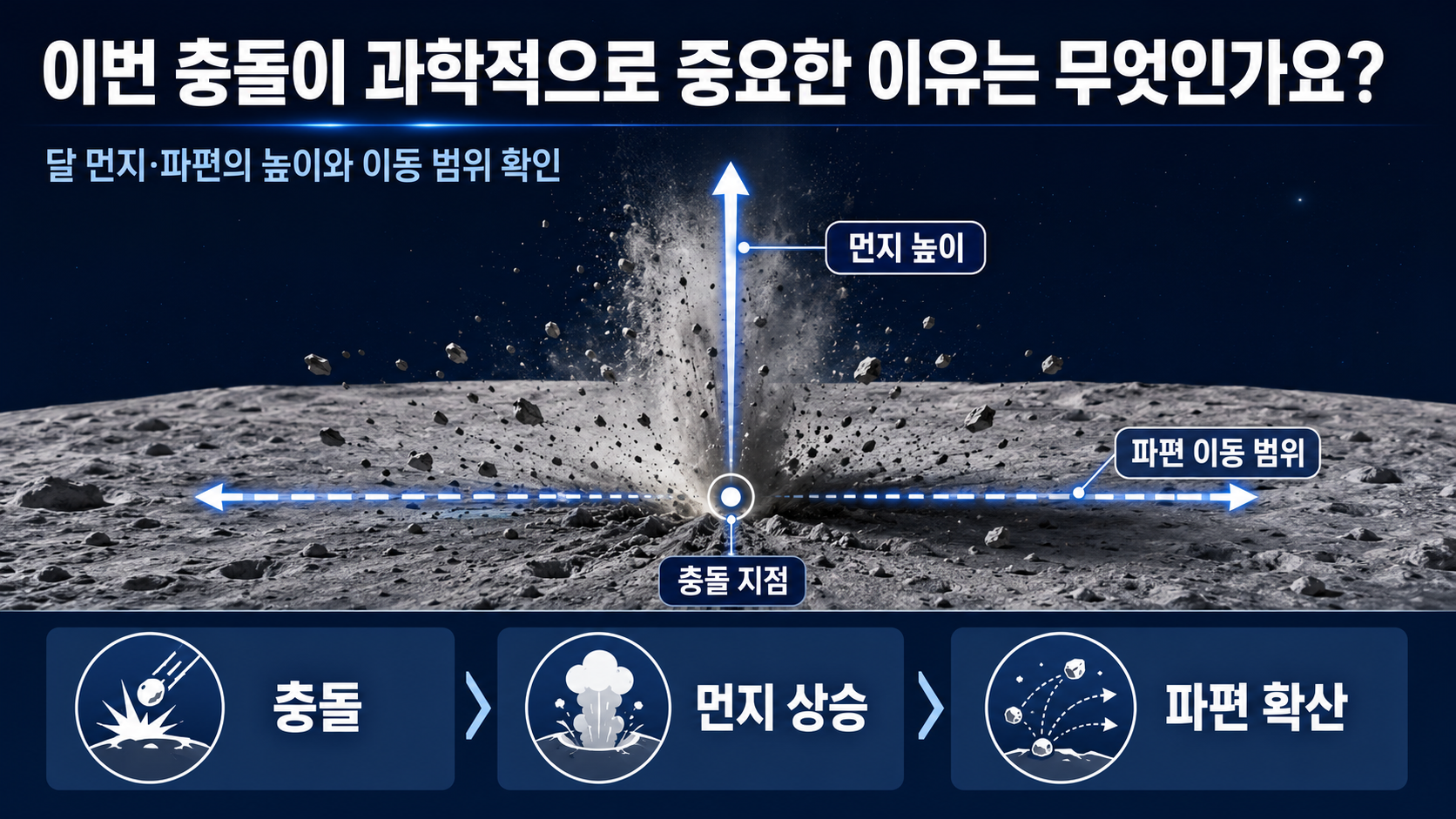
Improving the accuracy of simulations used to interpret natural meteorite impacts
Assessing potential risks from space debris to future lunar bases and exploration equipment
Developing standards for space traffic and debris management between Earth and the Moon
In particular, a rocket upper stage differs from a solid rocky object because it consists of a thin metal shell and relatively dense engine components. It may leave impact features different from those produced by a natural meteorite of the same mass, making actual observations especially valuable.
Is This the Same Falcon9 Rocket That Launched Danuri?
No. Danuri was launched aboard a SpaceX Falcon9 rocket in 2022-08-05, but the upper stage expected to strike the Moon came from a different Falcon9 rocket that launched Blue Ghost and HAKUTO-R Mission 2 in 2025-01-15.
The two events are easy to confuse because both involved Falcon9 rockets and their dates are associated with August 5.
Danuri launch: 2022-08-05
Impacting rocket's launch: 2025-01-15
Expected lunar impact of the rocket upper stage: 2026-08-05
Does the Impact Pose a Danger to Earth or Lunar Spacecraft?
There is no possibility of this impact directly damaging Earth. The rocket upper stage is heading toward the lunar surface rather than Earth, and its estimated impact energy is sufficient to leave only localized effects near the collision site, not to affect the Moon as a whole.
Danuri will perform planned orbital maneuvers to observe the area above the impact site. The observation plan released on 2026-08-03 did not indicate any safety problems involving Danuri.
Over the longer term, however, uncontrolled rocket upper stages could become a growing hazard as the number of spacecraft and crewed bases around the Moon increases. This collision also highlights the need to discuss future lunar space traffic management and launch vehicle disposal practices.
Results to Check After August 5
Predictions made before the collision may differ from the actual outcome. After the impact, the following information should be checked in order.
Actual impact time and final coordinates
Whether ground-based telescopes detected an impact flash or dust ejecta
Before-and-after images captured by Danuri's LUTI camera
Surface polarization changes detected by PolCam
Actual diameter and depth of the crater
Follow-up imaging results from NASA's Lunar Reconnaissance Orbiter
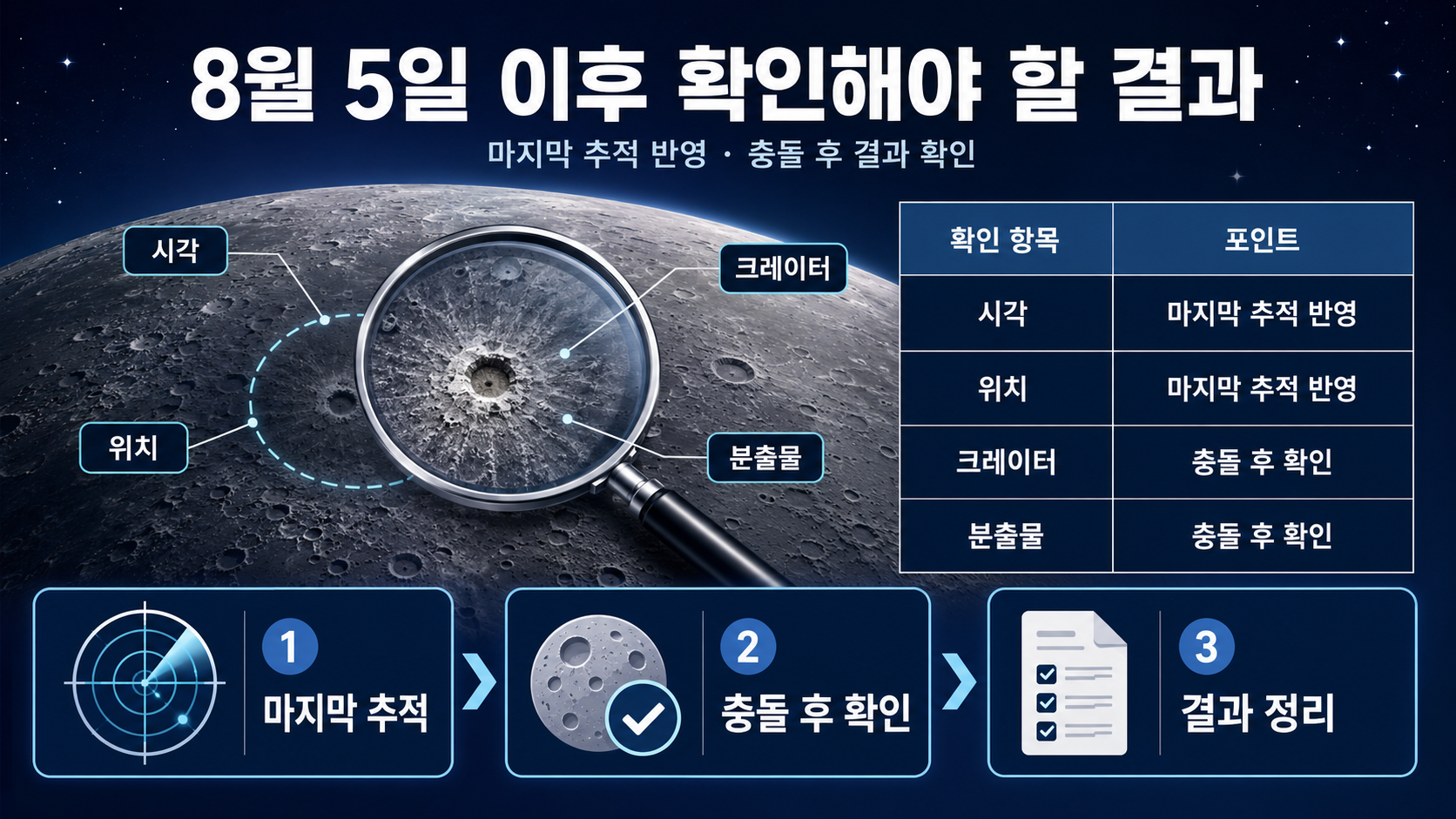
KASA's image release schedule and analysis by research institutions
The most firmly established information at present is that the impact is expected around August 5 at 3:34 p.m., direct real-time observation from South Korea will be difficult, and Danuri will document changes to the lunar surface before and after the collision.
The precise time and location may change based on the final tracking results. The actual crater size and whether ejecta can be observed will only be confirmed after the impact.
---