

Why Bitcoin Funding Rates Differ Across Exchanges: What Determines Opposite Long and Short Payment Directions at the Same Time
This post contains Coupang Partners affiliate links. We may earn a commission from qualifying purchases.

Bitcoin futures funding rates can differ across exchanges even when checking the same cryptocurrency at the same time. In some cases, longs pay funding on Binance while shorts pay on another exchange. The main reasons are differences in futures prices, premium indices, calculation methods, and settlement intervals across exchanges.
Comparing funding rate figures alone can lead to an inaccurate assessment of actual costs. Let's look at what you should check first when comparing funding rates across exchanges.
1. Why Funding Rates Differ Across Exchanges for the Same Bitcoin
Funding rates reflect how far the perpetual futures price on each exchange deviates from the spot reference price.

Although Bitcoin itself moves similarly across global markets, execution prices and the composition of market participants' positions differ from one exchange to another.
Consider the following hypothetical example.
Exchange A: Bitcoin perpetual futures trade at a higher price than spot
Exchange B: The perpetual futures price trades below the spot reference price
Exchange C: The difference between futures and spot prices is relatively small
As a result, funding rates can be calculated differently even for the same Bitcoin.
| Exchange Market Conditions | Funding Rate Direction | Paying Party |
|---|---|---|
| Futures price is relatively high | Potentially positive | Long → Short |
| Futures price is relatively low | Potentially negative | Short → Long |
| Small price difference | Close to neutral | Determined by the calculation formula |
The important point here is that funding rates are not determined simply by counting the total number of long and short accounts across an exchange.
In practice, several factors work together, including the difference between futures and index prices, interest rate components, and each exchange's calculation formula.
2. 4 Factors That Determine Funding Rates Across Exchanges
① The Difference Between Futures Prices and the Spot Index
One of the most important factors is the Premium Index.
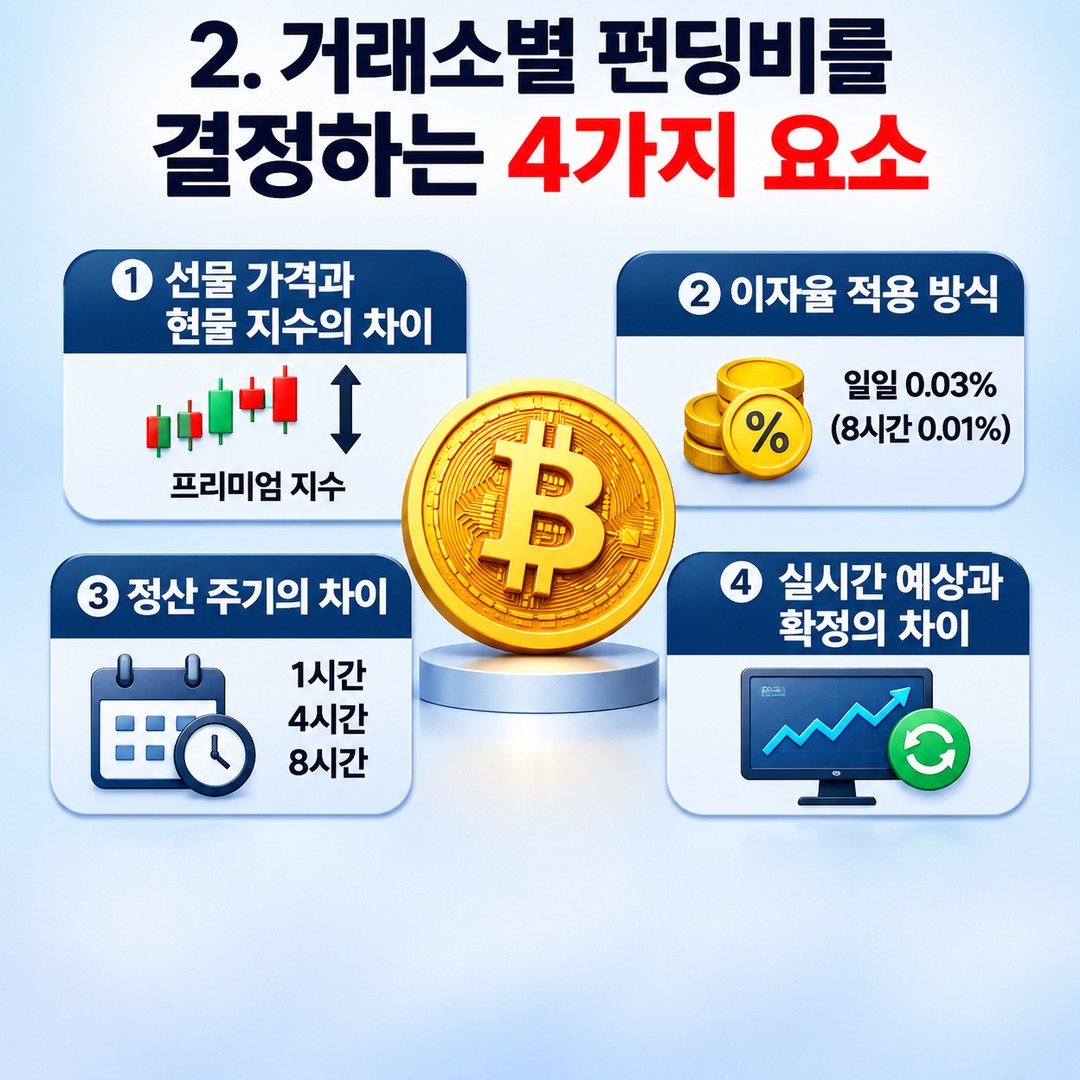
The Premium Index measures how much more expensive or cheaper perpetual futures trade compared with the spot reference price.
Binance and Bybit each use Impact Bid/Ask Prices and index prices, among other inputs, according to their respective calculation methods.
Therefore, differences in order book liquidity and futures prices across exchanges can also lead to differences in their Premium Indices.
② Differences in How Exchanges Apply Interest Rates
Funding rates also include an Interest Rate component.
According to Binance's official documentation, the standard interest rate for typical USDⓈ-M perpetual contracts is 0.03% per day, or 0.01% per settlement interval when using 8-hour settlements.
However, some contracts may use different interest rates.
Bybit also uses a structure that combines the interest rate with the average Premium Index.
Therefore, you should not assume that all exchanges calculate funding rates using the same formula.
③ Differences in Settlement Intervals
This is a factor that is often overlooked when comparing funding rates.
Depending on the exchange and contract, settlement intervals can differ, with periods such as 1 hours, 4 hours, or 8 hours.
For example, suppose you see the following two figures.
Exchange A: +0.01% per 8 hours
Exchange B: +0.01% per 1 hour
Although the two figures look identical, they represent different things.
If Exchange B maintains a rate of 0.01% per 1 hour, its simple 8-hour equivalent would be 0.08%.
In other words, comparing the figures without checking the settlement intervals can lead to a major misunderstanding of the actual cost difference.
④ Differences Between Estimated Real-Time Funding Rates and Finalized Funding Rates
You should also be careful not to assume that the funding rate displayed on the screen at any given moment is the final rate that will be settled.
According to Bybit's official documentation, funding rates fluctuate in real time until the next settlement time and are calculated based on the interest rate and average Premium Index.
Binance also calculates funding rates using Premium Index data collected during the funding period.
Therefore, an estimated funding rate checked at 3 PM may differ from the funding rate actually applied at settlement.
This is particularly important during periods of high volatility, when you should not treat an interim figure as the final cost.
3. Can One Exchange Have a Positive Funding Rate While Another Has a Negative Rate at the Same Time?
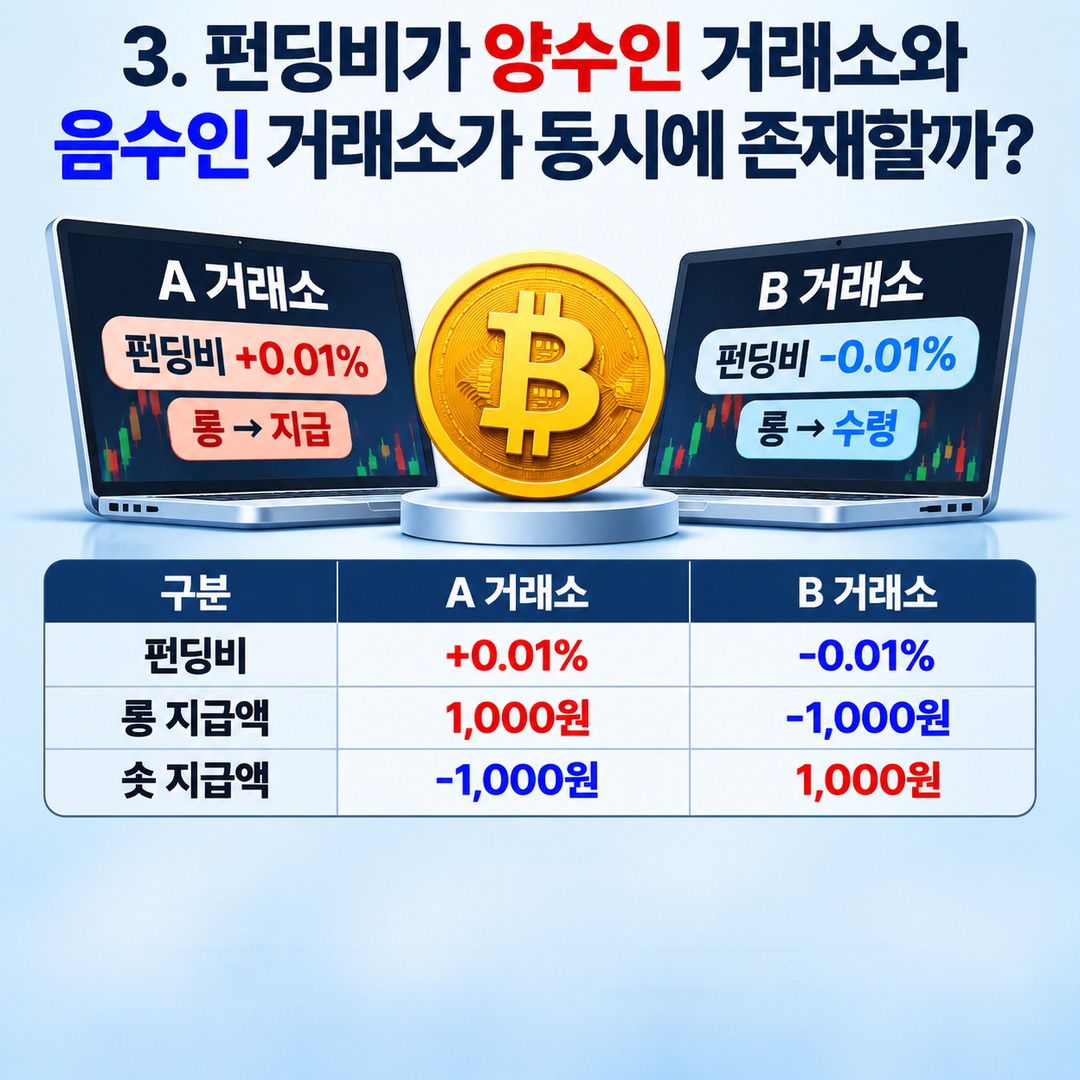
Yes, this is possible. The reason is that futures prices are formed differently and calculation standards vary across exchanges.
In the 2026-08-10 Reddit cryptocurrency community, a user asked about a comparison of the same BTCUSDC contract, where Bitget displayed +0.0032% while OKX displayed -0.03198%.
The user asked why the payment direction was reversed even though both exchanges offered the same Bitcoin contract.
The important point in this example is not simply that one exchange displayed a higher figure than the other.
You need to consider each exchange's settlement interval, contract terms, funding rate formula, and futures price together.
Also, the figures posted in the community represent a user's observation at a specific point in time. They should not be interpreted as current funding rates or as officially verified exchange data.
How Much Can the Actual Payment Amount Differ?
Let's work through a hypothetical comparison example.
Assume both exchanges settle every 8 hours and set the position's notional value at KRW 10,000,000.
| Category | Exchange A | Exchange B |
|---|---|---|
| Funding rate | +0.01% | -0.01% |
| Long payment | KRW 1,000 | -KRW 1,000 |
| Short payment | -KRW 1,000 | KRW 1,000 |
The table above illustrates the direction of payments between long and short positions.
On Exchange A, longs pay KRW 1,000.
On Exchange B, longs receive KRW 1,000.
The difference in funding cash flows for long positions across the two exchanges is KRW 2,000.
Author's calculation
KRW 10,000,000 × 0.01% = KRW 1,000
Because the payment directions are opposite on the two exchanges, KRW 1,000 + KRW 1,000 = KRW 2,000.
The actual payment amount depends on the notional value and applicable funding rate at the settlement time.
This calculation does not include trading fees, slippage, price fluctuations, margin costs, or other expenses.
4. What to Check When Comparing Funding Rates Across Exchanges
Simply finding the exchange with the highest funding rate and the one with the lowest rate on a funding rate comparison site is not enough.

It is better to check the following points in order.
First, confirm that the contracts are identical.
BTCUSDT and BTCUSDC may both appear to be Bitcoin futures, but their settlement and collateral structures differ.
Whenever possible, compare contracts with the same underlying asset and the same contract type.
Second, check the settlement intervals.
Do not directly compare funding rates settled every 1 hour with those settled every 8 hours.
You can refer to a 8-hour equivalent rate, but this is only a simple conversion for comparison purposes and does not guarantee the actual payment amount.
Third, align the data collection times.
If one exchange's data was collected at 3:10 p.m. and the other exchange's data at 3:25 p.m., the comparison will be less accurate.
Whenever possible, use data collected at exactly the same time.
Fourth, distinguish estimated rates from finalized rates.
Do not mix estimated funding rates, which can change before the next settlement, with historical funding rates that have already been applied.
Fifth, check multiple settlement intervals.
You need to determine whether an unusually high funding rate is persistent or merely a temporary fluctuation.
It is risky to judge the overall market's long-short positioning based on a figure from just one point in time.

5. Can Large Funding Rate Differences Create Arbitrage Opportunities?
One strategy that takes advantage of funding rate differences between exchanges is called Funding Rate Arbitrage.
A typical structure involves holding a long position on one exchange and a short position of the same size on another. This reduces exposure to price direction while taking advantage of the funding rate difference.
However, a funding rate difference does not automatically create risk-free profit.
The following factors need to be checked:
Whether the contracts on both exchanges are identical
Whether the notional values of the long and short positions match
Whether the settlement intervals are aligned across exchanges
The entry and exit trading fees
Whether slippage occurs during order execution
Whether the price divergence becomes unusually large on only one exchange
Whether there is a risk of insufficient margin or forced liquidation
Whether asset transfers or withdrawals are restricted
In particular, even if one exchange pays you funding, your overall profit and loss can still be negative if the price loss on the opposite position is larger.
Additionally, if prices on the two exchanges diverge significantly for a while, it may become difficult to maintain both positions simultaneously.
Therefore, Funding Rate Arbitrage is not a simple strategy that can be executed merely by comparing funding rate figures.
6. Official Resources for Checking Funding Rates
To understand funding rates accurately across exchanges, it is a good idea to consult each exchange's official help documentation alongside real-time comparison screens.

Official Binance Futures funding rate guide: funding rate formula, premium index, and settlement conditions
Official Bybit funding rate guide: interest rate, average premium index, and settlement intervals
OKX funding rate formula change announcement: changes to formulas by settlement interval announced in May 2026
Community discussions about funding rate differences across exchanges: examples of differences raised by actual users

Because product terms and funding rate calculation methods can change, check the latest guidance for the specific contract before trading.
Conclusion: Funding Rates Are Meaningful Only When Compared on the Same Basis Across Exchanges
Differences in Bitcoin funding rates across exchanges should not automatically be considered errors.
Differences in futures prices, premium indices, interest rates, settlement intervals, and calculation methods mean that funding rates can vary even for the same Bitcoin asset.
When comparing funding rates, it is particularly important to remember these three points.
1. Compare identical contracts.
2. Match the settlement intervals.
3. Distinguish estimated funding rates from the actual settlement rates.
Funding rates are a reference indicator for understanding market positioning imbalances and holding costs. They are not a definitive signal of whether Bitcoin will rise or fall.
Rather than focusing on a single number, it is important to first understand the criteria used to calculate it.
※ This article is provided for informational purposes to help readers understand market trends and does not constitute an investment recommendation for any specific security or asset. All final investment decisions and responsibility for them rest with the individual.
This post contains Coupang Partners affiliate links. We may earn a commission from qualifying purchases.