

Bitcoin Futures Stop-Loss Orders: Why to Use Mark Price to Act Before Liquidation

To trigger a stop-loss order before liquidation in Bitcoin futures, it is generally preferable to use Mark Price rather than Last Price as the trigger, because exchanges also determine forced liquidation based on Mark Price. However, the price that triggers the stop-loss and the price at which the position is actually closed are different, so setting Mark Price alone cannot completely prevent liquidation or losses.
2026-11-07 The key point common to the official guidance from Binance, Bybit, and OKX is to align the liquidation reference price with the stop-loss trigger price. In particular, watch for situations where Mark Price reaches the liquidation price before Last Price reaches the stop-loss price.
Why a stop-loss based on Last Price may be preceded by liquidation
Last Price is the most recently traded price for a futures contract on an exchange. Mark Price, by contrast, is a reference price used to assess liquidation, calculated using prices from several spot markets and related data.
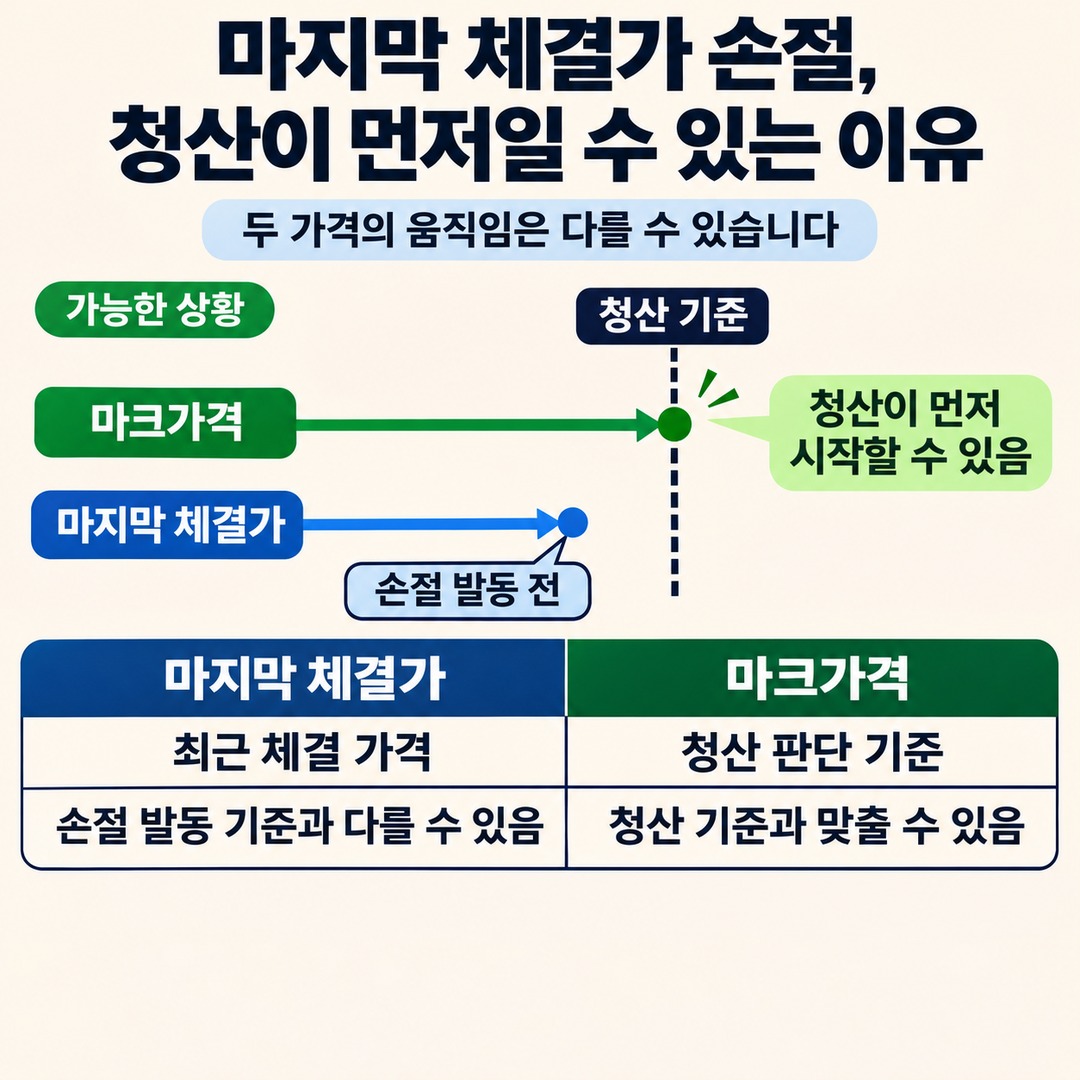
The two prices are not always the same. As a result, Mark Price may already have reached the liquidation price even if Last Price on the chart has not yet reached the stop-loss price.
In its official customer support document 2026-09-25, Bybit explains that if a stop-loss is set based on Last Price, forced liquidation may occur before the stop-loss if Mark Price reaches the liquidation level first.
Binance also states in its official guidance on the futures liquidation protocol that liquidation occurs when Mark Price reaches the position's liquidation price.
The difference between the two prices can be understood as follows.
| Category | Last Price | Mark Price |
|---|---|---|
| Meaning | Most recently traded contract price | Reference price used to determine fair value |
| Key characteristic | Reflects actual trading activity | Incorporates prices from multiple markets and related data |
| Used to determine liquidation | Not the direct reference | Used to determine liquidation |
| Stop-loss setting | Signal closer to the execution price | Better suited to aligning with the liquidation reference |
Therefore, if the goal is to trigger a stop-loss before liquidation, it is reasonable to consider Mark Price before Last Price.
The liquidation sequence shown in Bybit’s official example
Bybit’s published example shows specifically what can go wrong when the two prices are confused.
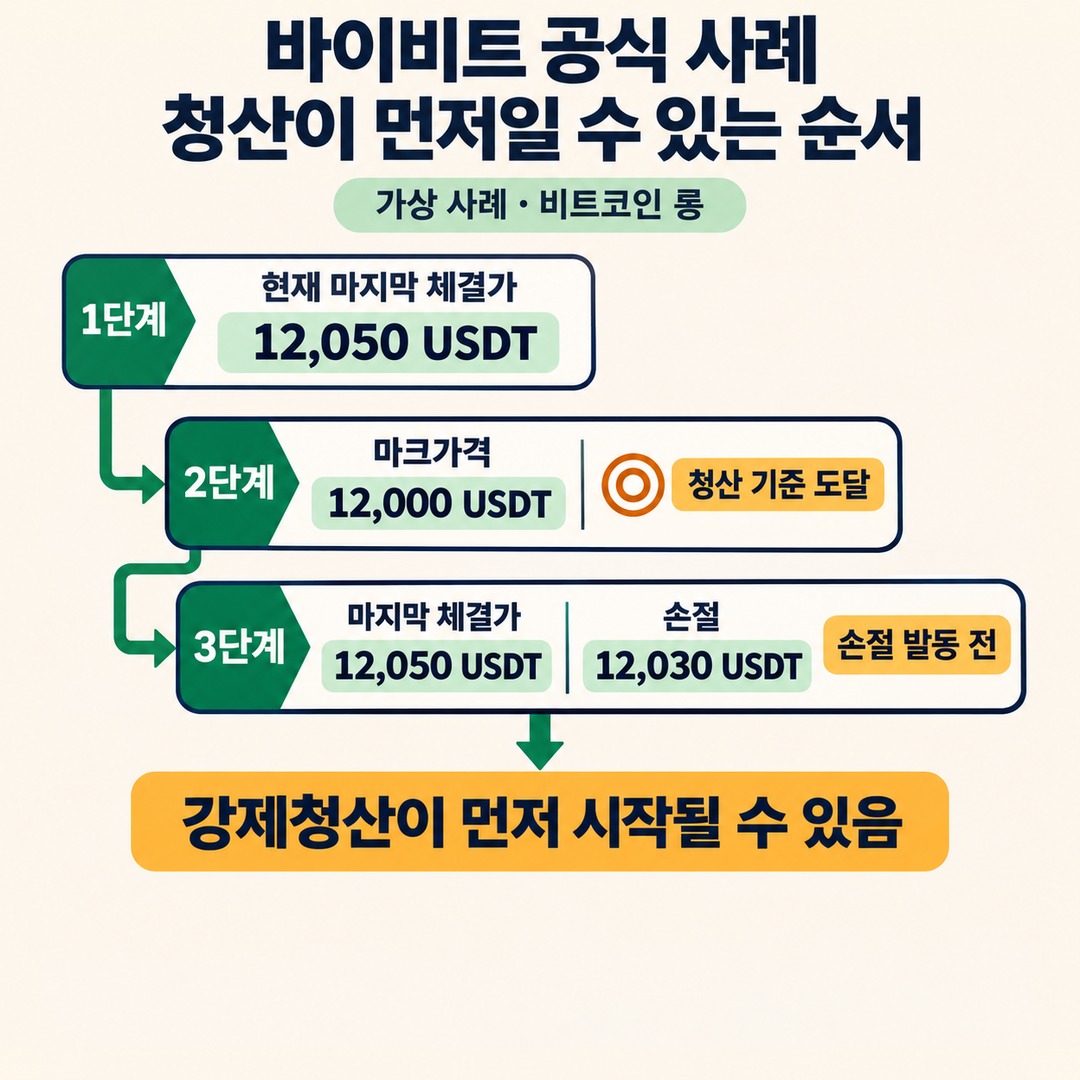
Bybit’s official document gives the following hypothetical example:
Position: Long Bitcoin
Last Price: 12,050 USDT
Liquidation price: 12,000 USDT
Stop-loss price: 12,030 USDT
Stop-loss trigger reference: Last Price
In this situation, the stop-loss order is set to trigger if Last Price falls to 12,030 USDT.
But what if Mark Price reaches 12,000 USDT first while Last Price remains at 12,050 USDT?
Liquidation may occur first. Because Mark Price has reached the liquidation threshold, forced liquidation may begin before the stop-loss order is triggered based on Last Price.
The key point in this example is not the stop-loss price of 12,030 USDT itself, but that the stop-loss order and the liquidation system are using different prices.
Bybit’s official order execution and liquidation FAQ explains this situation and the difference between the price references.
How should you set Mark Price to act before liquidation?
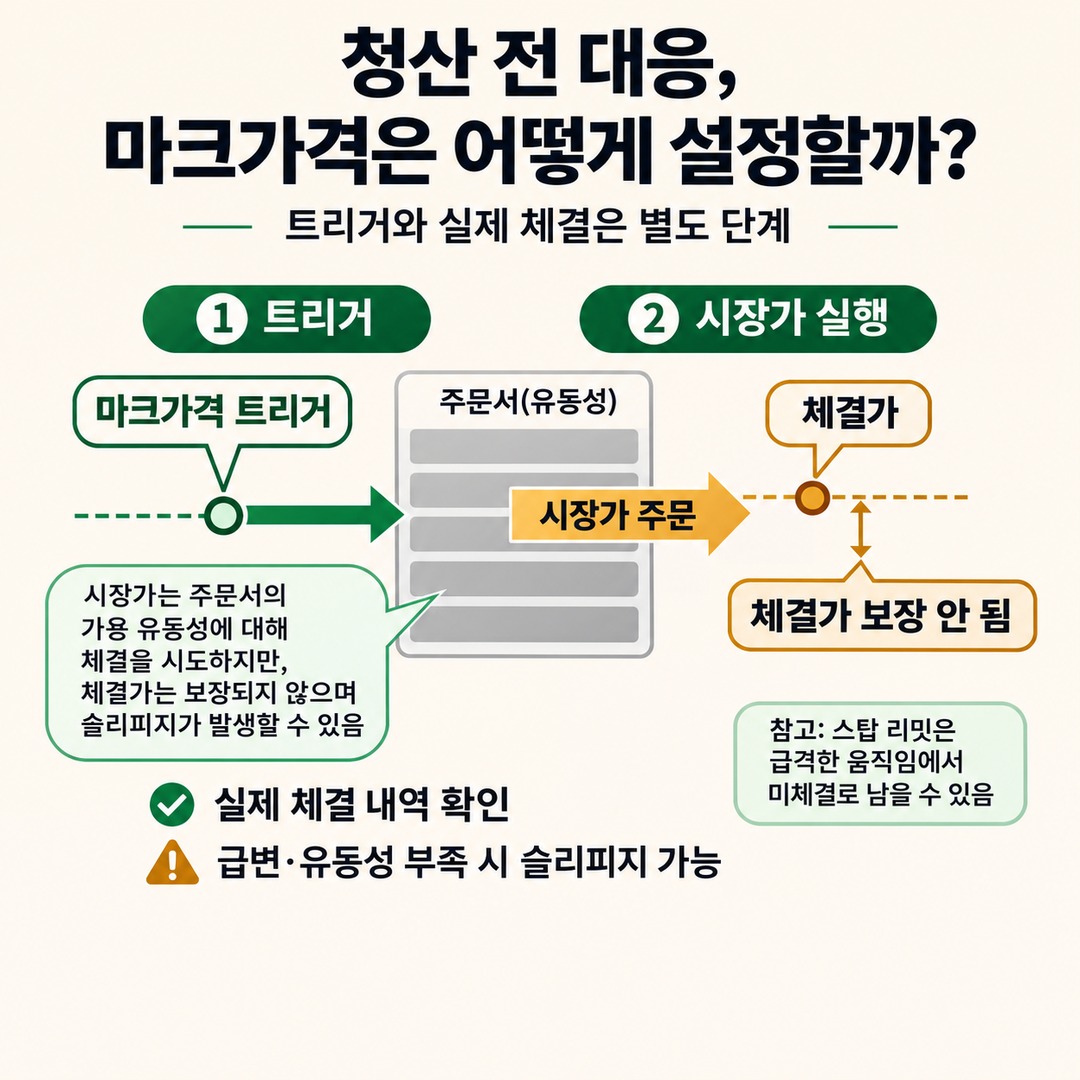
You can first consider using Mark Price as the stop-loss trigger and setting the actual liquidation order to execute at market. This aligns the stop-loss trigger with the price used to determine liquidation.
However, triggering an order does not mean the position will be closed immediately at the desired price.
The order proceeds in two stages:
1. Trigger: The order activates when the specified Mark Price reaches the stop-loss threshold.
2. Execution: The activated market order fills using available liquidity in the order book.
In its official FAQ, Bybit distinguishes between the trigger price and the actual execution price, and explains that slippage may occur during sharp market moves.
Therefore, when setting a stop-loss order, you should choose both the price reference and the order execution method.
| Setting | Option to consider first | Reason |
|---|---|---|
| Trigger reference | Mark Price | Matches the liquidation reference |
| Execution method | Market | Attempts to fill immediately after triggering |
| Liquidation scope | Entire position | Helps prevent some of the position from remaining open |
| Additional check | Actual execution history | Check for unfilled or partially filled orders |
A market order does not guarantee an execution price either. Sharp price moves or insufficient order book liquidity may result in a fill at a less favorable price than expected.
A stop-limit order, by contrast, submits a limit order after the trigger. It offers more control over the price, but if the market moves quickly, the order may remain unfilled.
If avoiding liquidation is the priority, you should also account for the risk that a stop-limit order may not fill.
What settings do Binance and Bybit actually support?
Both exchanges describe a feature that lets users choose either Last Price or Mark Price as the stop-loss trigger reference. However, their menus and the conditions that apply to each order may differ, so check the order screen on the exchange you use.

Binance
According to Binance’s 2026-02-27 updated guide to futures stop-loss and take-profit orders, a stop-loss order can be set to trigger based on either Last Price or Mark Price.
Binance uses Mark Price as the liquidation reference and cautions that if a stop-loss price is set too close to the expected liquidation price, liquidation may occur before the stop-loss.
Bybit
Bybit’s TP/SL settings guide explains that orders can be set for all or part of a position, and that Last Price, Mark Price, or Index Price can be selected as the trigger reference.
Execution methods are also offered, including market and limit orders.
It is especially important not to confuse settings for the entire position with those for part of a position. Even if a stop-loss order triggers as intended, if it is set to close only part of the position, the remaining quantity may still be exposed to liquidation risk.
OKX
OKX’s 2026-10-05 updated official FAQ on forced liquidation explains that liquidation is determined based on Mark Price, not Last Price.
It also explains that stop-loss orders and forced liquidation are separate processes, and that liquidation may still occur even when a stop-loss is set—for example, because of the stop-loss trigger reference, an insufficient order quantity, or an execution failure.
What the three exchanges have in common is that Mark Price and Last Price serve different purposes. However, liquidation procedures and order conditions vary by exchange, so do not apply another exchange’s settings without adjustment.

How far should the stop-loss price be from the liquidation price?
It is important to leave enough distance between the stop-loss price and the liquidation price, but there is no fixed distance that works for every Bitcoin futures position.
The liquidation price can vary depending on margin, position size, maintenance margin rate, fees, funding fees, and margin mode.
With cross margin in particular, changes in other positions and the account balance can affect the risk level, so do not treat the displayed estimated liquidation price as a fixed number.
Binance’s official guidance says not to set a stop-loss trigger too close to the estimated liquidation price. OKX also explains that the estimated liquidation price can change in real time as margin, positions, funding fees, and other factors change.
For an actual setup, it is a good idea to check the following in order.
1. Check the current Mark Price.
2. Check the estimated liquidation price on the position details screen.
3. Set the stop-loss price based on the loss you can afford.
4. Select Mark Price as the stop-loss trigger reference.
5. Check that the stop-loss order covers the entire position.
6. Check the execution conditions for a market or limit order.
7. Check that the order is active and whether it has actually been filled.
The most important point is not to set the stop-loss price based on the liquidation price. First decide how much you are willing to lose, then leave enough distance from the liquidation price.
You should also monitor both prices if the gap between Mark Price and Last Price suddenly widens.
Why a Mark Price stop-loss cannot completely prevent liquidation
Setting Mark Price as the stop-loss reference does not eliminate the risk of liquidation.

Three situations can still arise.
First, a rapid price move.
If Mark Price moves quickly from the stop-loss threshold to the liquidation threshold, the liquidation process may begin before the order is executed.
Second, slippage on a market order.
Even if the stop-loss order triggers as intended, insufficient order book liquidity may result in an actual fill at a less favorable price than expected.
Third, the stop-loss quantity may differ from the position size.
If the stop-loss is set to close only part of the position, the remaining position stays exposed to risk.

OKX addresses each of these three issues in its forced liquidation FAQ. In particular, it is important to distinguish between a stop-loss order being triggered and the entire position actually being closed.
Which price should you use as the reference?
If your goal in Bitcoin futures is to trigger a stop-loss before liquidation, using Mark Price as the reference is the first option to consider.
Last Price provides a signal closer to the actual trading price, but because it differs from the liquidation reference, the stop-loss order may trigger after liquidation.
Conversely, choosing Mark Price does not resolve execution delays, slippage, insufficient order quantity, or sudden market moves.
Keep these three points in mind:
To act before liquidation: consider a Mark Price trigger first
To close the actual position: use market execution and check the full quantity
To manage remaining risk: keep checking the gap between the liquidation and stop-loss prices, along with the margin ratio
A stop-loss order is not a safety measure that replaces liquidation. It is a risk management tool intended to close the position before the liquidation engine does.
Before starting your next trade, it is a good idea to check not only the Last Price shown on the chart, but also Mark Price and the maintenance margin ratio.
※ This article is for reference to help readers understand market movements and is not a recommendation to invest in any particular security or asset. You are responsible for your own decisions and investments.