

The Funding Fee Was Deducted on Bybit, but the Liquidation Price Changed? What Happens When Your Balance Is Too Low
If the liquidation price changed after you paid a funding fee on Bybit perpetual contracts, first check whether the fee was deducted from your position margin. In isolated margin, if your available balance is insufficient and the funding fee is taken from your position margin, the liquidation price may move closer to the current market price. Conversely, if the funding fee was properly deducted from your available balance, the funding payment itself

If the liquidation price changed after you paid a funding fee on Bybit perpetual contracts, first check whether the funding fee was deducted from your position margin. In isolated margin, if your available balance is insufficient and the funding fee is taken from your position margin, the liquidation price may move closer to the current market price.
Conversely, if the funding fee was properly deducted from your available balance, the funding payment itself did not reduce the margin of your isolated position.
The key difference is not only how much funding you paid, but also which balance it was deducted from.
1. Paying a funding fee does not necessarily change the liquidation price
Bybit funding fees are payments settled between holders of long and short positions in perpetual contracts.

When a funding fee is due, Bybit generally deducts it from the available balance. If the balance is insufficient, it may deduct the fee from the position’s initial margin.
The following comparison shows the two scenarios for isolated margin.
| Category | Sufficient available balance | Insufficient available balance |
|---|---|---|
| Funding fee deducted from | Available balance | Position’s initial margin |
| Position margin | Not deducted directly | May decrease |
| Liquidation price | Not changed directly by the funding fee deduction alone | May move unfavorably |
| Liquidation risk | Limited direct impact on the position | May increase |
For example, if you hold a long position in isolated margin, a reduction in margin leaves you with less room to withstand a price drop.
The same applies to a short position. If your margin decreases, you have less room to withstand a price increase.
With cross margin, however, the account’s total assets and margin usage affect the risk calculation, so you should not assess it the same way as isolated margin.
2. What happens if a funding fee of 5 USDT is deducted from 100 USDT in margin?
The difference becomes clearer when you compare actual figures.
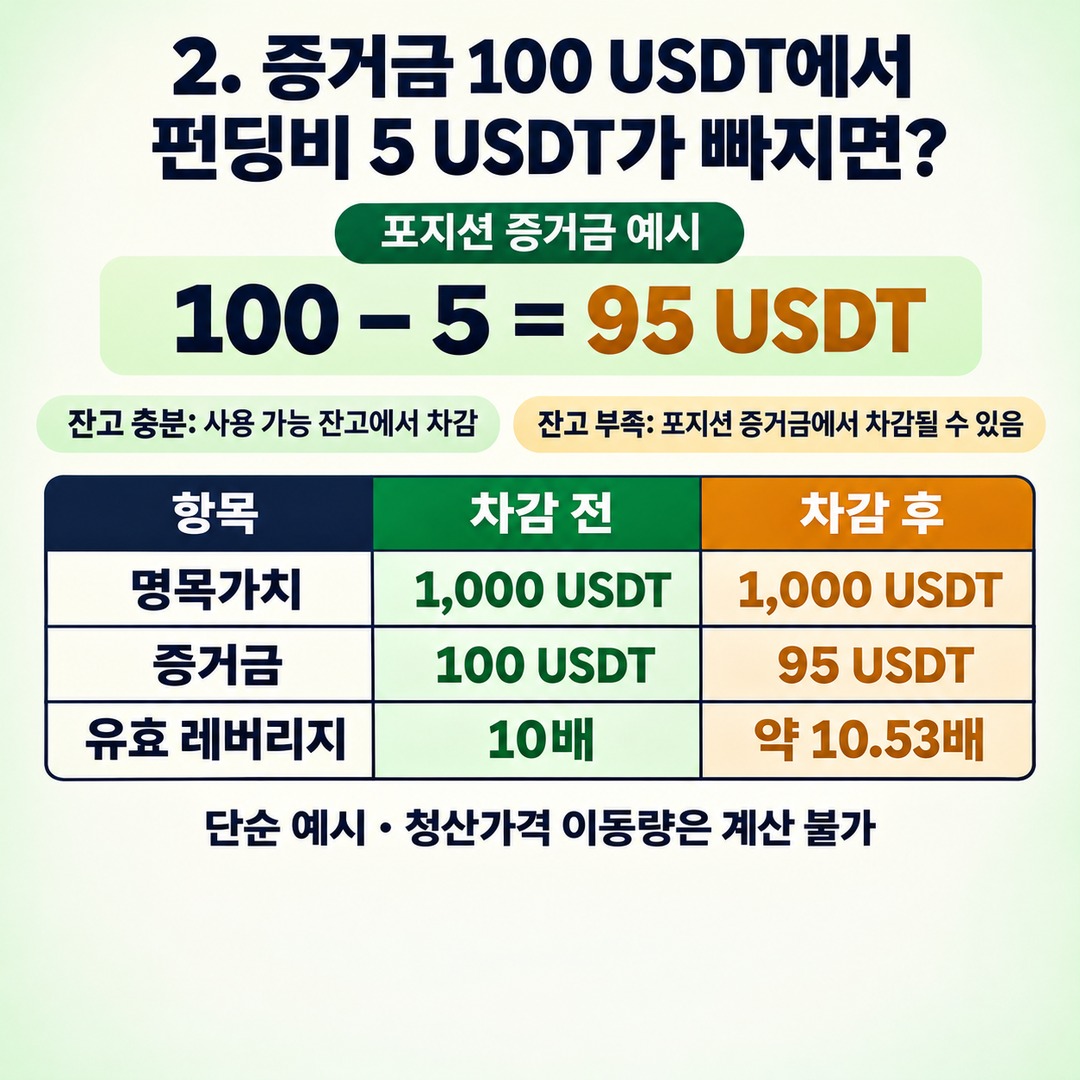
The following is a hypothetical calculation example based on an isolated-margin USDT perpetual contract position. It does not represent a funding rate in the actual market or the trading history of a specific account.
Position notional value: 1,000 USDT
Initial margin: 100 USDT
Set leverage: 10x
Funding fee due: 5 USDT
Other margin changes: Assumed to be none
If there is enough available balance
The funding fee of 5 USDT is deducted from the available balance.
The 100 USDT in initial margin allocated to the position remains unchanged.
If there is not enough available balance
The funding fee of 5 USDT may be deducted from the position margin.
In that case, the remaining margin based on a simple calculation is as follows:
100 - 5 = 95 USDT
Assuming the position’s notional value of 1,000 USDT remains unchanged, the change in effective leverage is as follows:
| Item | Before deduction | After deduction |
|---|---|---|
| Position notional value | 1,000 USDT | 1,000 USDT |
| Margin | 100 USDT | 95 USDT |
| Effective leverage | 10x | Approximately 10.53x |
*Author’s calculation: notional value ÷ margin. This is a simplified example that excludes price movements, unrealized profit or loss, fees, maintenance margin, and other factors.*
There is an important point here.
Even if the leverage set on the trading screen remains at 10x, effective leverage can rise if the margin backing the actual position decreases.
In this example, where margin decreased by 5%, effective leverage increases by approximately 5.26%.
However, these figures alone do not show exactly how far the liquidation price will move. The actual liquidation price is calculated based on factors such as maintenance margin, position size, contract structure, and fees.
3. What is the difference between isolated and cross margin?

To assess liquidation risk after a funding fee deduction, first check the margin mode of the current position.
Isolated Margin
Isolated margin is a method that calculates liquidation risk mainly based on the margin allocated to a specific position.
If your available balance is insufficient and the funding fee is deducted from your position margin, the liquidation price may move in an unfavorable direction.
The general directions are as follows:
Long position: The liquidation price may move up
Short position: The liquidation price may move down
In both cases, the liquidation price moves closer to the current market price.
Cross Margin
With cross margin, the account’s available margin and the profit or loss of other positions may affect the risk calculation.
In a Bybit Unified Trading Account, liquidation under cross margin and portfolio margin is determined using the account maintenance margin ratio (MMR).
When MMR reaches 100%, the liquidation condition is met.
Therefore, judging actual liquidation risk based only on the liquidation price shown on the cross-margin screen may not be accurate.
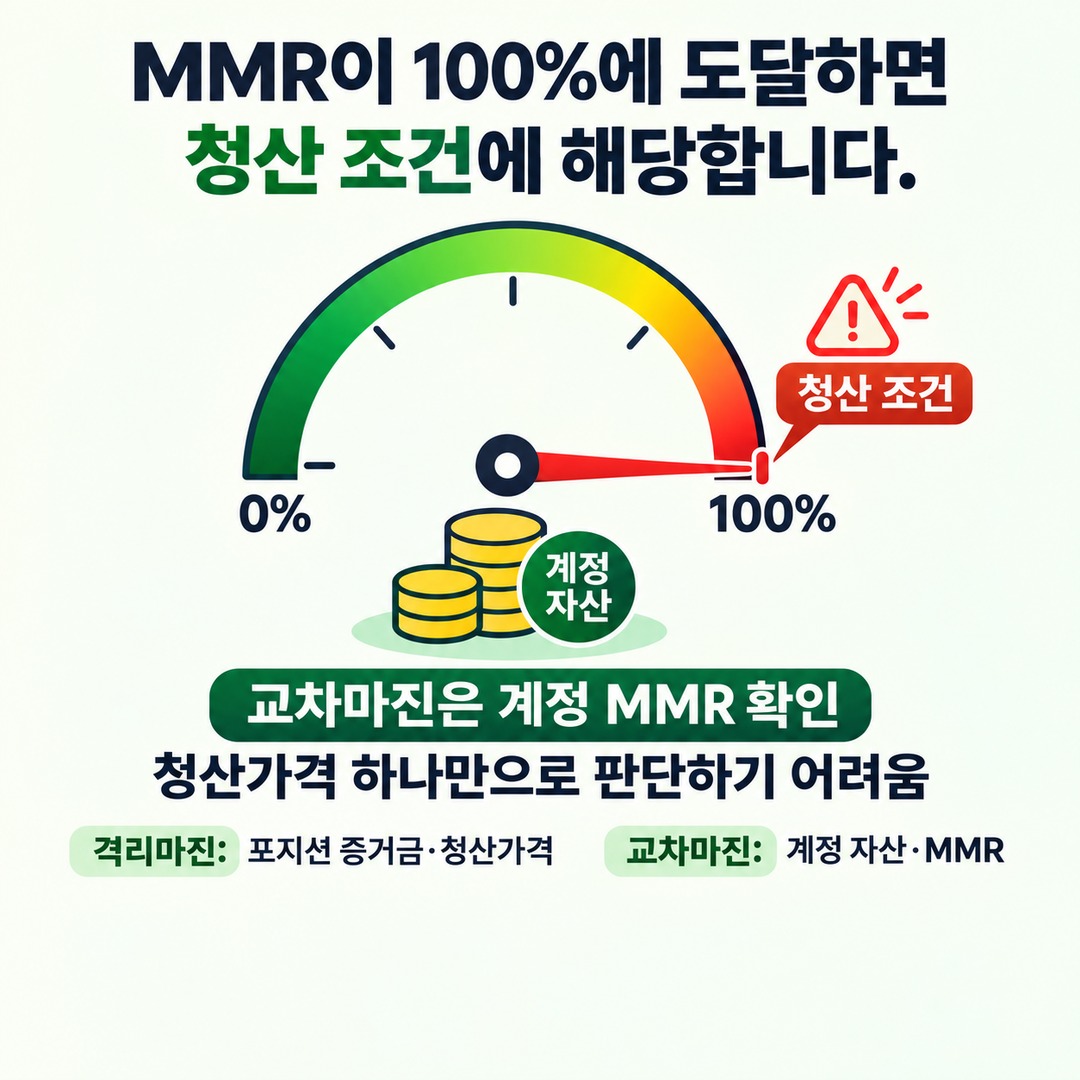
| Item to check | Isolated margin | Cross margin |
|---|---|---|
| Primary basis for risk assessment | Individual position | Entire account |
| Main liquidation criterion | Mark price and liquidation price | Account MMR |
| Impact of other assets and positions | Limited in principle | May have an impact |
| Values to check first | Position margin and liquidation price | Account assets and MMR |

4. What should you actually check if the liquidation price changed?
To identify why the liquidation price changed, it is more accurate to compare the funding settlement history and margin changes together than to look only at the current screen.
First, check the funding settlement history
In a Bybit Unified Trading Account, you can check the Funding entry in Trade History.
You can also find the Funding Rate Settlement entry in the Transaction Log.
Check the settlement time, contract, and the amount actually paid or received.
Second, compare the available balance and position margin
Check how the following figures changed before and after the funding fee was settled.
Available balance
Position margin
Liquidation price
Mark Price
Account maintenance margin ratio (MMR, if applicable to that margin mode)
In particular, it matters whether the available balance was insufficient at the time the funding fee was settled.
Third, distinguish other possible causes
Funding fees are not the only reason the liquidation price can change.
Changes in position size, added or removed margin, profit or loss on other positions, and changes in account assets can also have an effect.
Therefore, do not immediately conclude that funding fees caused the change just because the funding settlement and the liquidation price change occurred around the same time.
5. Can you avoid the funding fee by closing your position just before payment?
According to Bybit’s official explanation, funding fees apply to users holding a position at the relevant settlement time.

Therefore, in principle, if you fully close your position before the settlement time, you will not incur the funding fee for that settlement period.
There is, however, an important exception in actual trading.
Bybit notes that if you open or close a position within approximately 5 seconds before or after the settlement time, it cannot guarantee whether that position will be included in the funding settlement for that period.
For example, if settlement is scheduled for 9 in the morning, you cannot be certain that no funding fee will be charged just because you placed a closing order at 8:59:59 a.m.
That is because the order submission time and the actual execution time may differ.
Also, closing and then reopening a position to avoid funding fees may incur trading fees and slippage.

The cost of re-entering could also exceed the amount saved on funding fees.
6. How can you reduce the increased liquidation risk caused by funding fees?
The first thing to check is whether you will have enough available balance through the next funding settlement time.
Bybit’s official help center also explains that maintaining sufficient available balance can help reduce the liquidation risk caused by funding fee deductions.
However, checking your balance alone is not enough.
You should also review the following:
1. Check whether your current position uses isolated or cross margin.
2. Check the next funding settlement time and the estimated funding rate.
3. Check whether there is enough available balance to cover the funding fee deduction.
4. With isolated margin, check the distance between the liquidation price and the mark price.
5. With cross margin, also review the account MMR and the risks posed by other positions.
The estimated funding rate may differ from the final settlement rate. The actual amount paid or received is determined by the funding rate applied at settlement and the position value.
Also, adding margin does not eliminate the possibility of a loss. Since it may expose more of your funds to risk, you should also review the position size itself.
7. Frequently asked questions
If I receive a funding fee, does my liquidation price also move in a favorable direction?
Not necessarily.
Receiving a funding fee and increasing the available balance is not the same as increasing the margin of a specific position. The actual impact depends on the margin mode and account status.
If I pay a funding fee, does my set leverage automatically increase?
Set leverage and effective leverage are different and should not be confused.
If a funding fee deduction reduces your position margin, effective leverage may increase even if you do not directly change the set leverage.
If the funding rate is negative, does that automatically favor short positions?
No.
When the funding rate is negative, short position holders generally pay funding fees to long position holders. However, gains or losses from price movements may be much larger than the funding fee.
It is risky to choose a position direction based only on whether the funding rate is positive or negative.
Conclusion: Check which balance was charged before focusing on the funding fee amount
If the liquidation price changed after you paid a funding fee on Bybit, check the funding settlement record and the change in your position margin together.
With isolated margin in particular, liquidation risk may increase if the funding fee is deducted from your position margin because your available balance is insufficient.
With cross margin, it is important to check the account’s overall MMR and margin status, rather than focusing only on the liquidation price.
Funding fees are simply a cost of holding a position, but when your balance is insufficient, they can also affect how much room you have to keep the position open.
※ This article provides information for understanding market trends and is not a recommendation to invest in any particular security or asset. You are responsible for your own final decisions and investments.