

Minervini’s VCP Trading: From Pivot Breakout Entry to Final-Contraction Stops and Identifying Failures
This post contains Coupang Partners affiliate links. We may earn a commission from qualifying purchases.
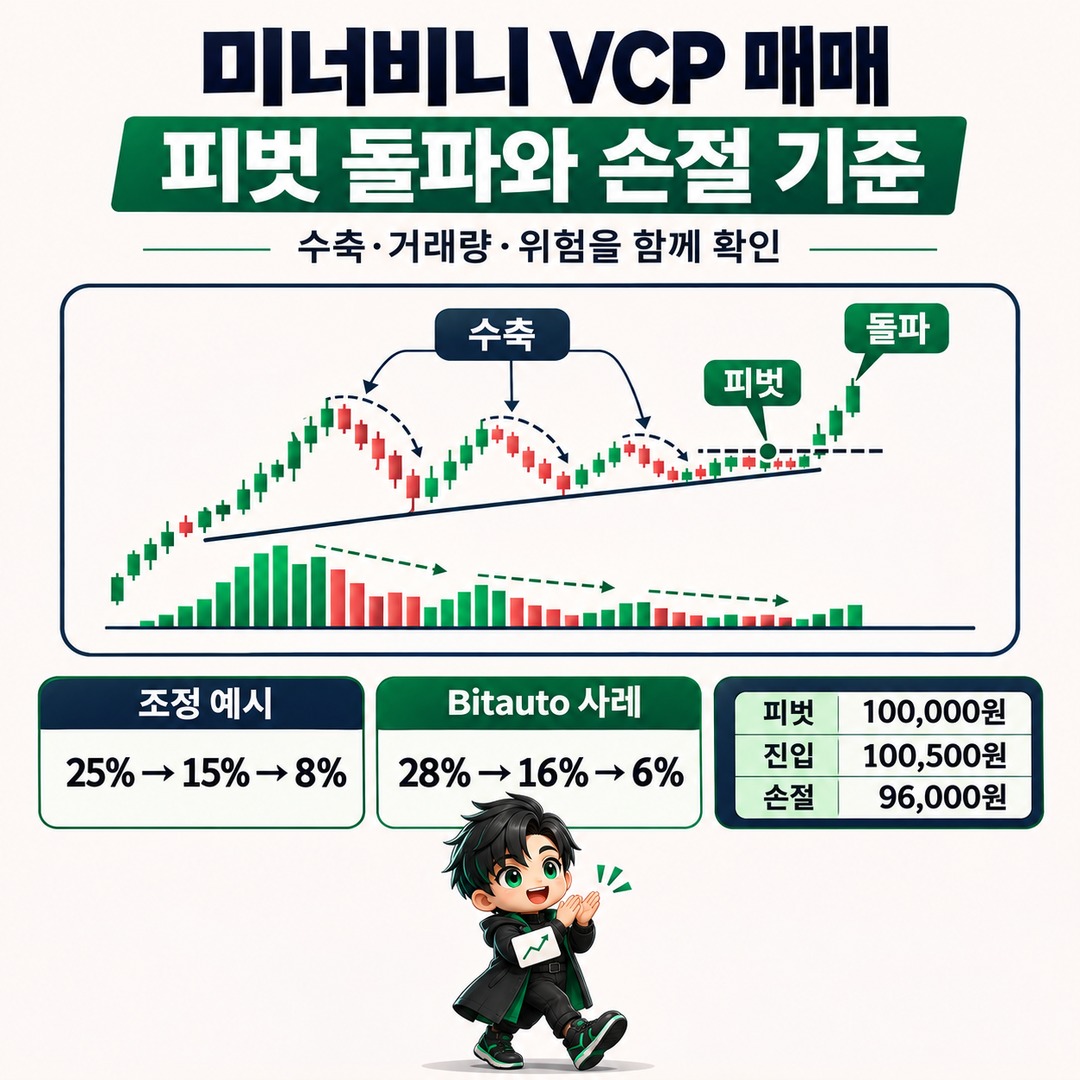
Mark Minervini’s Volatility Contraction Pattern (VCP) is a trading technique in which you enter when a stock in an uptrend, after several pullbacks that gradually reduce its price volatility and trading volume, breaks above the pivot in its final contraction. The key is to decide the entry price, final contraction low, volume, and acceptable loss before buying, rather than focusing on the breakout itself.
Based on Minervini’s books and related trading materials reviewed as of 2026-11-05, VCP does not have a fixed stop-loss percentage or a foolproof entry formula that applies equally to every stock. You should therefore distinguish the price at which the pattern is invalidated from the price at which you actually exit the trade.
Why look for contractions to become smaller in a VCP?
VCP is a technical pattern that uses price and volume to identify diminishing selling pressure in a stock that is in an uptrend.
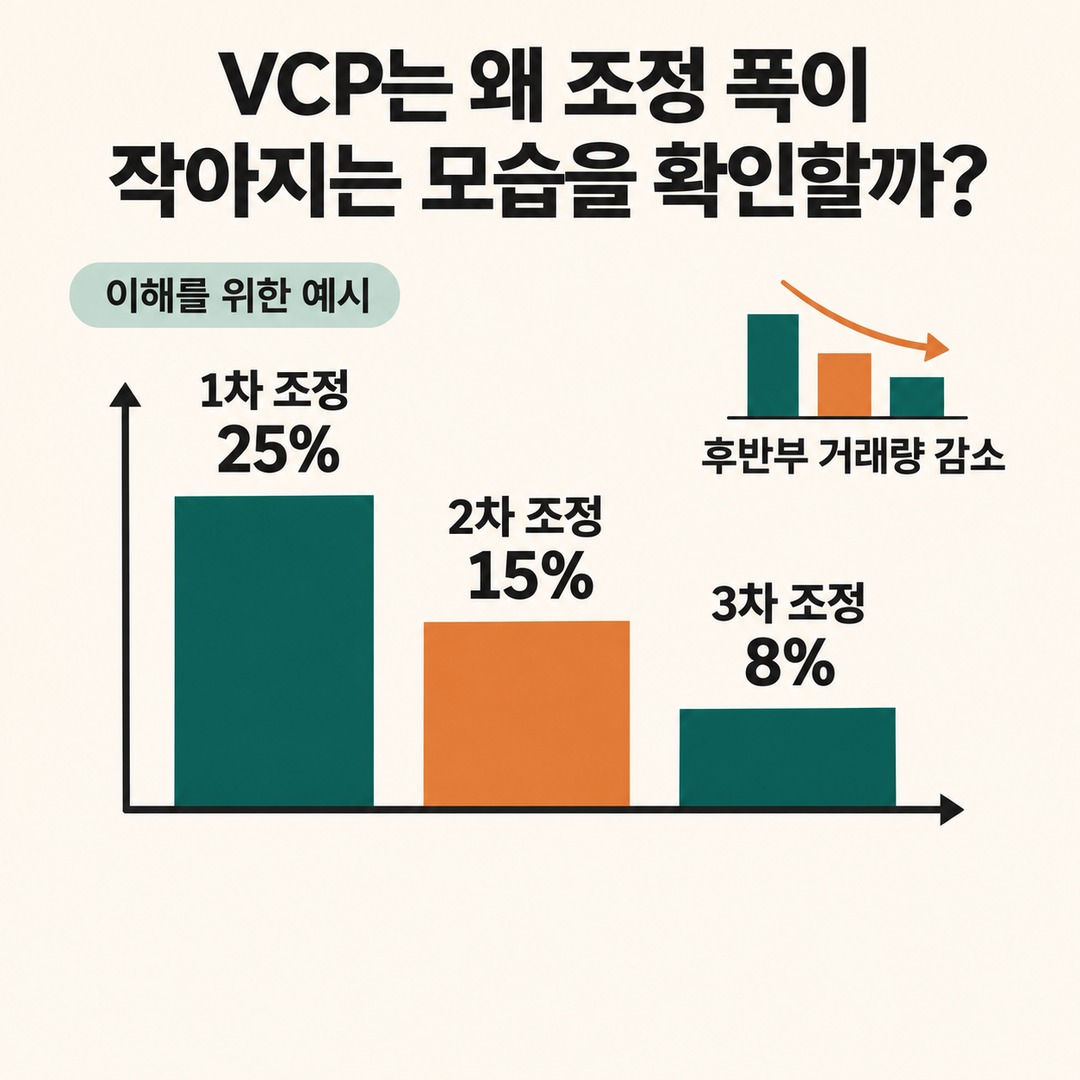
In his 2017 book *Think & Trade Like a Champion*, Minervini explains that a price pattern may generally show 2 to 6 contractions. Most patterns consist of 2 to 4 contractions, though a stock may have more.
For example, the pullbacks might look like this:
First pullback: 25%
Second pullback: 15%
Third pullback: 8%
The structure shows each pullback becoming smaller than the previous one, with volume also declining in the later stages.
Here, 25% → 15% → 8% is an illustrative example, not a mandatory ratio for every VCP.
In his book, Minervini presents the 2010-year Bitauto Holdings case. Over 8 weeks, the stock’s pullbacks narrowed in this sequence: 28%, 16%, 6%. Volume also declined during the final contraction.
What matters in this case is not the stock’s subsequent percentage gain, but the price structure and volume changes observed before buying.
The contraction structure of the VCP and the Bitauto case can be found in the original text of Minervini’s 2017 book, pages 108–110.
The entry price is the final pivot, not the top of the entire range
The VCP entry point is the pivot formed during the final contraction. The pivot is the reference price the stock must break above, determined with reference to the high of the final contraction.
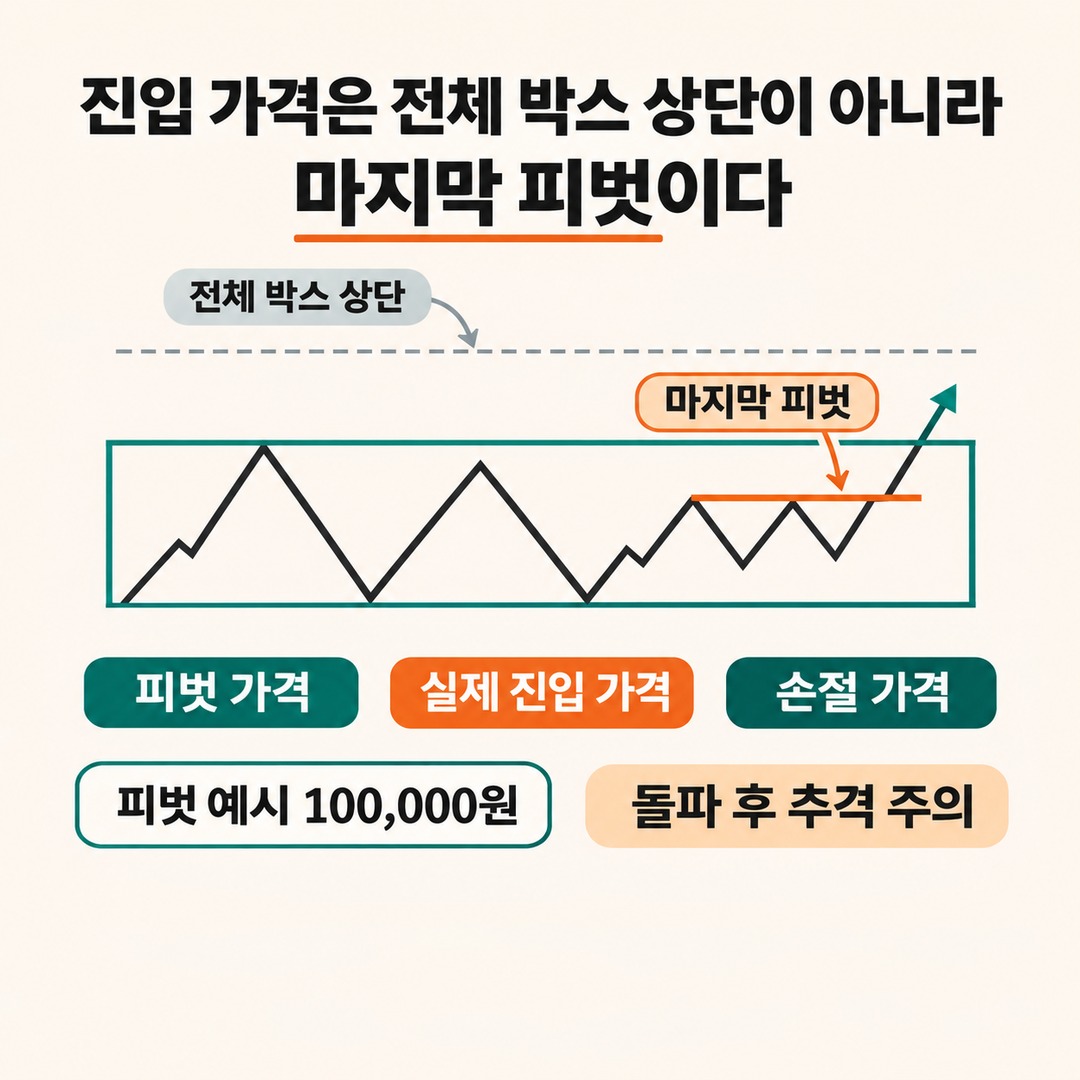
Minervini’s entry rule is to buy when the stock breaks above the pivot with increasing volume.
Three prices need to be distinguished:
| Type | Meaning |
|---|---|
| Pivot price | The breakout reference for the final contraction |
| Actual entry price | The price at which the order is actually filled |
| Stop-loss price | A risk-management level at which the trade thesis is invalidated |
The fact that the pivot is KRW 100,000 does not mean the actual fill price must also be KRW 100,000.
You could place an order as soon as the price moves above KRW 100,000, or wait to see whether it closes above the pivot before entering.
The two approaches differ in entry timing and fill price.
One thing to watch for with a breakout entry is chasing a price that has already risen far just because it moved above the pivot.
Minervini explains the principle of buying as close to the pivot as possible and avoiding chasing the price beyond a certain percentage.
He also identifies declining volume during the final contraction, below the average volume over 50 days, and very quiet trading days as positive characteristics.
However, declining volume during the final contraction and increased volume on the breakout day are two separate confirmation points.
Calculate the stop using the gap between the final contraction low and the actual entry price
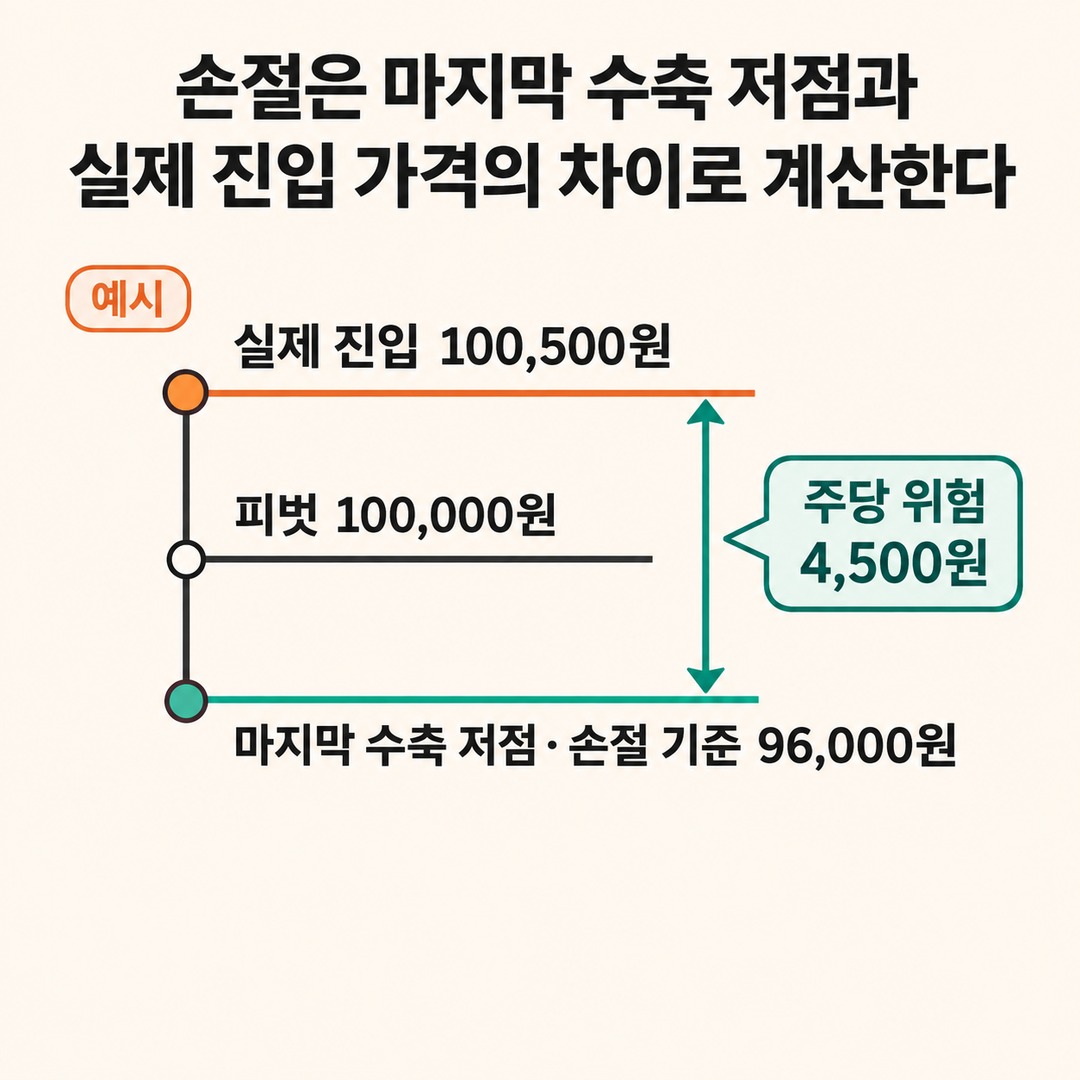
The key to setting a VCP stop is not to apply a fixed percentage mechanically, but to first identify the price at which the chart structure invalidates the trade rationale.
In his book, Minervini describes a risk-first approach: decide on the initial stop price before buying, then follow the plan before the loss exceeds the acceptable limit.
When applying a VCP to an actual trade, the low of the final contraction can serve as a key invalidation level.
For example, if the final contraction low is KRW 96,000 and the pivot is KRW 100,000, you could plan as follows.
Pivot: KRW 100,000
Actual entry: KRW 100,500
Stop price: KRW 96,000
Risk per share: KRW 4,500
Here, KRW 96,000 is an example stop price. The actual order price should be determined by considering the stock’s price movement and normal trading range.
If the stop is set too close to the final contraction low, the position may be closed out by a temporary fluctuation. Conversely, placing the stop too far below that level increases the loss you would have to bear on a single trade.
That is why it is important to set the stop price before deciding whether to enter.
How to calculate the number of shares to buy based on your account’s loss limit
As a hypothetical example, suppose the account balance is KRW 10,000,000 and the acceptable loss on one trade is 0.5%.
These figures are assumptions for explaining the calculation, not fixed rules Minervini sets for all investors.
| Calculation item | Amount |
|---|---|
| Account balance | KRW 10,000,000 |
| Acceptable loss 0.5% | KRW 50,000 |
| Entry price | KRW 100,500 |
| Stop price | KRW 96,000 |
| Risk per share | KRW 4,500 |
The author’s calculation is as follows:
Acceptable loss ÷ risk per share
KRW 50,000 ÷ KRW 4,500 = approximately 11.11 shares
Therefore, buy 11 shares, rounded down to a whole number.
Purchase amount: KRW 1,105,500
Estimated loss if the stop is triggered: KRW 49,500
Buying 12 shares would result in an estimated loss of KRW 54,000, exceeding the set KRW 50,000 limit.
This is a simplified calculation that excludes commissions, taxes, slippage, and additional losses from a gap down.
Since the actual fill price may be less favorable than the stop price, the calculated acceptable loss and the actual loss cannot be assumed to match exactly.
When judging whether a VCP breakout has failed, distinguish among three scenarios
VCP failures can be assessed in three broad categories: failure of the pattern to form, failure of the breakout, and a stop being triggered after entry.
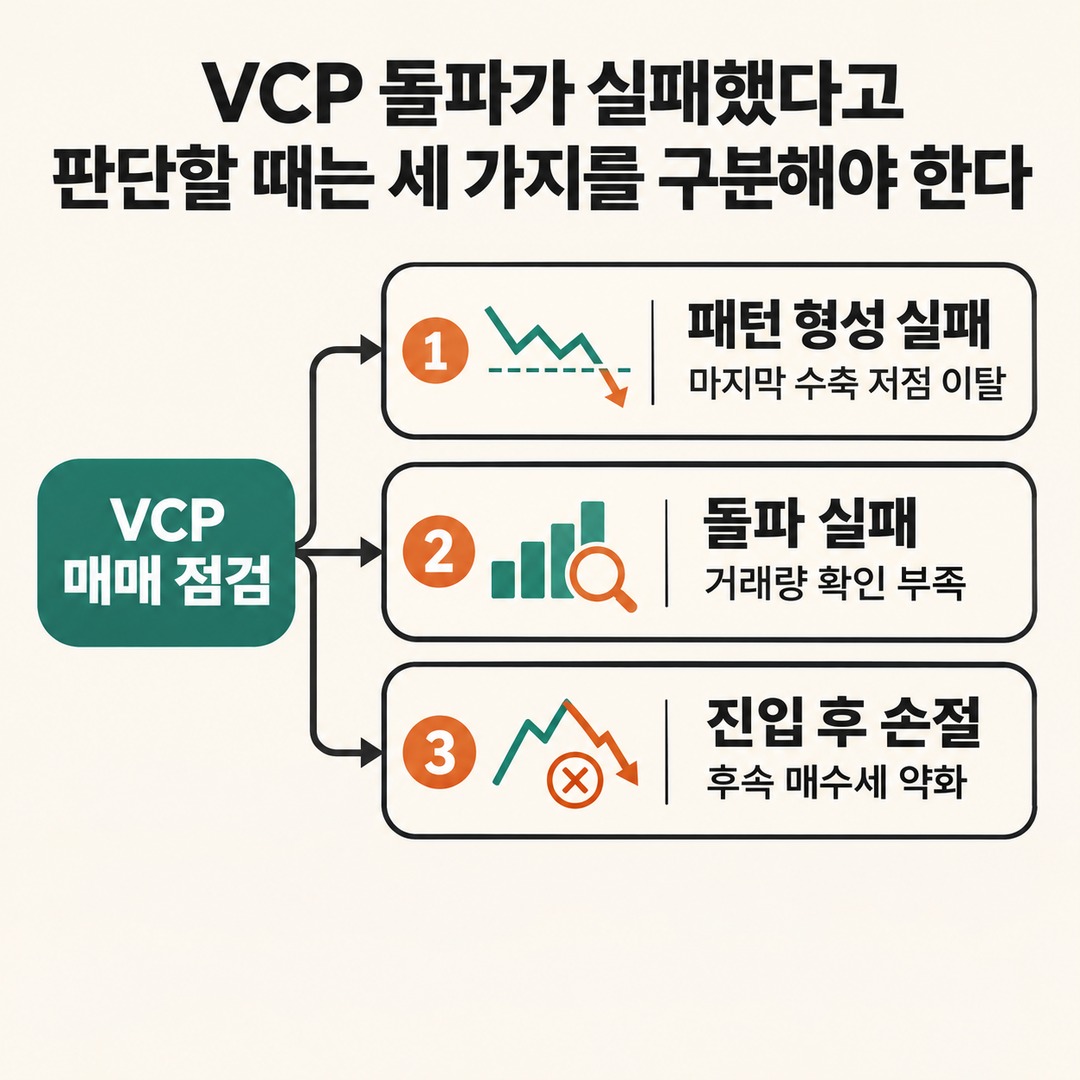
1. The final contraction low breaks first
If the stock falls below the low of the final contraction before breaking above the pivot, it is reasonable to invalidate the existing VCP buying plan.
Do not keep relying on the original pivot based only on the expectation that the price will recover.
Check whether new lows and highs form and whether a contraction structure develops again.
2. The price moves above the pivot without volume confirmation
Volume declined during the final contraction, but caution is warranted if it does not increase clearly at the breakout.
Minervini’s entry rule is to look for both an upward break above the pivot and an increase in volume.
It is therefore better not to treat a brief move above the pivot as a confirmed breakout on its own.
Applying one specific volume multiple to every stock should be distinguished from a universal fixed rule described in Minervini’s books.
3. Follow-up buying does not continue after the breakout
After a pivot breakout, check whether the advance actually continues.
Minervini describes follow-through gains over several trading days after the breakout, accompanied by increased volume, as a positive signal.
Conversely, if any of the following movements appear, the trading plan should be reconsidered.
The price falls back below the pivot immediately after the breakout
The price declines as volume increases
The price falls below the low of the final contraction
The advance fails to continue after the breakout and selling pressure builds
However, a brief dip below the pivot does not by itself mean every trade should immediately be declared a failure.
Minervini also explains the need to distinguish normal fluctuations from abnormal price movements. This is why the actual stop and the conditions for exiting the trade should be set in advance.

Separate pre-entry checks from post-entry actions
When applying VCP in practice, check the following in order.
Before entry
1. Is the stock already in an uptrend?
2. Are the pullbacks narrowing from left to right?
3. Is volume declining during the final contraction?
4. Can you clearly identify the final pivot price?
5. Can you set a stop price based on the low of the final contraction?
6. Is the difference between the actual entry price and stop price within the account’s risk limit?
After entry
1. Check whether the price holds above the pivot.
2. Watch volume and follow-through gains after the breakout.
3. Manage the low of the final contraction and the stop set in advance.
4. If the stop condition is triggered, close the position according to plan.
5. If a new VCP structure forms, assess it again as a separate trade.
The key is not to automatically buy the same stock again after a stop-out. A new purchase should be treated as a separate trade, evaluated only after a new pattern and entry rationale have formed.
In a VCP, the entry price relative to risk matters more than the pattern
If you understand Minervini’s VCP simply as a chart pattern in which pullbacks become smaller, it is easy to overlook what matters in actual trading.

The price action and volume during the final contraction, the pivot breakout, and the initial stop price should all connect as parts of one plan.
In particular, clearly distinguish between these two questions:
Is the pattern sound? Are an uptrend, successive price contractions, and declining volume evident?
Is the trade worth taking? Is the risk between the pivot entry and the stop at a level the account can bear?
VCP is a tool for identifying buy signals, not a formula that guarantees profits. Breakouts can fail even with a good pattern, and a trade that requires a stop should not be interpreted as a normal pullback.
When reviewing an actual chart, it is helpful to start by marking the final contraction low, the pivot, and the expected fill price, then calculating the risk per share and the number of shares you can buy.
※ This article provides reference information for understanding market trends and is not investment advice for any specific stock or asset. You are responsible for your own final decisions and investments.
This post contains Coupang Partners affiliate links. We may earn a commission from qualifying purchases.