

Why the U.S. Military Resumed Airstrikes on Iran: Retaliation After Six Days and the Impact on South Korean Oil Prices and Financial Markets
이 포스팅은 쿠팡 파트너스 활동의 일환으로, 이에 따른 일정액의 수수료를 제공받습니다.
This article is based on the latest reports and official sources available as of 2026-07-30 Korea Standard Time.
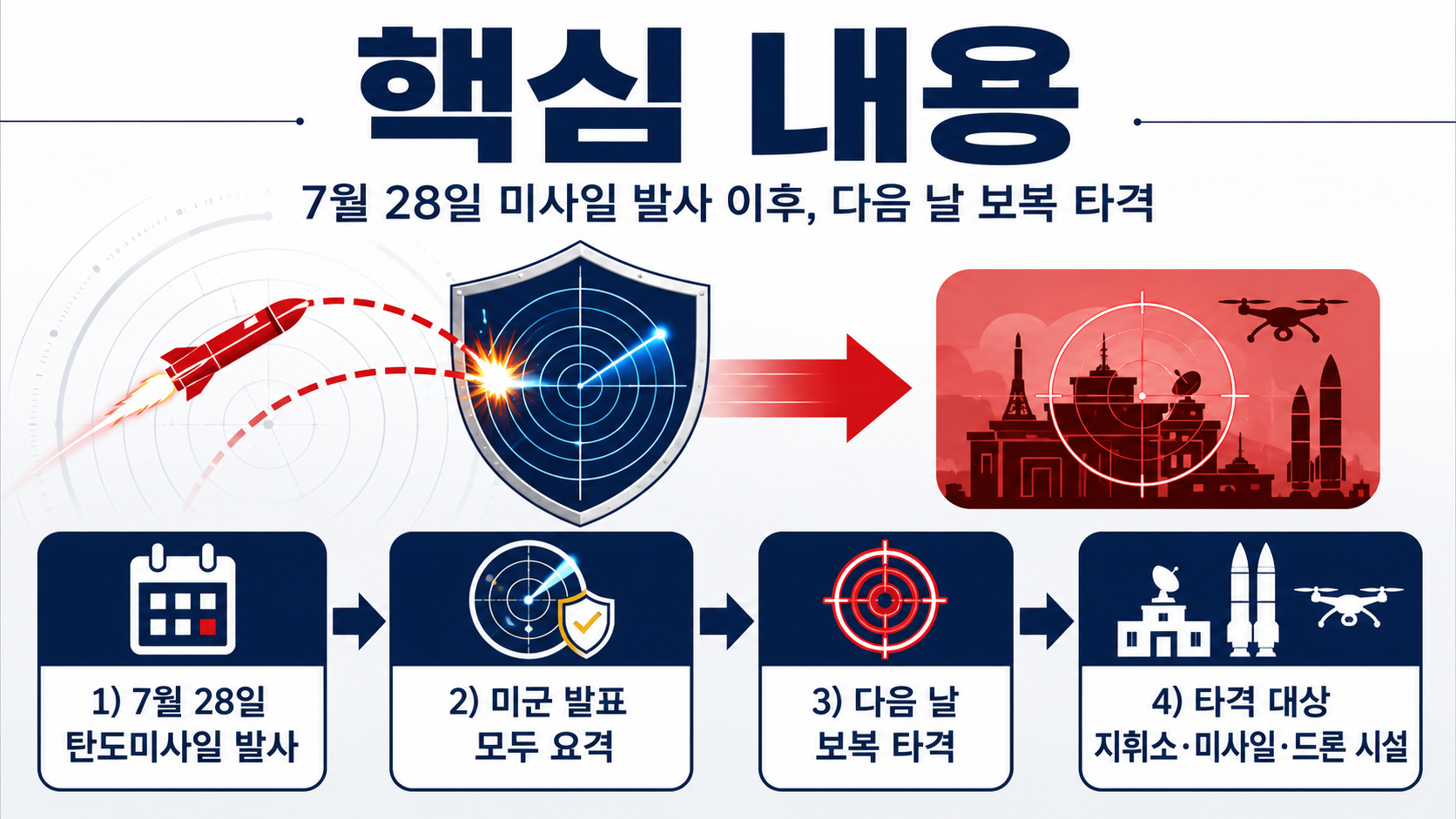
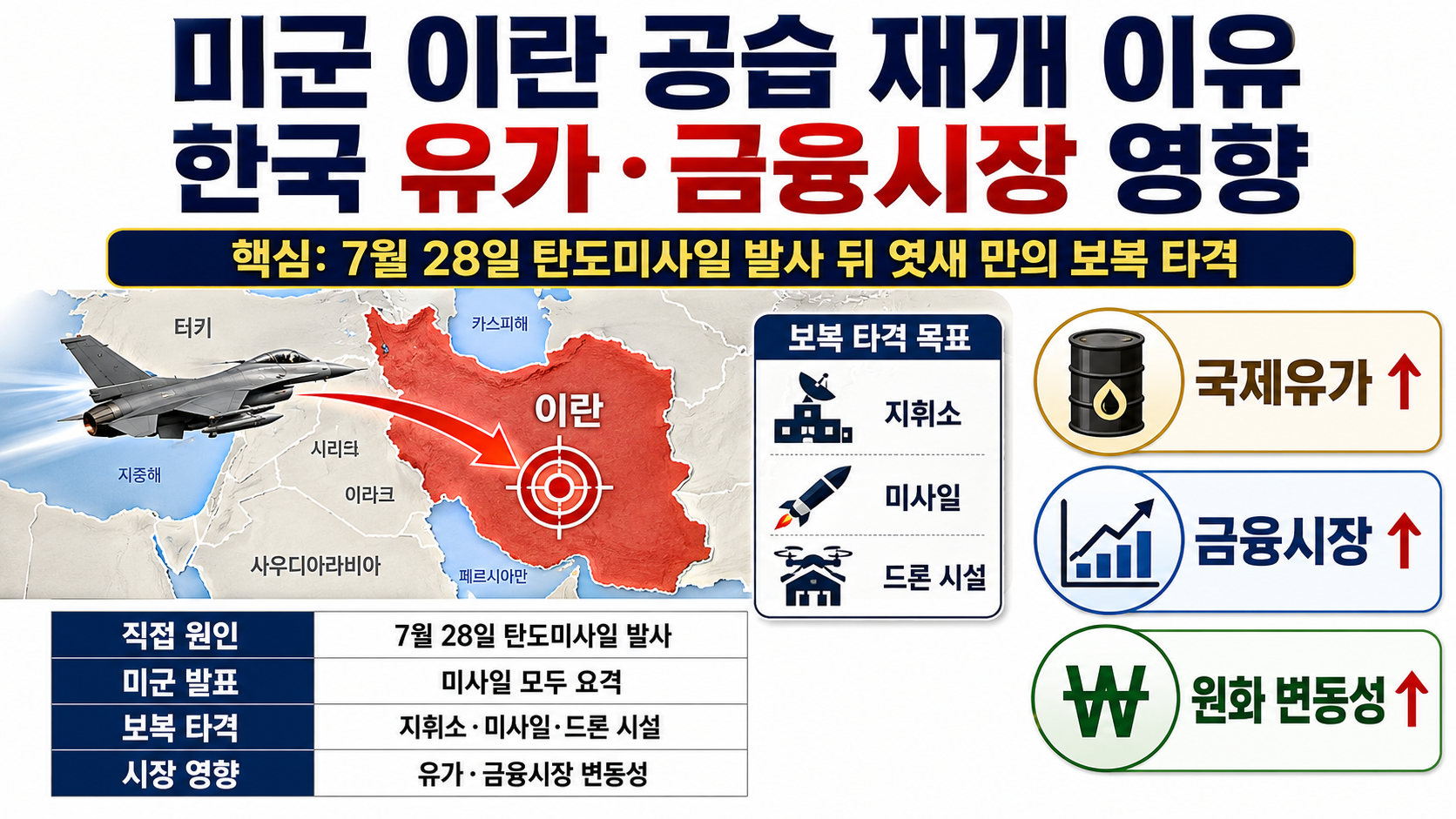
The immediate reason the U.S. military resumed airstrikes on Iran after six days was that Iran's Islamic Revolutionary Guard Corps (IRGC) launched ballistic missiles at U.S. forces stationed in the Middle East on July 28. The U.S. military said all the missiles were intercepted and carried out retaliatory strikes the following day against dozens of locations, including IRGC command posts and missile and drone facilities.
The operation appears to have been primarily a response to attacks threatening U.S. forces, Gulf countries, and commercial shipping, rather than an attack on nuclear facilities or a formal declaration of a new war. However, if the cycle of retaliation continues, the Strait of Hormuz and international oil prices could be among the first to feel the effects.
Why Did the U.S. Military Resume Airstrikes on Iran After Six Days?
According to the official statement from U.S. Central Command, the immediate trigger for resuming the airstrikes was Iran's ballistic missile attack. On July 28, Iran's Islamic Revolutionary Guard Corps launched several ballistic missiles targeting U.S. forces in the Middle East. The U.S. military said it intercepted every missile.
According to AP reporting and statements from Jordanian authorities, the target was Muwaffaq Salti Air Base in Jordan, and the Jordanian military reportedly intercepted 5 Iranian missiles. The base is known as a major hub supporting U.S. military operations in the Middle East.
The U.S. military subsequently announced that it had completed the airstrikes at 10 p.m. U.S. Eastern Time on July 29. That corresponds to 11 a.m. Korea Standard Time on July 30.
The U.S. military's stated objectives can be summarized in three points.
Deter further attacks against U.S. forces stationed in the Middle East
Protect commercial vessels passing through the Strait of Hormuz
Weaken the missile and drone attack capabilities of Iran and Iran-linked armed groups
Therefore, the most immediate reason for these airstrikes was retaliation for Iran's attack on U.S. forces and deterrence of further attacks, rather than the failure of negotiations itself.
How Many Days Were the Airstrikes Actually Suspended?
U.S. Central Command announced that it had ended its airstrikes on Iran, which had continued for 13 consecutive days, at 9 p.m. U.S. Eastern Time on July 23. It subsequently completed a new round of airstrikes at 10 p.m. on July 29.
The interval between the two announced times was 6 days and 1 hours, totaling 145 hours.
This is the author's calculation based on the announcement times.
End of previous airstrikes: 9 p.m. U.S. Eastern Time on July 23
Completion of the resumed airstrike operation: 10 p.m. U.S. Eastern Time on July 29
Calculation: 6 days × 24 hours + 1 hours = 145 hours
Converted to Korea Standard Time, the interval runs from 10 a.m. on July 24 to 11 a.m. on July 30. This time gap explains why news reports describe the operation as the resumption of airstrikes 'after six days.'
Why Did the United States Temporarily Halt the Airstrikes?
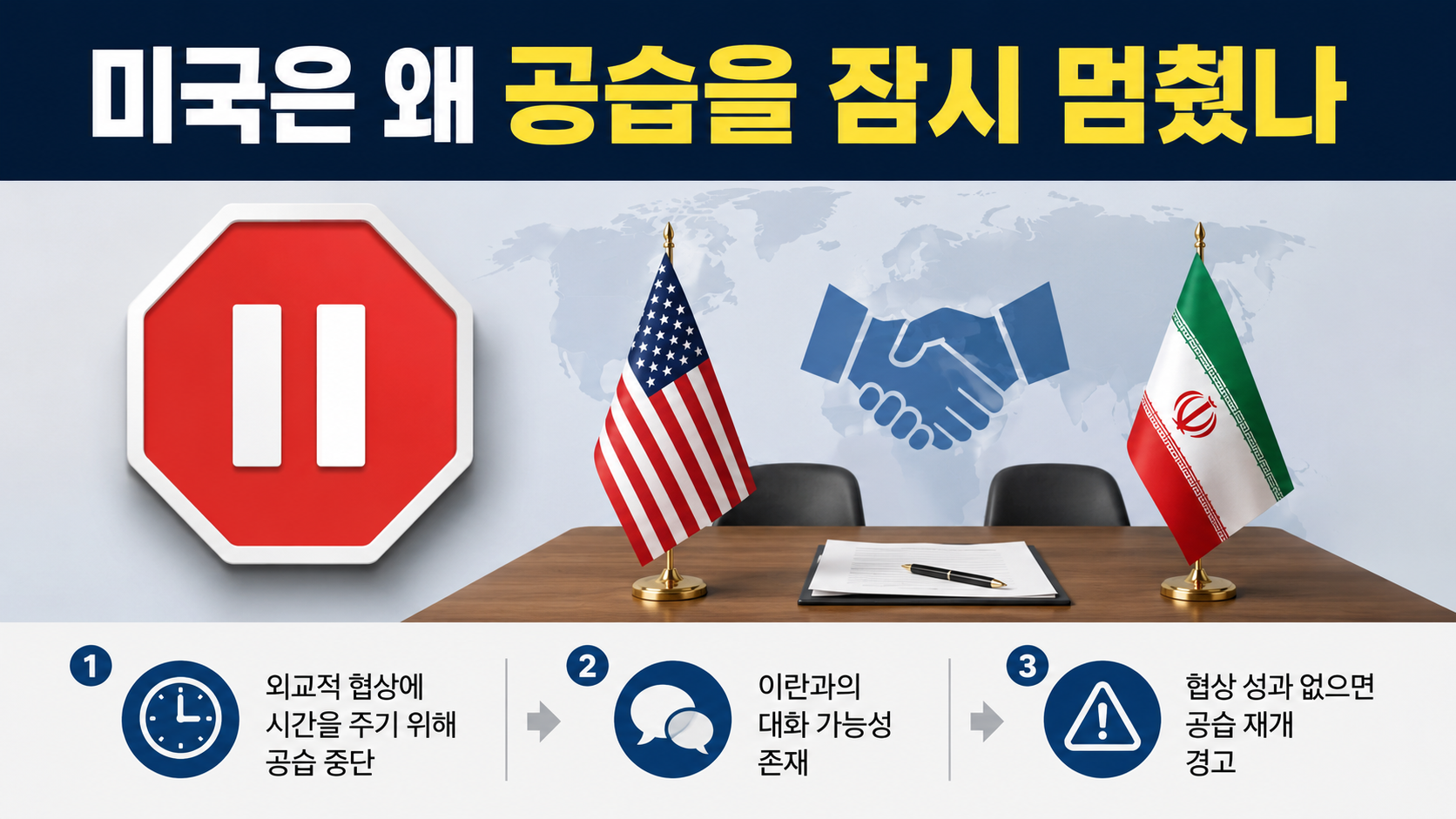
Officially, the United States explained that it had suspended the airstrikes to allow time for diplomatic negotiations. At the time, U.S. officials indicated that talks with Iran might proceed and warned that airstrikes could resume if negotiations failed to produce results.
However, reports also suggested that military considerations influenced the suspension.
Reuters reported that U.S. military commanders had used up a substantial portion of their previously selected targets and were concerned about potential pressure on inventories of precision-guided weapons and air-defense ammunition. U.S. President Donald Trump disagreed with claims of an ammunition shortage.
The distinctions are as follows.
| Category | Confirmed Information |
|---|---|
| Official U.S. explanation | Temporary suspension to allow time for diplomatic negotiations |
| International media reports | A reduction in remaining preselected targets and pressure on ammunition inventories were also considered |
| President Trump's position | Warned that airstrikes could resume if negotiations failed |
| Actual trigger for resumption | Iran's ballistic missile attack targeting U.S. forces stationed in the Middle East |
Importantly, the suspension was not a formal ceasefire or an agreement to end the war. It was closer to a temporary pause during which both sides refrained from attacks while attempting negotiations.
Which Locations in Iran Did the U.S. Military Attack?
U.S. Central Command said it attacked dozens of targets associated with Iran's Islamic Revolutionary Guard Corps during the operation.
| Target | Stated U.S. Military Objective |
|---|---|
| Military command posts | Weaken command-and-control capabilities for attacks |
| Missile facilities | Reduce the ability to attack U.S. bases and neighboring countries |
| Drone facilities | Weaken drone attack and support capabilities |
| Coastal surveillance facilities | Limit surveillance capabilities in the Strait of Hormuz |
| Coastal defense facilities | Reduce threats to commercial vessels and U.S. naval ships |
| Maritime operational capabilities | Deter maritime attacks by Iran and affiliated groups |
The U.S. military stated that the targets were military facilities belonging to Iran's Islamic Revolutionary Guard Corps. Based on the information released so far, it is difficult to verify the exact locations of all the facilities or the extent of the damage.
Further verification is needed because estimates of Iranian losses and civilian casualties may differ depending on the reporting source.
Does This Airstrike Mean a Return to Full-Scale War?
The announcements available so far are insufficient to conclude that the United States has resumed a prolonged, full-scale air campaign. Although U.S. Central Command described the operation as 'powerful airstrikes,' it did not release a separate operational schedule indicating that attacks would continue every day.
To determine whether the conflict is expanding into full-scale war, three developments matter more than a single round of airstrikes.
1. Whether U.S. Airstrikes Continue on Consecutive Days
If the U.S. military conducts nighttime airstrikes over several consecutive days, there would be stronger grounds to view the operation as the beginning of a new offensive campaign rather than a one-off retaliation.
Conversely, if mediation talks resume without further airstrikes, the attack may remain a limited retaliatory operation.
2. Targets of Further Iranian Retaliation
If Iran attacks oil fields, refineries, or ports in Saudi Arabia and the Gulf region, in addition to U.S. military bases, concerns about energy supplies could intensify.
It is also important to monitor whether attacks by Iran-linked armed groups in Iraq or Yemen's Houthi rebels expand.
3. Vessel Traffic Through the Strait of Hormuz
For financial markets and international oil prices, the most sensitive issue is not the number of airstrikes but whether crude oil and LNG can actually be transported.
If vessel traffic through the Strait of Hormuz is restricted or insurance premiums and freight rates surge, international oil prices could incorporate an additional risk premium even without a physical supply disruption.
How Much Have International Oil Prices Moved?
On July 29, when the conflict between the United States and Iran intensified again, Brent crude rose approximately 7% during the day and closed at USD 90.74 per barrel. U.S. West Texas Intermediate crude also rose to USD 84.46.
At the time of Reuters' report on July 30, Brent crude was around USD 90.38, while West Texas Intermediate was around USD 83.74. Although prices gave back some of the previous day's sharp gains, Brent remained above the USD 90 level.
International oil prices do not necessarily move in one direction solely in response to news of airstrikes. Several factors are reflected simultaneously.
Shipping conditions in the Strait of Hormuz and the Red Sea
U.S.-Iran negotiations through mediating countries such as Oman
Whether energy facilities in Saudi Arabia have been damaged
U.S. crude oil inventories
OPEC+ production decisions
Oil tanker freight rates and maritime insurance premiums
The repeated intraday rises and falls in oil prices on July 30 also reflected the simultaneous influence of airstrike risks and hopes for negotiations.
Will Gasoline Prices in South Korea Rise Immediately?
A sharp one-day increase in international crude oil prices does not mean that prices at South Korean gas stations will rise by the same percentage the following day. Domestic gasoline and diesel prices reflect international petroleum product prices, the won-dollar exchange rate, refinery supply prices, distribution costs, taxes, and existing inventories.
However, if international oil prices and the won-dollar exchange rate both remain elevated, upward pressure on domestic fuel prices could increase.
South Korea is particularly sensitive to developments in the Middle East because of its dependence on imported crude oil. According to the latest research published by the Korea Energy Economics Institute, South Korea's dependence on Middle Eastern crude oil increased again from 59.7% in 2021 to 71.7% in 2024.
Because a substantial portion of Middle Eastern crude oil passes through the Strait of Hormuz, shipping conditions in the strait may be more important for South Korea's domestic supply than the specific locations of the airstrikes.
When monitoring domestic fuel prices, the following sequence is useful.
1. Check whether Brent and Dubai crude prices remain elevated for several days.
2. Check whether the won-dollar exchange rate is rising at the same time.
3. Monitor changes in international petroleum product prices in Singapore.
4. Check refinery supply prices and average gas station prices through Opinet, operated by the Korea National Oil Corporation.
5. Review government announcements concerning fuel taxes and strategic petroleum reserves.
Rather than focusing on a single day's price spike, observing whether elevated prices persist for more than a week is more useful for assessing the direction of domestic fuel prices.
How Could the Airstrikes Affect South Korea's Financial Markets?
U.S. airstrikes on Iran could affect South Korea's financial markets through international oil prices, exchange rates, and foreign capital flows. However, caution is needed when attributing movements in the KOSPI on any particular day solely to the airstrikes on Iran.
On July 30, global markets were also influenced by expectations for U.S. benchmark interest rates, share-price fluctuations among artificial intelligence-related companies, and earnings results from major corporations, in addition to developments in the Middle East.
The impact also varies by industry.
| Sector | Expected Impact | Additional Factors to Monitor |
|---|---|---|
| Airlines and transportation | Higher jet fuel and transportation costs | Duration of elevated oil prices, fuel surcharges |
| Petrochemicals | Higher raw material costs, including naphtha | Ability to pass costs on through product prices, pri |
※ This article is provided for reference to help readers understand market trends and does not constitute investment advice regarding any particular stock or asset. Final investment decisions and responsibility rest with the individual investor.
이 포스팅은 쿠팡 파트너스 활동의 일환으로, 이에 따른 일정액의 수수료를 제공받습니다.