

Can Switching to a U.S. S&P500 Currency-Hedged (H) ETF Prevent Foreign Exchange Losses? Returns When the Exchange Rate Falls and Hidden Costs
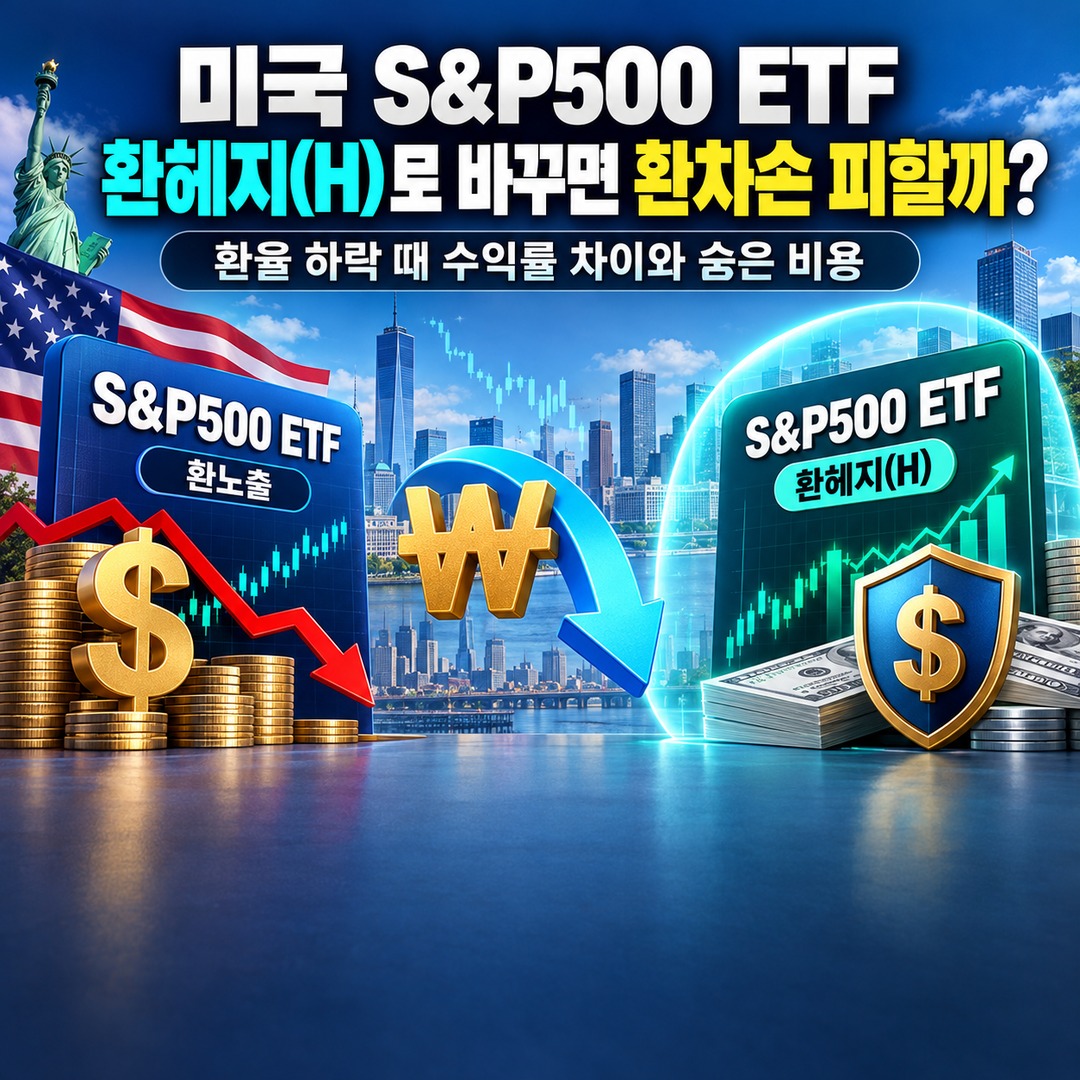
Currency-hedged ETFs may also incur costs associated with interest rate differentials and derivatives transactions. Rather than switching simply because the exchange rate is high, investors should consider the actual difference in returns and their investment horizon.
Information checked: 2026-10-27, 7 p.m. Korea Standard Time
1. Why Do Hedged and Unhedged ETFs Have Different Returns Even When They Track the Same S&P500 Index?
Although both products track the U.S. S&P500 Index, they differ in how movements in the Korean won–U.S. dollar exchange rate affect their returns.
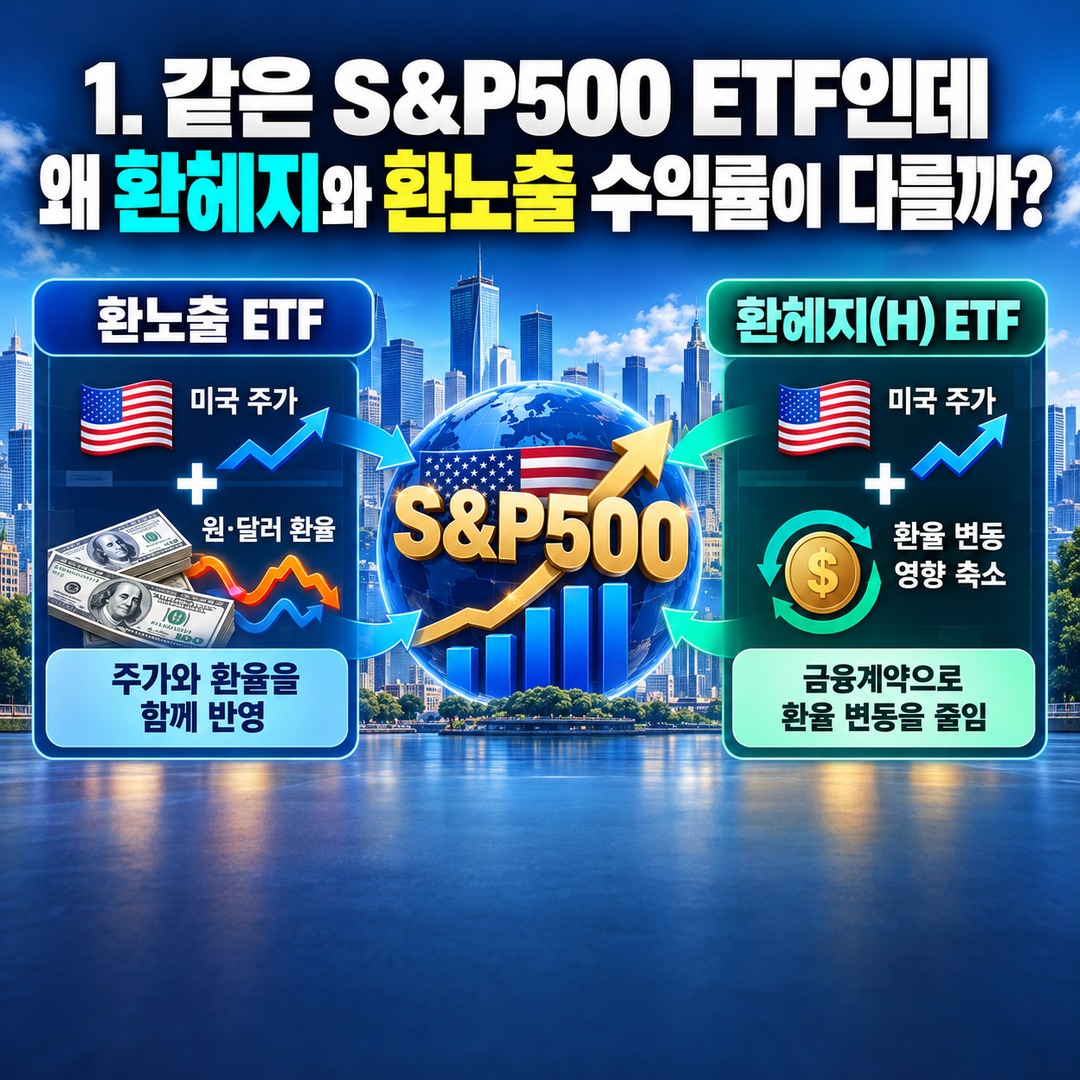
An unhedged ETF is exposed to both U.S. stock prices and exchange rate movements. A currency-hedged ETF, by contrast, uses financial contracts such as currency forwards to reduce the impact of exchange rate fluctuations.
| Category | Unhedged ETF | Currency-Hedged (H) ETF |
|---|---|---|
| Rising U.S. stock prices | Reflected in returns | Reflected in returns |
| Falling KRW/USD exchange rate | Reduces returns | Limits the impact of foreign exchange losses |
| Rising KRW/USD exchange rate | Boosts returns | Limits foreign exchange gains |
| Currency hedging costs | No separate hedging costs | May incur costs |
| Main risks | Stock price and exchange rate fluctuations | Stock prices, hedging costs, and tracking error |
For example, even if the U.S. stock market rises, a substantial appreciation of the Korean won could reduce the unhedged ETF's return when measured in won.
Conversely, if the U.S. dollar strengthens while U.S. stock prices fall, the currency gain could partially offset the unhedged ETF's losses in won terms.
However, a currency-hedged ETF cannot prevent losses caused by falling stock prices.
2. How Much Difference Would It Make If the Exchange Rate Fell from KRW 1,400 to KRW 1,300?
The easiest way to understand the impact of a falling exchange rate is to compare an unhedged ETF with a currency-hedged ETF using the same initial investment.
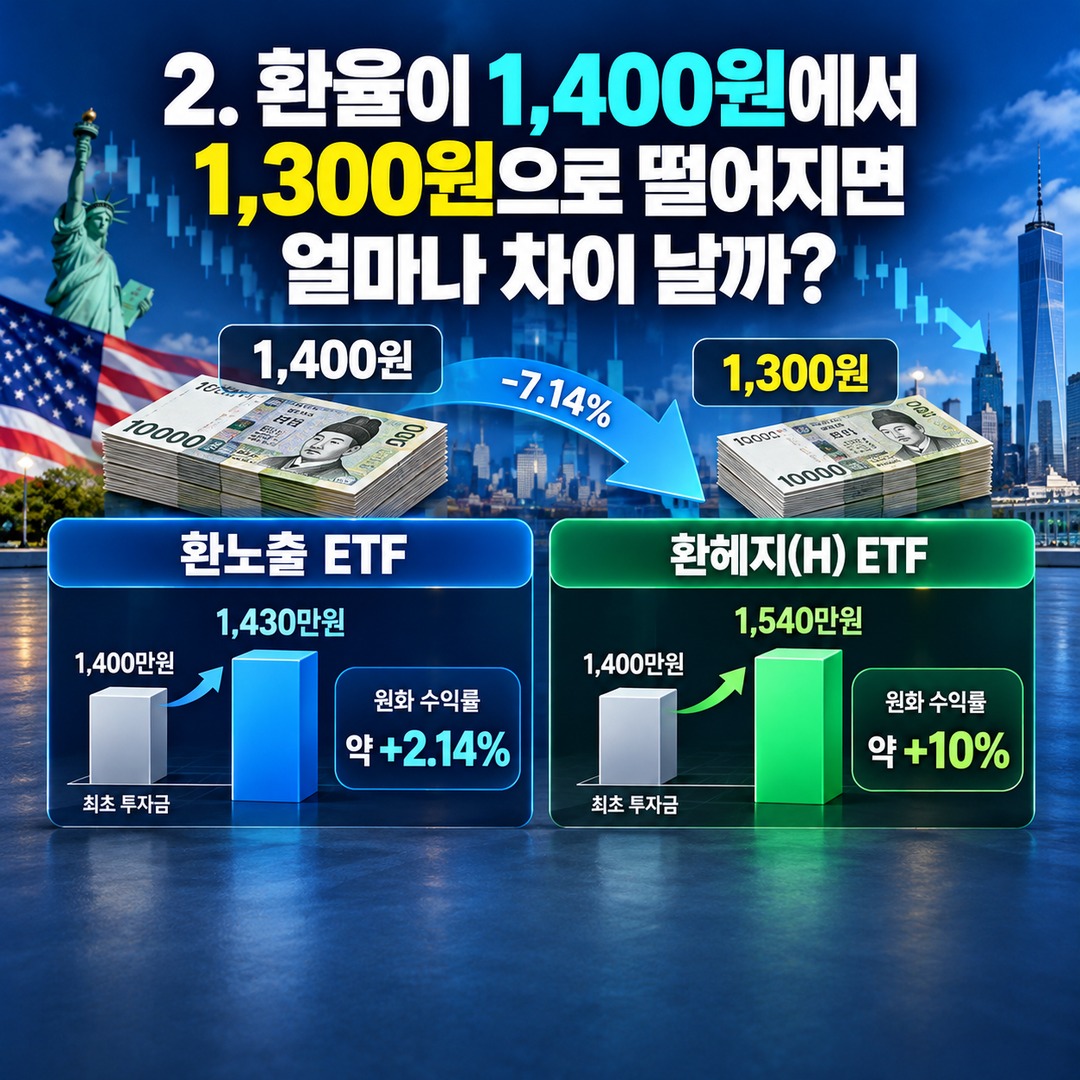
The following is a hypothetical example intended to illustrate the calculation, not actual market returns.
Assumptions
Initial investment: KRW 14,000,000
Initial exchange rate: KRW 1,400 per USD 1
Final exchange rate: KRW 1,300 per USD 1
Increase in the U.S. S&P500 Index: 10%
No additional purchases or sales during the investment period
Taxes, transaction costs, distributions, and tracking error excluded
Calculated Results for the Unhedged ETF
First, converting KRW 14,000,000 into U.S. dollars gives USD 10,000.
If U.S. stocks rise by 10%, the asset value increases to USD 11,000.
If the exchange rate has fallen to KRW 1,300 at that point, the value in Korean won is calculated as follows.
USD 11,000 × KRW 1,300 = KRW 14,300,000
The resulting return in Korean won is approximately 2.14%.
Although U.S. stock prices rose by 10%, the investment gained only approximately 2.14% when measured in Korean won.
Calculated Results for the Currency-Hedged ETF
Assuming exchange rate movements are fully offset over the same period and there are no hedging costs, the currency-hedged ETF could be expected to deliver a return close to the U.S. stock market's gain of 10%.
| Item | Unhedged | Currency-Hedged (H) |
|---|---|---|
| Initial investment | KRW 14,000,000 | KRW 14,000,000 |
| U.S. index gain | +10% | +10% |
| Exchange rate change | Approximately -7.14% | Assumed to be fully offset |
| Final investment value | KRW 14,300,000 | KRW 15,400,000 |
| Return in Korean won | Approximately +2.14% | Approximately +10% |
Calculations by the author. The currency-hedged return is a theoretical figure that excludes hedging costs, tracking error, and other factors. It differs from actual ETF performance.
The difference in the final investment values of the two products is KRW 1,100,000.
However, this does not mean the same difference would occur in an actual investment. Currency-hedged ETFs incur costs, and their actual hedge ratios are not always maintained at 100%.
3. How Much Are the Hidden Costs of a Currency-Hedged ETF?
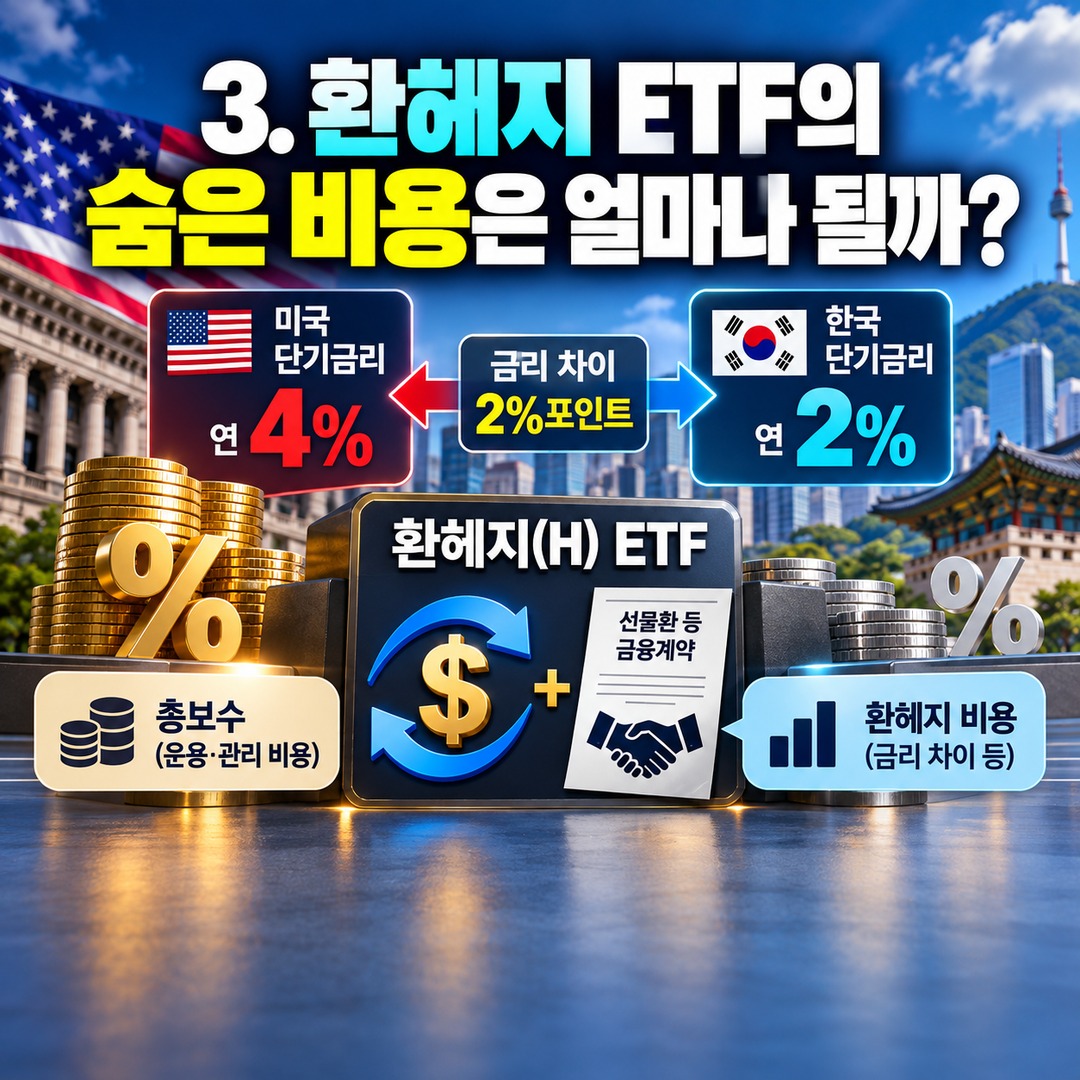
Currency-hedged ETFs reduce exposure to exchange rate fluctuations, but maintaining their hedging contracts may involve costs.
An important distinction is that an ETF's total expense ratio and its currency hedging costs are not necessarily the same thing.
The total expense ratio covers costs such as fund management and administration, while currency hedging costs are the economic costs arising from transactions, including currency forwards, designed to reduce exchange rate risk.
In particular, the interest rate differential between the Korean won and the U.S. dollar can affect currency hedging costs.
For example, consider the following hypothetical interest rate environment.
| Item | Assumption |
|---|---|
| U.S. short-term interest rate | 4% annually |
| South Korean short-term interest rate | 2% annually |
| Interest rate differential | 2% percentage points annually |
When U.S. interest rates are higher than South Korean rates, hedging the currency exposure of dollar-denominated assets held by a won-based investor can create costs associated with the interest rate differential.
However, an interest rate differential of 2% percentage points does not mean that every ETF will incur an annual hedging cost of exactly 2%.
Actual costs vary depending on forward exchange rates, contract duration, market conditions, transaction costs, and the fund's management approach.
Currency-hedging costs may also be reflected in an ETF's net asset value, making it difficult to determine the true cost simply by comparing published total expense ratios.
What If You Invest KRW 10,000,000 Over the Long Term?
For example, assuming the annual net cost of currency hedging is 1% of the invested amount, that would correspond to KRW 100,000 per year based on an initial investment of KRW 10,000,000.
This, too, is a simplified hypothetical example intended to illustrate the scale of the costs.
Over a longer investment period, portfolio valuations, interest rate differentials, and hedging contract terms can change continuously. It would therefore be incorrect to assume that exactly KRW 100,000 in costs will arise every year.
When comparing currency-hedged ETFs, it is worth reviewing not only their total expense ratios but also the prospectus disclosures explaining how currency risk is managed and what costs may arise.
4. Could a Currency-Hedged ETF Underperform If the Dollar Rises Again?
Yes, it could.
That is because a currency-hedged ETF reduces the adverse effects of a falling dollar exchange rate but, in return, also gives up much of the potential gain from a rising dollar.
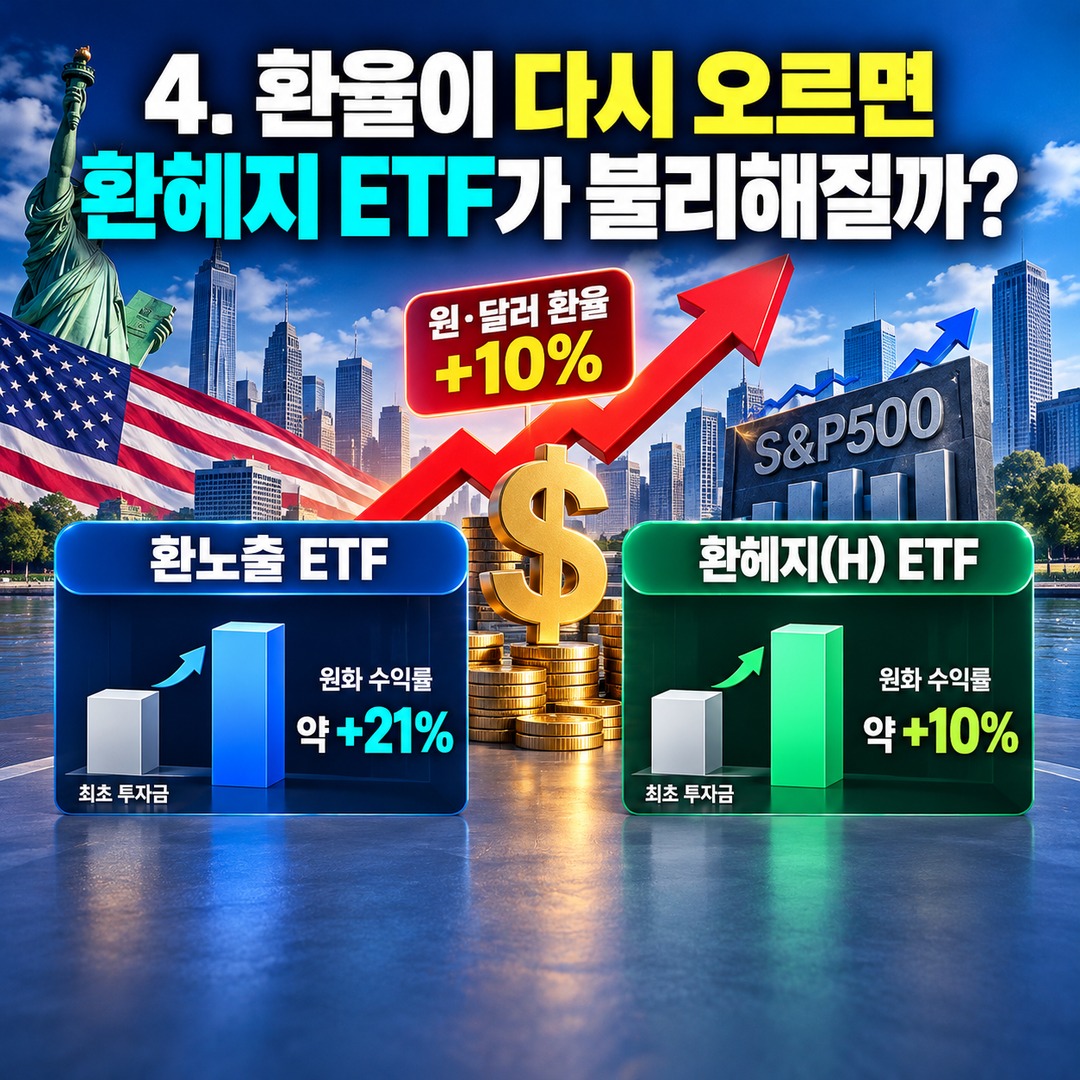
This time, let's consider a hypothetical scenario in which the U.S. S&P500 index rises by 10% and the U.S. dollar also appreciates by 10% against the Korean won.
The theoretical Korean-won return of an unhedged ETF would be calculated as follows.
(1 + 0.10) × (1 + 0.10) - 1 = 21%
By contrast, assuming a currency-hedged ETF completely offsets exchange-rate movements and incurs no hedging costs, it would generate a return of approximately 10%.
The important point is that the current exchange-rate level alone cannot establish where the currency will move next.
Even if the dollar appears expensive against the won, it could rise further. Likewise, even if it appears cheap, it could fall further.
Currency hedging is both an investment decision based on exchange-rate expectations and a tool for managing how much currency volatility an investor is willing to accept.

5. If You Already Own an Unhedged ETF, Should You Switch Now?
Deciding whether to sell an existing unhedged ETF and buy a currency-hedged ETF requires considering not only future exchange-rate movements but also gains or losses already incurred and the costs of trading.
In particular, switching to a currency-hedged ETF will not erase foreign-exchange losses that have already occurred.
Replacing an unhedged ETF with a hedged one changes your exposure to exchange-rate movements from that point onward.
Before switching, consider these four factors.
1. Investment horizon: Determine whether you will need Korean won in the near term or intend to hold dollar-denominated assets for the long term.
2. Overall dollar-asset allocation: Review how much you hold in dollar deposits and other overseas assets in addition to U.S. equities.
3. Fund costs: Compare the two ETFs' total expense ratios, actual costs, bid-ask spreads, and currency-hedging methods.
4. Taxes on selling: Tax treatment may differ depending on the account type and fund structure, so check the implications before selling.
If you are uncertain about the direction of exchange rates, you could also consider dividing your investment between currency-hedged and unhedged ETFs.
However, holding both types of ETF does not eliminate the risk of losses.
6. Are All ETFs Without (H) in Their Names Unhedged?
For overseas-investment ETFs listed in South Korea, `(H)` in the fund name generally indicates a currency-hedged product.
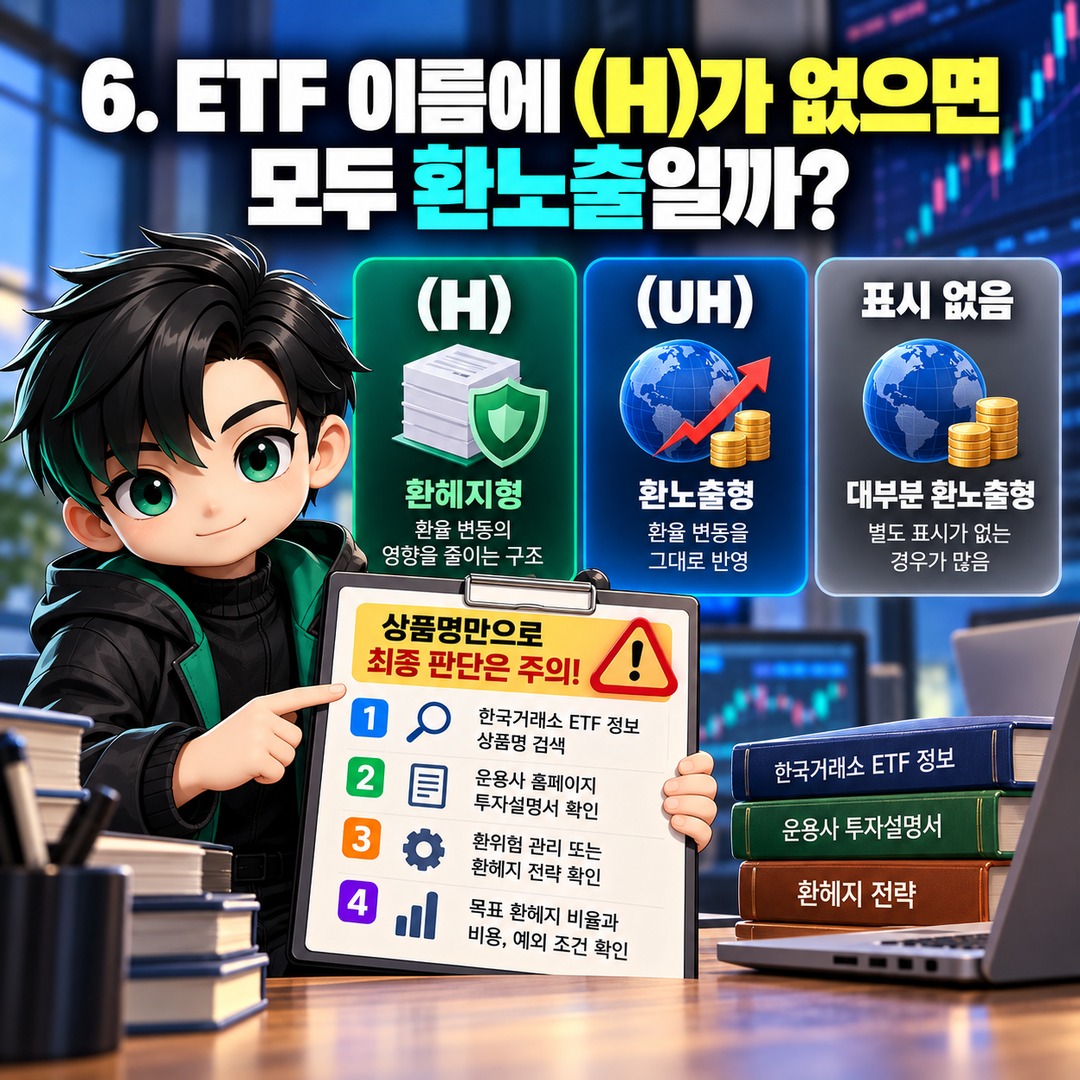
By contrast, `(UH)` indicates an unhedged product, and many unhedged ETFs have no special currency designation in their names.
However, you should not make a final determination based on the fund name alone.
Some funds use partial currency hedging or hedge exposure to only certain currencies.
To verify a fund's hedging approach, follow these steps.
1. Search for the fund name in the Korea Exchange's ETF information.
2. Review the prospectus on the asset manager's website.
3. Find the section covering currency risk management or currency-hedging strategies.
4. Check the target hedge ratio, associated costs, and any exceptions.
The Korea Exchange explains that, for unhedged overseas ETFs, comparing an underlying index denominated in a foreign currency with the fund's net asset value denominated in Korean won can make exchange-rate effects appear to be tracking error.
Therefore, when comparing ETF returns, it is important to use the same time period and currency basis and to account consistently for whether distributions are included.
The following official resources can be consulted.
KB Asset Management's explanation of currency-hedged and unhedged investments
U.S. SEC guidance on currency risks in international investing
7. Currency-Hedged vs. Unhedged ETFs: What Should Ultimately Guide Your Choice?
Neither type of ETF can be considered the better choice in every situation.
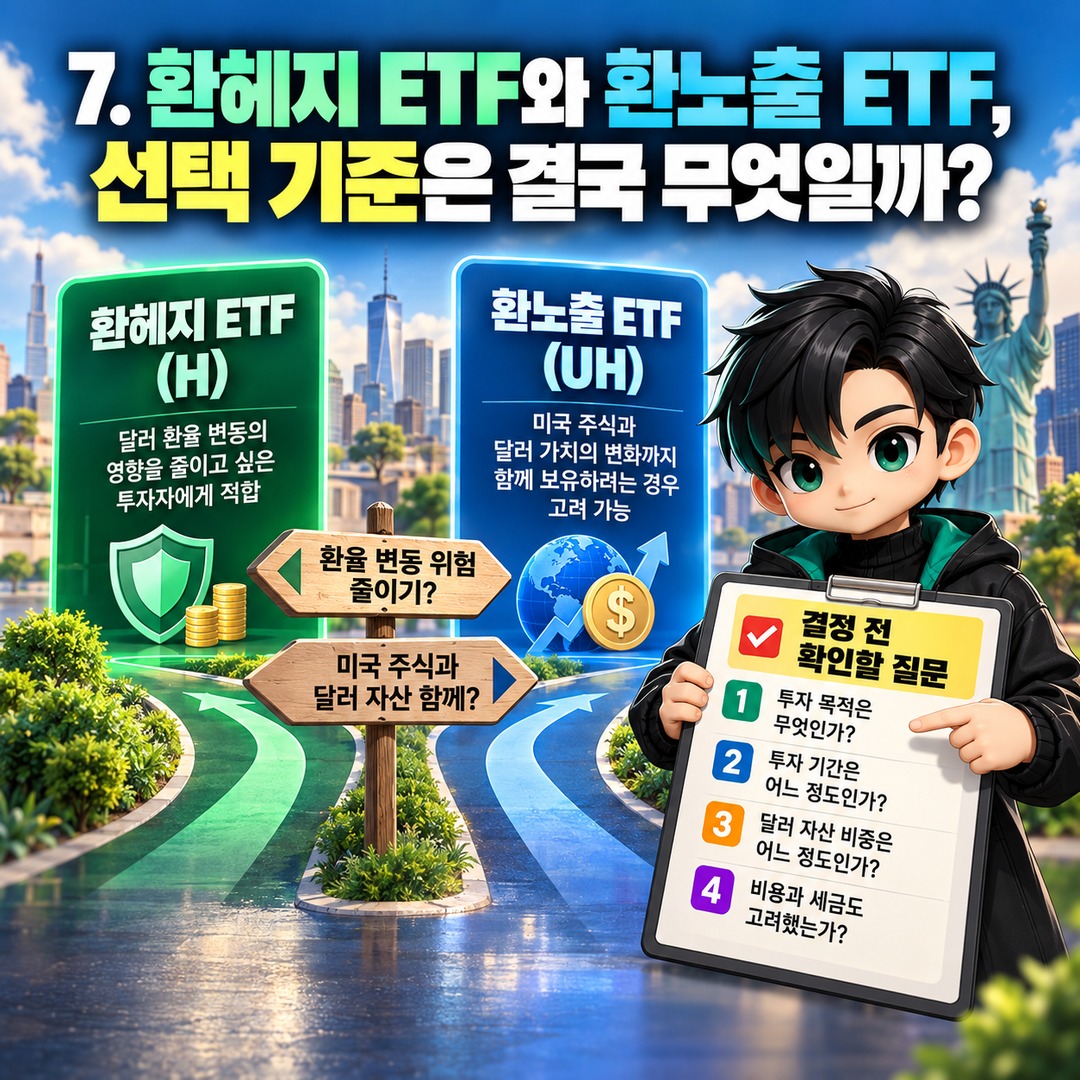
Currency-hedged ETFs may suit investors who want to reduce the impact of U.S. dollar exchange-rate fluctuations. Unhedged ETFs, on the other hand, may be worth considering for investors whose objectives include maintaining exposure to dollar-denominated assets.
In particular, if you are investing in a U.S. S&P500 ETF for the long term, frequently switching products based solely on short-term exchange rate forecasts can increase transaction costs and the risk of making poor investment decisions.
Ultimately, there is one key question to consider.
Am I primarily investing in the performance of U.S. stocks, or do I also want exposure to changes in the value of the U.S. dollar?
Your answer to this question is the starting point for choosing between currency-hedged and unhedged ETFs.
※ This article is provided for informational purposes to help readers understand market trends and does not constitute a recommendation to invest in any particular security or asset. You are responsible for your own investment decisions and their outcomes.