

Nasdaq Plunges 2.6% While the Dow and Small-Cap Stocks Rise: How Should ETF Investors Respond to the Divergence in AI Tech Stocks?
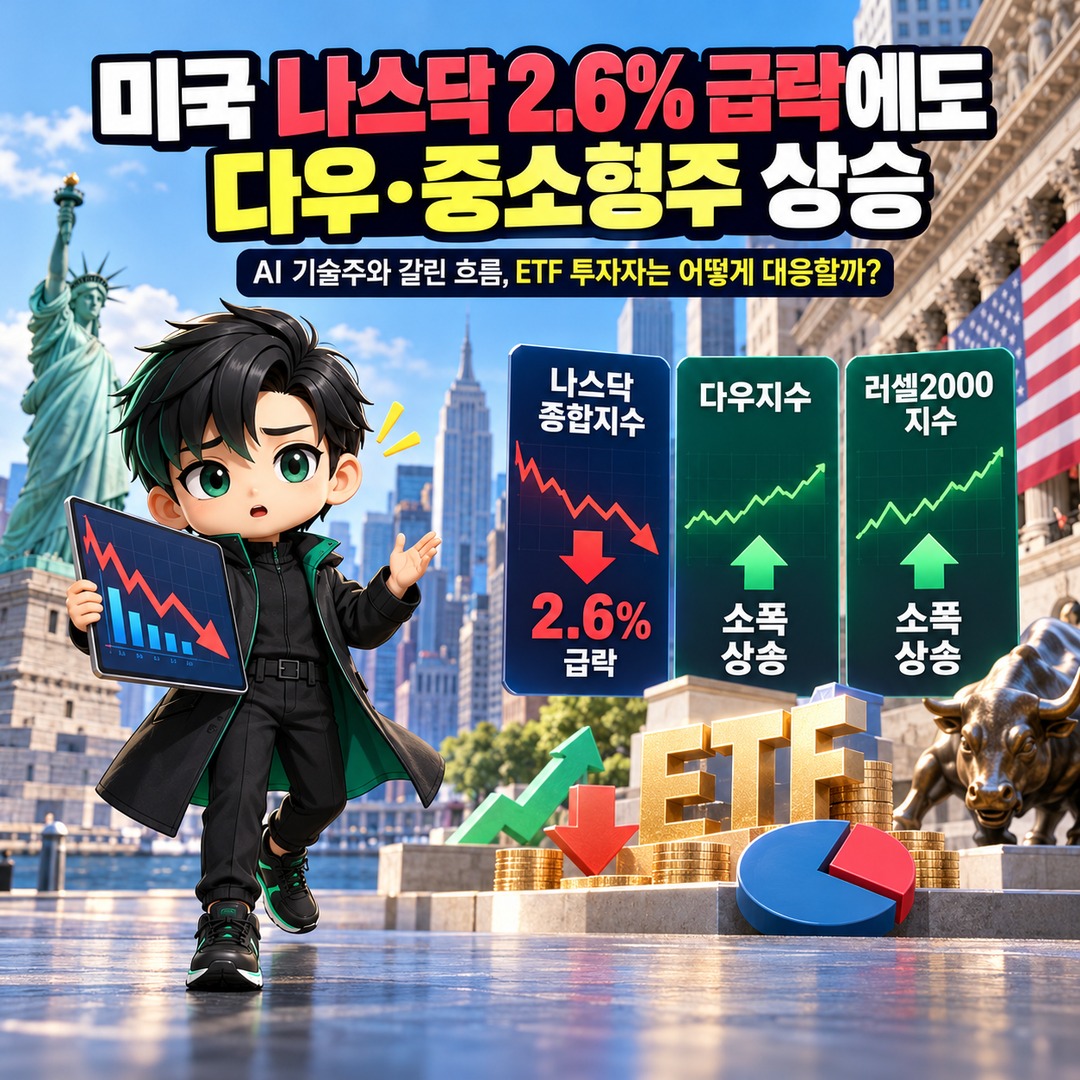
U.S. stock indexes moved in different directions on the same day. On 2026-10-22 (U.S. local time), the Nasdaq Composite plunged 2.6%, while the Dow Jones Industrial Average and the small-cap-focused Russell 2000 Index posted modest gains. As concerns about AI investment costs weighed on technology stocks, Nasdaq ETF holders should first assess their portfolios' concentration in technology stocks rather than focus solely on short-term losses.

It would be difficult to interpret this decline as a broad-based selloff across the entire U.S. stock market. Shares of major AI-related companies and semiconductor manufacturers dragged down the indexes, while more stocks advanced in other sectors.
How Large Was the Gap Between the Nasdaq and the Dow on October 22?
A defining feature of the U.S. stock market that day was the wide performance gap between technology-heavy indexes and indexes representing a more diverse range of industries.

The U.S. stock market closing results for October 22 were as follows.
| U.S. Stock Index | Closing Level | Daily Change |
|---|---|---|
| Nasdaq Composite | 26,008.86 | -2.6% |
| S&P 500 | 7,663.43 | -1.2% |
| Dow Jones Industrial Average | 52,867.98 | +0.02% |
| Russell 2000 | 2,784.03 | Approximately +0.1% |
The Nasdaq Composite fell 694 points during the session. In contrast, the Dow Jones Industrial Average gained 11.89 points, while the Russell 2000 Index, which represents U.S. small-cap stocks, rose 3.01 points.
The difference between the Nasdaq's and Dow's daily returns was approximately 2.62% percentage points. Although the Dow's gain was small, the contrast was striking because it finished in positive territory even as technology stocks suffered substantial losses.
However, both the Dow and Russell 2000 gained only around 0.1%. It is too early to interpret these gains as evidence that small-cap stocks or traditional industrial companies have entered a sustained upward trend.
Why Did AI Technology Stocks Plunge?

The technology-sector decline was driven less by doubts about the growth of the AI industry itself than by concerns about the costs of massive investments and companies' ability to generate actual cash flow.
AI companies are investing enormous amounts of money in infrastructure, including data centers, semiconductors, and servers. However, as investment spending increases, markets become more sensitive not only to revenue growth but also to the cash flow needed to support that spending and the returns generated by those investments.
Interest in AI investment spending and financing intensified particularly after Meta Platforms released its earnings results.
Meta faced pressure on its cash flow because of AI-related spending, renewing market questions about how much profit these investments could generate over the long term.
Tesla's shares also declined following its earnings announcement. However, Meta and Tesla have different business structures and investment plans, so their stock-price declines cannot be attributed entirely to the same cause.
The semiconductor sector also suffered substantial losses.
Companies supplying semiconductors and manufacturing equipment for the AI industry are sensitive to the outlook for data center investment. As concerns about AI investment costs intensified, selling pressure spread across semiconductor-related stocks.
There is an important distinction here.

A Decline in AI-Related Share Prices Is Not the Same as a Disappearance of Demand for AI Technology
Even when a company's revenue is growing, its share price can decline if profitability falls short of investor expectations or the market changes its assessment of future cash flows.
Therefore, this decline alone does not provide sufficient grounds to conclude that growth in the AI industry has ended.
Why Did the Dow and Small-Cap Stocks Rise?
The Dow and Russell 2000 rose because investment conditions did not deteriorate simultaneously for every U.S. company.
The Nasdaq is sensitive to movements in major technology and growth stocks. In contrast, the Dow consists of 30 major companies, and its index calculation methodology also differs from that of the Nasdaq Composite.
The Russell 2000 is an index focused on U.S. small-cap stocks. Declines in the share prices of major AI companies do not necessarily affect all small-cap stocks in the same way.
During this trading session, AI-related companies suffered steep declines, but more stocks advanced than declined across the broader U.S. market.
This distinction matters when interpreting market conditions.
A falling Nasdaq does not mean that most U.S. stocks declined. Conversely, a rising Dow does not mean that risks across the broader market have disappeared.
It means that concentrated selling pressure in technology stocks can occur at the same time as relative strength in other sectors.
Small-cap stocks, in particular, are influenced by interest rates, economic expectations, and corporate financing conditions. A single day's gain in the Russell 2000 does not establish that small-cap stocks will continue to outperform.
Should Nasdaq ETF Holders Sell Now?
Rather than deciding to sell their entire positions or buy more based solely on a single day's decline, Nasdaq ETF investors would be better served by first reviewing their investment horizons and portfolio allocations.
Even among Nasdaq-related ETFs, the underlying investments differ.
ETFs tracking the Nasdaq 100 concentrate on large nonfinancial companies, and their holdings and portfolio weights differ from those of products tracking the Nasdaq Composite.
Semiconductor ETFs and leveraged ETFs may also be more sensitive to specific industries or changes in daily returns than standard Nasdaq 100 ETFs.
Therefore, a 2.6% decline in the Nasdaq Composite does not mean that every Nasdaq-related ETF will fall by exactly 2.6%.
Long-Term Investors Making Regular Contributions
Investors with long investment horizons who regularly contribute fixed amounts should carefully consider whether a sharp one-day decline is sufficient reason to change their existing investment plans.
However, long-term investing does not eliminate the risk of losses. Investors should check whether they can afford to leave their money invested for an extended period without affecting their daily lives and whether their technology-stock exposure is excessively high.
Investors With Heavy Technology-Stock Exposure
Investors who hold not only Nasdaq 100 ETFs but also individual AI stocks, semiconductor ETFs, and funds investing in major U.S. technology companies may have greater exposure to the technology sector than they realize.
Even when investors hold different products, diversification benefits can be limited if those products have overlapping major holdings.
For example, holding both a Nasdaq 100 ETF and a semiconductor ETF may mean that changes in the share price of a particular AI-related company affect both investments simultaneously.
It is more important to examine actual holdings and sector allocations than simply count the number of investment products owned.
Short-Term Investors and Leveraged ETF Holders
Investors who need to access their funds in the near future or hold leveraged products need to respond more carefully to price volatility than typical long-term investors.
Leveraged ETFs are generally designed to track a specified multiple of an underlying index's daily return.
Consequently, when held over multiple days in volatile markets, their cumulative returns can differ from a simple multiple of the underlying index's cumulative return.
Aggressive additional purchases intended to recover losses can further increase investment risk.
Three Things Nasdaq ETF Investors Should Check
1. The Index the ETF Actually Tracks
First, investors should determine whether their ETF tracks the Nasdaq 100, the Nasdaq Composite, or a semiconductor index.
Even ETFs classified as technology-related investments can differ in their underlying assets and volatility.
Rather than relying on the product name alone, investors should review the fund manager's holdings disclosures and prospectus.
2. Technology Stocks' Share of Total Investment Assets
If Nasdaq ETFs represent only a portion of an investor's total investment assets, a one-day decline may have a limited impact on the overall portfolio.
Conversely, investors who have concentrated most of their investment assets in technology ETFs may experience larger losses from the same market movement.
For example, assume that 60% of total investment assets is held in a Nasdaq ETF.
If the ETF's price falls 10% while the prices of all other assets remain unchanged, the loss on the total investment portfolio would be 6%.
This is a simple calculation that multiplies the ETF's portfolio weight of 60% by its decline of 10%. Actual investment returns will vary depending on exchange rates and price movements in other assets.
Calculating the impact on the entire portfolio, rather than focusing only on the ETF's own percentage decline, may therefore be more useful for investment decisions.
3. Exchange Rates and Investment Horizon
Investors in U.S. Nasdaq ETFs listed in South Korea should examine not only U.S. stock indexes but also exchange rates and whether their ETFs use currency hedging.
For products without currency hedging, changes in the U.S. dollar–South Korean won exchange rate may affect returns measured in won.
Even if a U.S. index declines, a weaker won may offset part of the loss. Conversely, a stronger won may amplify losses.
Investors in currency-hedged products should also review product-specific conditions, including hedging costs and tracking errors.
What Should Investors Watch in AI Technology Stocks Going Forward?
To assess whether AI technology stocks are stabilizing, investors should examine changes in corporate investment spending and profitability rather than focusing solely on stock-price rebounds.
First, investors should monitor how data center investment and capital expenditure plans change in earnings announcements from major technology companies.
Capital expenditure refers to money companies spend acquiring long-term assets such as servers, facilities, and data centers.
When investment spending is increasing, it is important to examine how operating cash flow and free cash flow change alongside revenue growth.
Other variables that may influence the market include semiconductor companies' earnings and order outlooks, changes in U.S. Treasury yields, and international oil prices.
On October 22, rising international oil prices and geopolitical tensions also weighed on financial markets.
However, the future direction of these variables cannot be determined with certainty.
What this U.S. trading session demonstrated was a substantial divergence between the performance of technology stocks and the rest of the market.
For Nasdaq ETF holders, the key question is not whether they can predict a one-day decline, but how heavily their current ETFs are concentrated in particular companies and industries, and whether they can tolerate the associated risks.
Investors should first review their investment horizons, asset allocations, and product structures before deciding whether to sell, buy more, or continue holding.
※ This article is provided for informational purposes to help readers understand market developments. It does not constitute an investment recommendation for any particular security or asset. Investors are responsible for their own final decisions and investment outcomes.