

Single-Stock Leveraged ETF Cash Deposit Requirement of KRW 30,000,000: Trading Rules Changing from July 31
이 포스팅은 쿠팡 파트너스 활동의 일환으로, 이에 따른 일정액의 수수료를 제공받습니다.
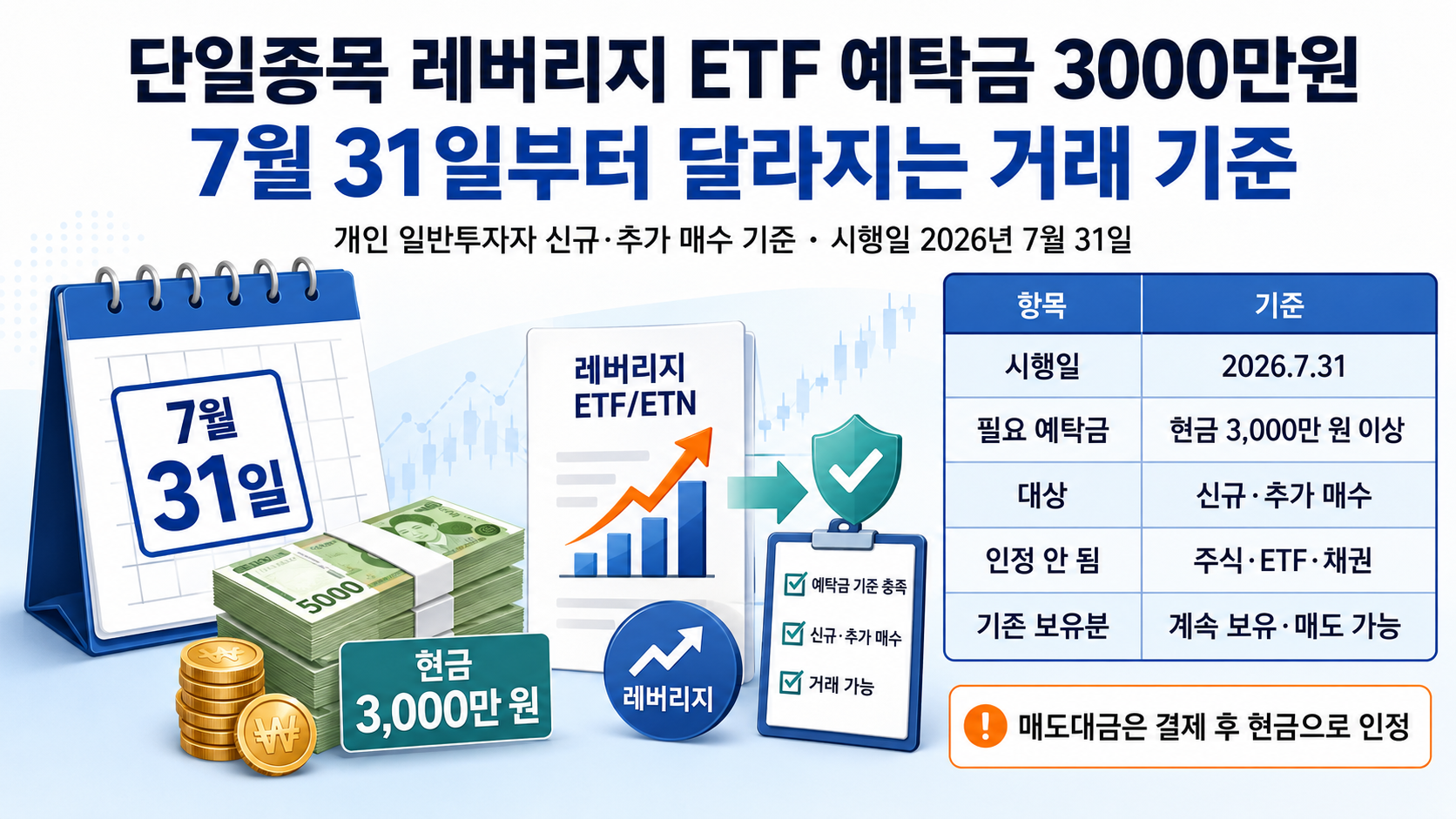
This article is based on the latest available news reports and official materials verified as of 2026-07-27 Korea Standard Time.
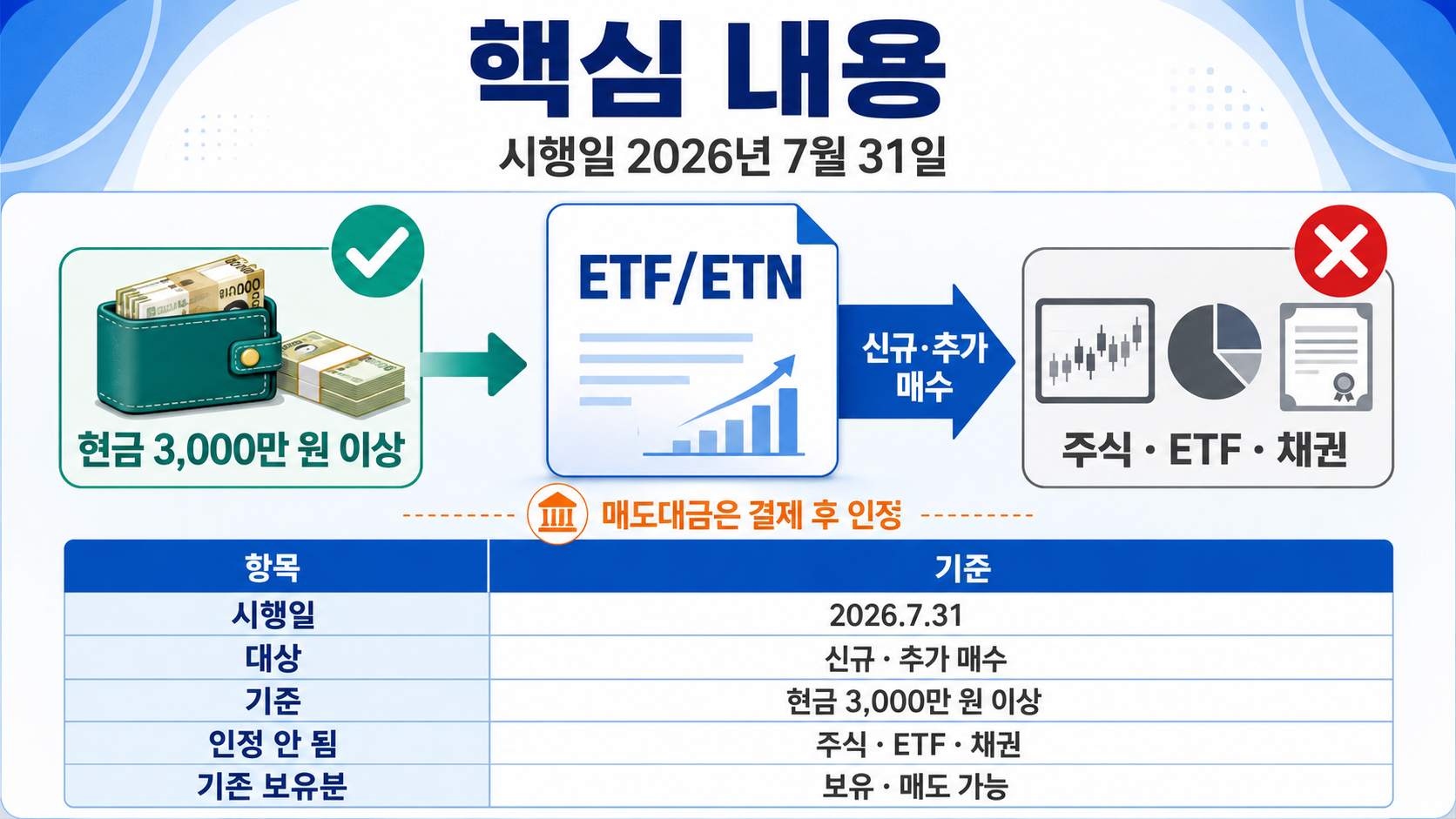
Starting 2026-07-31, individual retail investors must hold at least KRW 30,000,000 in cash in their accounts to make new or additional purchases of domestically or overseas-listed single-stock leveraged ETFs and ETNs. Existing holdings may continue to be held or sold, but stocks, ETFs, and bonds will not count toward the required deposit. Proceeds from securities sales will be recognized as cash only after settlement is completed.
The measure was originally scheduled to take effect during August, but financial authorities moved the implementation date forward to July 31. Misunderstanding which products and orders are covered could result in additional purchase orders being rejected even when an account's total valuation exceeds KRW 30,000,000.
What Exactly Changes Starting July 31?
The biggest change is that the minimum required deposit will increase from KRW 10,000,000 to KRW 30,000,000 in cash. The market value of stocks or ordinary ETFs held in an account will no longer count toward the minimum deposit required to trade single-stock leveraged products.
| Category | Through July 30 | Starting July 31 |
|---|---|---|
| Minimum deposit requirement | KRW 10,000,000 | KRW 30,000,000 |
| Eligible assets | Cash and certain securities accepted as collateral | Cash only |
| Stocks, ETFs, and bonds | A specified percentage of market value recognized | Not recognized |
| Covered products | Domestic and overseas single-stock leveraged products | Same |
| Covered transactions | Primarily new purchases | New and additional purchases |
| Sale of existing holdings | Permitted | Permitted |
| Relaxation based on investment experience | Possible depending on brokerage | Relaxation prohibited; stricter requirements permitted |
The minimum required deposit is an amount that must be maintained in the account to establish trading eligibility, separate from the purchase price of the product. Even when placing an order worth only KRW 1,000,000, new or additional purchases may be restricted if the cash deposit requirement is not met.
Author's calculations
Previous requirement: KRW 10,000,000
New requirement: KRW 30,000,000
Increase: KRW 30,000,000-KRW 10,000,000=KRW 20,000,000
Percentage increase: KRW 20,000,000÷KRW 10,000,000×100=200%
The new requirement is 3 times the previous requirement
The minimum deposit requirement has increased by KRW 20,000,000, representing an increase of 200%.
Do Investors Have to Sell Products They Already Own?
Investors are not required to dispose of single-stock leveraged products they already hold. They may continue holding or selling existing positions even without maintaining KRW 30,000,000 in cash.
Additional purchases, however, are different. Even existing investors must meet the strengthened cash deposit requirement to buy more units after July 31.
The rules apply to different situations as follows.
| Investor situation | Permitted after July 31? |
|---|---|
| Continue holding existing positions | Yes |
| Sell all or part of existing positions | Yes |
| Purchase additional units of an existing position | Yes, if the KRW 30,000,000 cash requirement is met |
| Make a first-time purchase | Yes, if the KRW 30,000,000 cash requirement is met |
| Hold KRW 30,000,000 including the market value of stocks | Purchases may be restricted if cash is insufficient |
| Sell existing stocks and immediately purchase on the same day | Purchases may be restricted until sale proceeds settle |
The new regulation is better understood as a tightening of requirements for new and additional purchases rather than a prohibition on holding these products. Instead of automatically selling their positions, existing investors should separately consider product volatility, holding periods, and plans for additional purchases.
Do Proceeds from Selling Stocks Immediately Count Toward the Cash Deposit Requirement?
Proceeds from securities sold on a particular day will not immediately qualify as cash for the minimum deposit requirement. For single-stock leveraged products, financial authorities have changed the rules so that sale proceeds are recognized as eligible cash deposits on T+2, when settlement is completed and the cash is actually credited to the account.
T refers to the trading day on which the stocks are sold. Under the ordinary domestic securities settlement schedule, assuming there are no market holidays, stocks sold on Monday would count as cash after settlement on Wednesday.
For example, suppose an account has the following balances.
Cash: KRW 12,000,000
Ordinary stocks: KRW 25,000,000
Total account valuation: KRW 37,000,000
After July 31, eligibility will be determined using the cash balance of KRW 12,000,000 rather than the total account valuation of KRW 37,000,000. Even if stocks worth KRW 25,000,000 are sold, the proceeds may not immediately be recognized as a cash balance of KRW 37,000,000 on the sale date. Investors should check whether they can place orders again after settlement is completed.
Loans secured by securities sale proceeds are also excluded from the minimum required deposit. The intention is to prevent investors from satisfying the cash requirement merely by borrowing money.
Because the cash balance displayed on a brokerage's mobile trading system (MTS) or home trading system (HTS) may differ from the amount actually recognized for the minimum deposit requirement, investors should review brokerage notices and customer service guidance before placing orders.
Does the Rule Apply Only to Domestic Products?
The strengthened minimum deposit requirement applies not only to domestically listed products but also to overseas-listed single-stock leveraged products. Individual retail investors purchasing single-stock leveraged products listed in markets such as the United States or Hong Kong through overseas stock trading accounts may also be subject to the rule.
However, this does not mean the deposit requirement for every ETF will uniformly change to KRW 30,000,000. The change is limited to single-stock leveraged products designed to amplify the returns of one specific underlying stock.
It would be incorrect to assume that ordinary equity ETFs, bond ETFs, and conventional market-index-tracking ETFs are all subject to the same requirement. Other investment requirements may already apply to products such as index-based leveraged ETFs, so investors should check product details and their brokerage's trading guidance.
If the product name alone does not make its classification clear, check the following points.
Whether the underlying asset is a single individual stock, such as Samsung Electronics or SK Hynix

Whether the product is structured to track 2 times the underlying stock's daily return or its inverse performance
Whether the prospectus identifies the product as having a single-stock leveraged or inverse structure
Whether the brokerage's order screen indicates that the product is subject to the strengthened deposit requirement
Why Were the Regulations Tightened So Quickly?
Financial authorities cited the rapid expansion of market size and trading activity following the launch of single-stock leveraged products, along with increased stock price volatility, particularly among semiconductor companies. Because single-stock leveraged products amplify the daily movements of individual stocks, investor losses can increase rapidly when the underlying shares experience sharp price swings.
According to information released by the Financial Services Commission, the combined market capitalization of the 16 related products increased from KRW 4,400,000,000,000 in 2026-05-27 to KRW 11,900,000,000,000 in July 15.
Author's calculations
Increase: KRW 11,900,000,000,000-KRW 4,400,000,000,000=KRW 7,500,000,000,000
Percentage increase: KRW 7,500,000,000,000÷KRW 4,400,000,000,000×100=approximately 170.5%
Multiple of original size: KRW 11,900,000,000,000÷KRW 4,400,000,000,000=approximately 2.70 times
Based on the officially announced figures, market capitalization increased by KRW 7,500,000,000,000 over approximately 7 weeks, reaching about 2.7 times its original size. Financial authorities stated that they may consider additional measures if market volatility does not stabilize.
Does 2 Times Leverage Always Mean Exactly 2 Times the Gains and Losses?
Single-stock leveraged products generally aim to track a specified multiple of the underlying stock's 'daily return.' They are not designed to consistently deliver exactly 2 times the cumulative return over multiple days.
For example, suppose the underlying stock falls by 10% on the first day and rises by 11.11% the following day. Its price returns to the original level.
Underlying stock: 100 → 90 → 100
Cumulative return: 0%
A simplified calculation for a product tracking 2 times the daily return produces the following result.
Leveraged product: 100 → 80 → approximately 97.78
Cumulative return: approximately -2.22%
Author's calculation: 80×(1+22.22%)=approximately 97.78
Although the underlying stock recovers to its original price, the leveraged product still records a loss. In markets with repeated upward and downward movements, the compounding effect of daily returns can cause long-term performance to differ from a simple 2 multiple of the underlying stock's cumulative return.
For this reason, financial authorities also describe single-stock leveraged products as short-term investment instruments with a higher potential for losses than ordinary ETFs.
Have New Listings and Advertising Also Been Suspended?
Starting 2026-07-16, financial authorities temporarily suspended new listings of single-stock-related products. The suspension covers new single-stock-related listings, including inverse and covered-call structures. Advertising and promotional event marketing for products already being traded have also been prohibited.
This does not mean trading in all previously listed products has been completely suspended. Products already on the market may continue trading under the strengthened investment requirements.
The suspension of new listings is a temporary measure intended to remain in effect until market conditions stabilize, rather than a confirmed permanent ban. No date for resuming listings has been finalized.
Will Price Deviations and Trading Lot Sizes Also Change?
Stricter management of price deviations is scheduled to take effect on 2026-08-19. The price deviation rate measures how much the market price of an ETF or ETN differs from the actual value of its underlying assets.
For domestic products, the deviation management obligation imposed on liquidity providers will be tightened from 3% to 2%. The measure is intended to reduce the risk of investors buying at prices excessively above fair value or selling at prices excessively below it.
Authorities are also pursuing a plan to temporarily increase the trading lot size for domestic single-stock products from the current 1 units to 20 units. However, as of July 27, the exact implementation date had not been finalized.
Although implementation was originally proposed for November, financial authorities are discussing ways to move the date forward after addressing fractional-lot handling and system development. Investors should not assume that all transactions will automatically have to be made in lots of 20 units starting July 31.
What to Check Before July 31
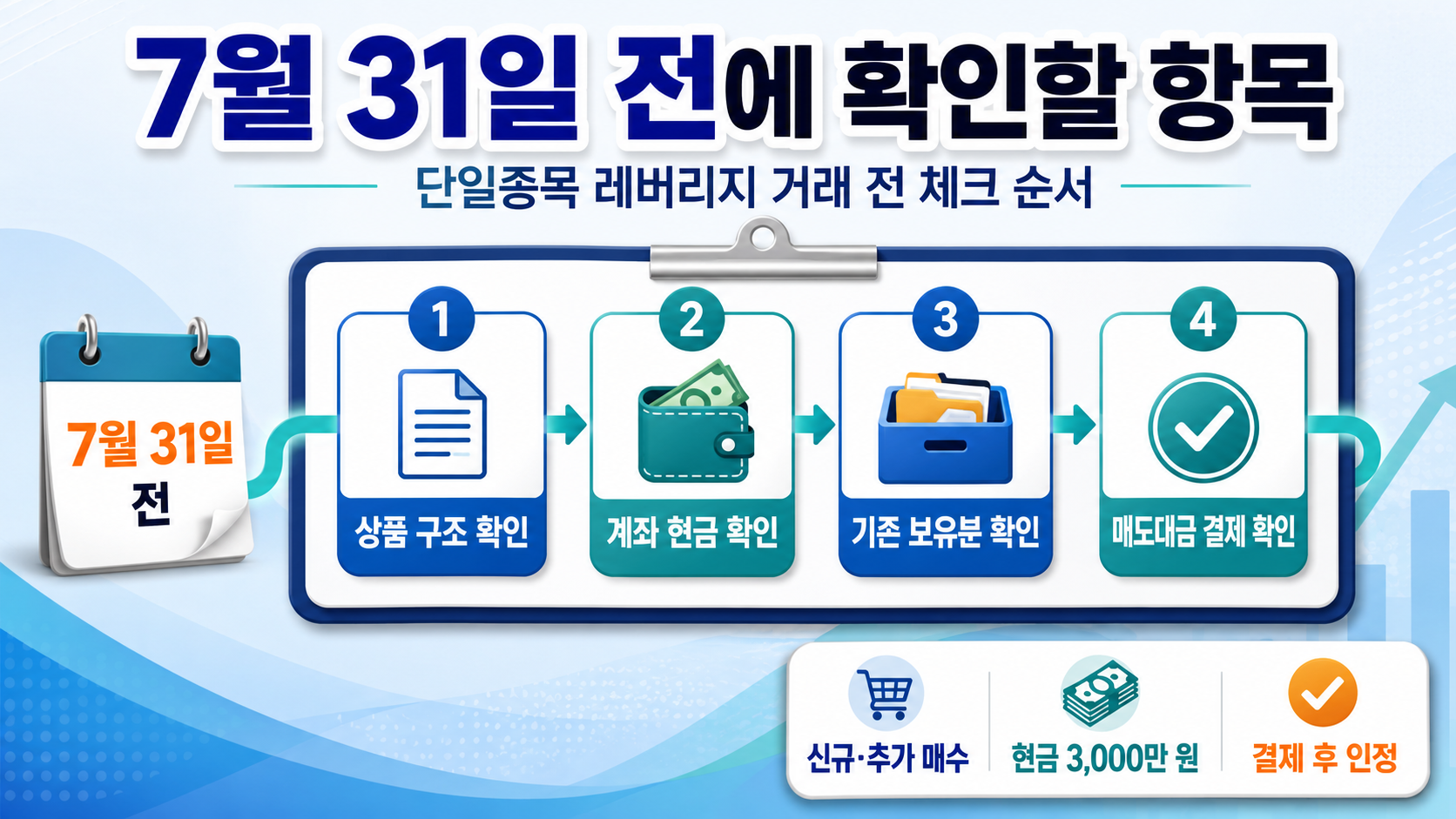
If you trade single-stock leveraged products, it is advisable to check the following items in order.
1. Check the underlying asset of your holdings.
Determine whether the product has a leveraged or inverse structure based on a single individual stock.
2. Check your cash balance, not your total account assets.
Confirm that your actual cash balance meets the KRW 30,000,000 requirement, excluding the market value of stocks, ETFs, and bonds.
3. Check the settlement date of sale proceeds.
If you plan to sell securities to raise cash, calculate your available funds based on the completed settlement date rather than the sale date.
4. Distinguish between holding and making additional purchases.
Holding and selling are permitted, but additional purchases are subject to the strengthened requirements.
5. Review notices from your brokerage.
Confirm the system implementation time, order processing procedures, and the scope of covered overseas products through your brokerage's official guidance.
6. Check price deviations and trading lot sizes.
Review product disclosures to prepare for the August 19 price deviation rules and future changes to trading quantities.
Frequently Asked Questions
If I Have Less Than KRW 30,000,000 in Cash, Will I Be Forced to Sell My Existing Holdings?
No. You may continue holding or selling existing positions. The KRW 30,000,000 cash requirement applies to new and additional purchase orders.
If I Have KRW 40,000,000 Worth of Stocks in My Account, Do I Meet the Requirement?
The market value of stocks alone does not satisfy the requirement. Starting July 31, only cash will count toward the minimum required deposit for single-stock leveraged products.
Can I Buy Single-Stock Leveraged Products Immediately After Selling Stocks on the Same Day?
It may be difficult unless you already held at least KRW 30,000,000 in cash before the sale. Sale proceeds will count toward the required cash deposit on T+2, when settlement is actually completed.
Does the Requirement Apply If I Sell an Existing Product and Then Buy It Again?
Yes. Selling is permitted, but a subsequent repurchase is treated as a new or additional purchase and must satisfy the cash deposit requirement.
Are Overseas-Listed Single-Stock Leveraged Products Also Covered?
Both domestically and overseas-listed single-stock leveraged products are subject to the strengthened requirements. Investors should consult their brokerage's notices for the specific securities covered.
Do All Ordinary ETFs Also Require KRW 30,000,000 in Cash?
No. This change is limited to single-stock leveraged products. However, other high-risk products, including index-based leveraged ETFs, may be subject to separate investor education and deposit requirements.
When Will Trading in Units of 20 Begin?
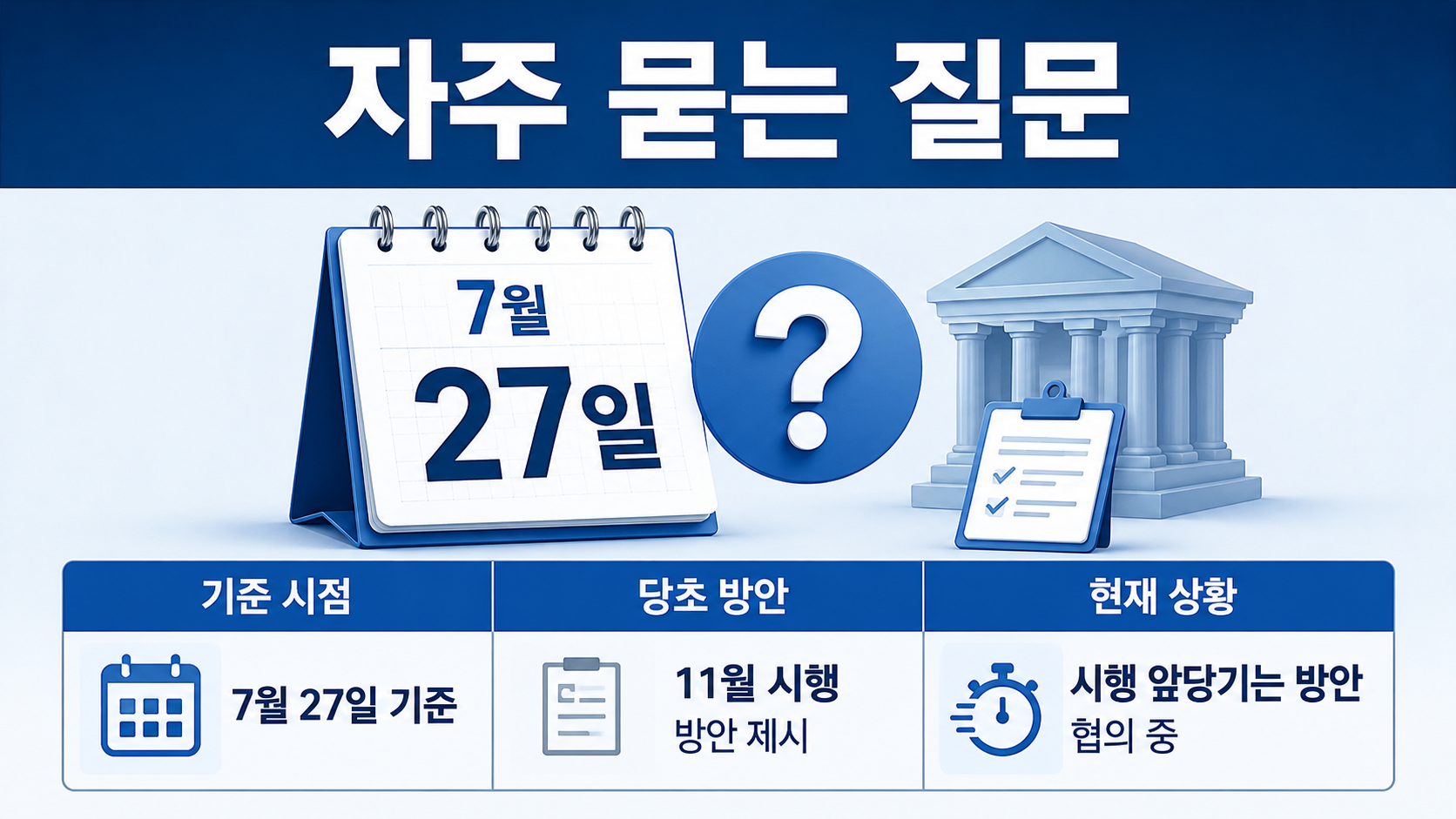
As of July 27, the exact implementation date had not been finalized. Although implementation was originally proposed for November, financial authorities are discussing ways to bring the date forward.
##
※ This article is provided for informational purposes to help readers understand market developments and does not constitute an investment recommendation for any particular security or asset. Final investment decisions and responsibility rest with the individual investor.
이 포스팅은 쿠팡 파트너스 활동의 일환으로, 이에 따른 일정액의 수수료를 제공받습니다.