

Nationwide Farmland Survey: In-Depth Inspections Begin August, 284 Million Parcels Flagged for Suspected Violations—What Should Landowners Check?
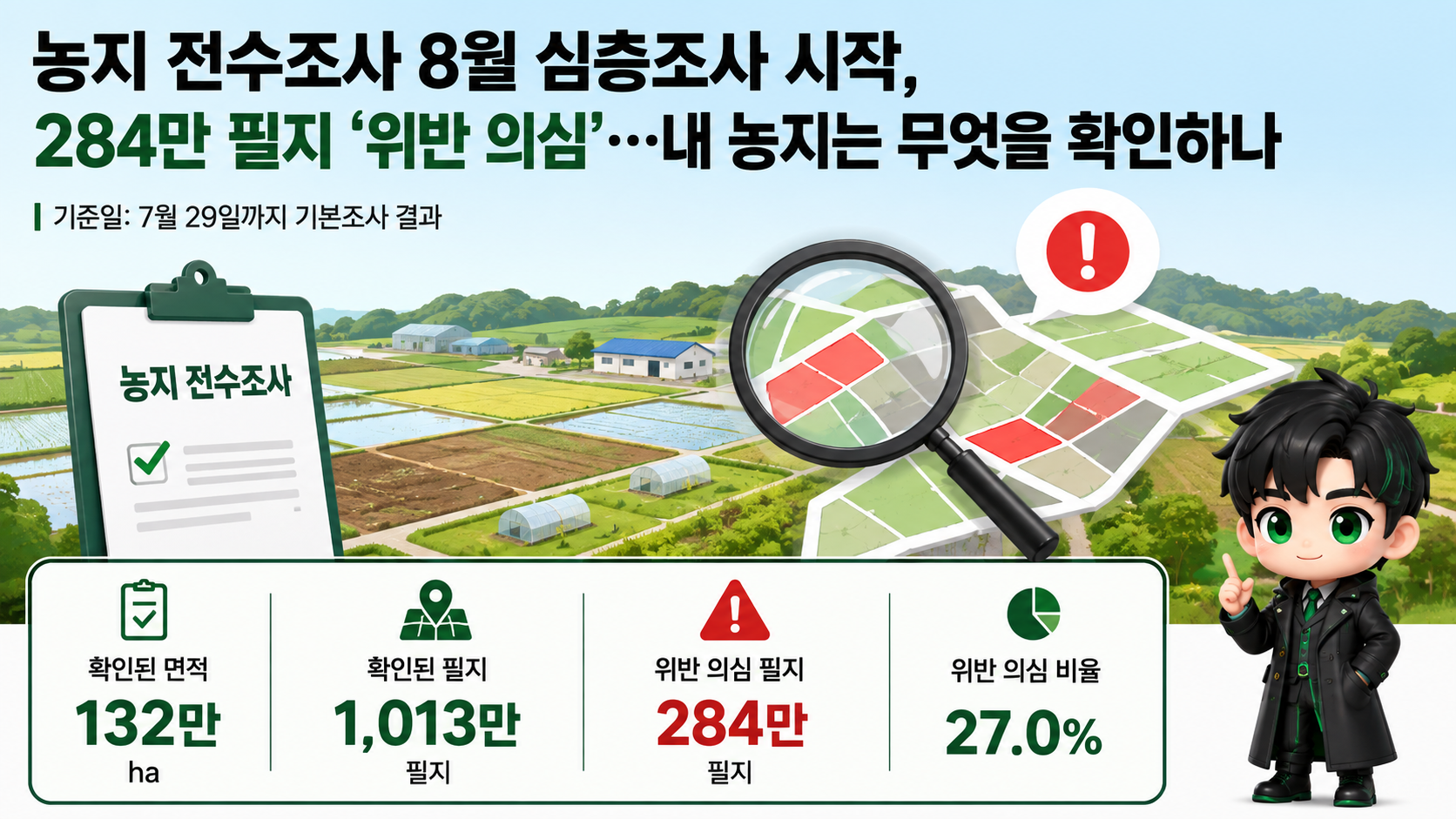
The nationwide farmland survey for 2026 entered the field-focused in-depth inspection phase on August. By July 29, authorities had examined 132 million hectares and 1,013 million parcels, representing 97% of the land subject to the preliminary survey. 284 million parcels (27.0%) were classified as potentially violating regulations on illegal leasing, unauthorized fallowing, illegal conversion, or ownership restrictions.
An important distinction must be made. This does not mean that 284 million parcels have been confirmed to violate the Farmland Act. These parcels were identified during preliminary screening using administrative records, aerial photographs, and other information as requiring further verification. Starting August, field inspections and supplementary investigations will determine whether violations actually occurred.
The reference date for this information is 2026-08-20.
Not All 284 Million Flagged Parcels Are Subject to Disposal Orders
Farmland suspected of violations during the preliminary survey accounted for 27.0% of the total surveyed area. By category, suspected illegal leasing accounted for 21.1%, suspected unauthorized fallowing for 11.6%, suspected illegal conversion for 9.0%, and suspected violations of ownership restrictions for 1.4%.
Adding these percentages produces 43.1%, although the overall proportion of farmland flagged for suspected violations is 27.0%. This is because a single parcel may fall into two or more categories. The overall figure of 27.0% excludes such duplication.
Suspected illegal leasing includes cases where farmland registers or agricultural business records indicate that an owner personally cultivates the land, but supporting activity involving fertilizer, tax-exempt fuel, agricultural disaster insurance, or similar records cannot readily be verified.
For suspected unauthorized fallowing, screening criteria included aerial photographs showing indistinct farmland boundaries or land that appeared to have reverted to woodland. Farmland may also be flagged for suspected illegal conversion when structures have been installed or the land is being used for another purpose without verifiable records of the required conversion authorization.
For farmland owned by non-farming individuals who inherited land or left agriculture, preliminary screening for suspected ownership restriction violations included cases where the owned area, excluding land entrusted to the Farmland Bank for leasing, exceeded 1ha.
Simply owning farmland does not constitute a violation, and being flagged during preliminary screening does not establish wrongdoing. The in-depth inspections beginning August are intended to determine how the land is actually being used.
What Will Inspectors Check on Farmland During the August In-Depth Investigation?
The in-depth investigation proceeds through field inspections followed by supplementary investigations. As a general rule, public officials and inspectors visit farmland to verify its actual condition and use.
In areas that are difficult to access directly, such as islands and mountainous regions, inspectors may use drones, aerial photographs, and satellite imagery. The National Agricultural Products Quality Management Service also participates in the in-depth investigation.
Suspected illegal leasing and other matters that are difficult to establish through field observation alone undergo supplementary investigation. During this process, farmland owners may be asked to provide supporting documentation.
However, authorities do not determine every situation based on a single document. They also examine additional administrative information and, when necessary, supplement their findings through questions and inquiries involving village residents and others.
The use of drones and AI is particularly extensive. During the 2026 survey, drone imagery covering approximately 40 million hectares is expected to be used, including approximately 18 million hectares across Gyeonggi Province and approximately 22 million hectares of suspected farmland outside the province.
People who have owned farmland for many years may naturally focus on whether their ownership is properly registered. However, this investigation examines not only who owns the farmland, but also who actually uses it and how it is being used.
What Should Owners Prepare If They Cultivate Their Farmland Themselves?
If farmland is being cultivated normally, the first priority is to check whether its actual use matches the information recorded in administrative systems.
For example, additional verification may be required during the in-depth investigation if the farmland register indicates personal cultivation but the actual farming arrangement is different, or if the land is leased without the relevant records being properly updated.
Conversely, administrative information or agricultural activity records that substantiate actual farming may be used during the investigation. The government uses various administrative records to verify actual cultivation, including information related to the public-interest direct payment program and registered agricultural businesses.
Owners should also examine any buildings or structures installed on farmland. During preliminary screening, authorities classified certain cases as suspected illegal conversion when structures other than facilities such as greenhouses were identified, or when land was being used for other purposes without verifiable records of lawful conversion authorization.
The same applies to land that has remained unused for an extended period. Farmland whose boundaries have disappeared in aerial photographs and which appears to have reverted to woodland may be subject to additional investigation for unauthorized fallowing.
Ultimately, the owner's initial checks are relatively straightforward. The key is to determine whether the farmland's actual use matches administrative records such as the farmland register, whether any leasing arrangement complies with the law, and whether the necessary procedures have been completed for installed structures or alternative land uses.
Will Elderly Farmers Who Temporarily Stop Farming or Farmers Who Exchange Land for Cultivation Immediately Face Disposal Orders?
Not every suspected violation will be handled in the same way. The government has stated that it will respond strictly to cases involving speculation while also preparing alternative measures, including guidance that takes local circumstances into account, for ordinary violations arising in rural communities.
Examples provided by the government include elderly farmers who cannot continue farming because of health or physical difficulties, farmers who exchange farmland for cultivation according to their needs, and farmers who install simple agricultural storage sheds without completing the required procedures.
Therefore, it would be incorrect to assume that 'temporarily stopping cultivation means immediately losing ownership of farmland.' Authorities must first examine the actual circumstances and how the farmland is being used.
At the same time, oversight of Farmland Act violations is being strengthened. Amendments to the Farmland Act passed by the National Assembly on May 2026 include provisions making farmland disposal orders mandatory rather than leaving them to the discretion of local governments.
The amendments also include restrictions intended to prevent people who receive disposal orders from evading regulations by selling farmland to related parties, such as spouses, direct ascendants or descendants, or corporations they represent. They also allow the Minister of Agriculture, Food and Rural Affairs to issue disposal orders directly when local governments fail to provide adequate follow-up management.
It is therefore important to distinguish simple discrepancies in administrative information from actual speculation or illegal land use.
If Someone Else Cultivates Your Farmland, Check the Leasing Arrangement First
The largest category identified in the survey was suspected illegal leasing, at 21.1%. If someone other than the owner cultivates the farmland, the owner should verify whether the current arrangement is permitted under the Farmland Act.
Concerns have also been raised that tenant farmers who actually cultivate the land could suffer losses if leasing arrangements are abruptly terminated after the nationwide survey begins.
In response, the government operated a special regularization period, encouraged the conversion of arrangements into written contracts and the entrustment of farmland to the Farmland Bank, and established a reporting center to protect tenant farmers.
According to the preliminary survey results announced on July 30, farmland entrusted to the Farmland Bank for leasing increased by 80% compared with the previous year during this period. The reporting center received 206 reports of suspected Farmland Act violations, and authorities decided to conduct special inspections of reports involving illegal leasing, illegal conversion, and related matters during the in-depth investigation period.
The existence of a leasing arrangement does not automatically make it illegal. Because the Farmland Act permits leasing under certain conditions, the circumstances of ownership acquisition, reasons for leasing, identity of the actual cultivator, and whether the land has been entrusted to the Farmland Bank must be examined individually.
In particular, people who own farmland through inheritance or after leaving agriculture would be well advised to check which ownership and leasing rules apply to their specific circumstances.
The Nationwide Farmland Survey Will Not End This Year
The 2026 survey represents the first year of a broader effort to reassess the entire farmland management system.
Under the latest government survey plan announced on July 21, the total area subject to investigation is approximately 195 million hectares. Of this, 136 million hectares acquired after the Farmland Act took effect in 1996 will be surveyed first in 2026, while 59 million hectares acquired before 1996 are scheduled for investigation in 2027.
Some initial announcements identified 115 million hectares as the target for the 2026 survey. However, as the scope was refined, the official announcement on July and the preliminary survey results on July 30 used 136 million hectares. For an accurate understanding of the current situation, the figure of 136 million hectares from the latest official announcement should be used.
The 2026 survey began on May 18. Preliminary screening using administrative records, satellite information, AI, and other resources continued through the end of July, before the investigation moved into the field-focused in-depth phase on August.
For farmland owners, the situation has moved beyond simply hearing that a nationwide survey is underway. Preliminary screening has already identified a substantial amount of potentially noncompliant farmland, and authorities are now examining actual conditions on the ground.
What Farmland Owners Should Check Now, in Order
If you own farmland or lease farmland for cultivation, start by verifying how the land is actually being used.
1. Identify who actually cultivates the farmland. First establish whether you cultivate it yourself or someone else farms it under a leasing arrangement.
2. Check whether administrative information, including the farmland register, matches actual use. Further verification may be necessary if the records indicate personal cultivation but someone else actually farms the land.
3. If the farmland is leased, verify that the arrangement is permitted. Different conditions apply to inherited farmland, land owned by people who have left agriculture, and land entrusted to the Farmland Bank.
4. If the farmland is fallow, establish why. It is important to distinguish simple neglect from genuine circumstances such as illness or advanced age.
5. Check structures on the farmland and any use for other purposes. If structures have been installed, determine whether the relevant permit or reporting procedures apply.
6. If investigators request additional verification, prepare evidence explaining the actual circumstances. In-depth investigations may combine documents, administrative information, field inspections, interviews, and local inquiries.
Looking only at the headline figures, it is easy to misunderstand the survey as meaning that '27% have been caught violating the law.' The accurate interpretation, however, is that 27.0% were classified as suspected violations during preliminary screening, and in-depth investigations beginning August are determining whether actual violations occurred.
If your farmland is being used lawfully, the priority should be checking that its actual use matches administrative records rather than worrying about the overall statistics. Conversely, if the land has been neglected for a long time, the actual cultivator differs from the person recorded in official documents, or leasing arrangements and installed structures have not been properly documented, there may be more matters requiring verification during the current in-depth investigation period.