

Why Did U.S. Stocks Rise Despite Growing Rate Hike Expectations? Why Did U.S. Stocks Rise Despite Growing Rate Hike Expectations? Falling Oil Prices Were More Important to the Sept
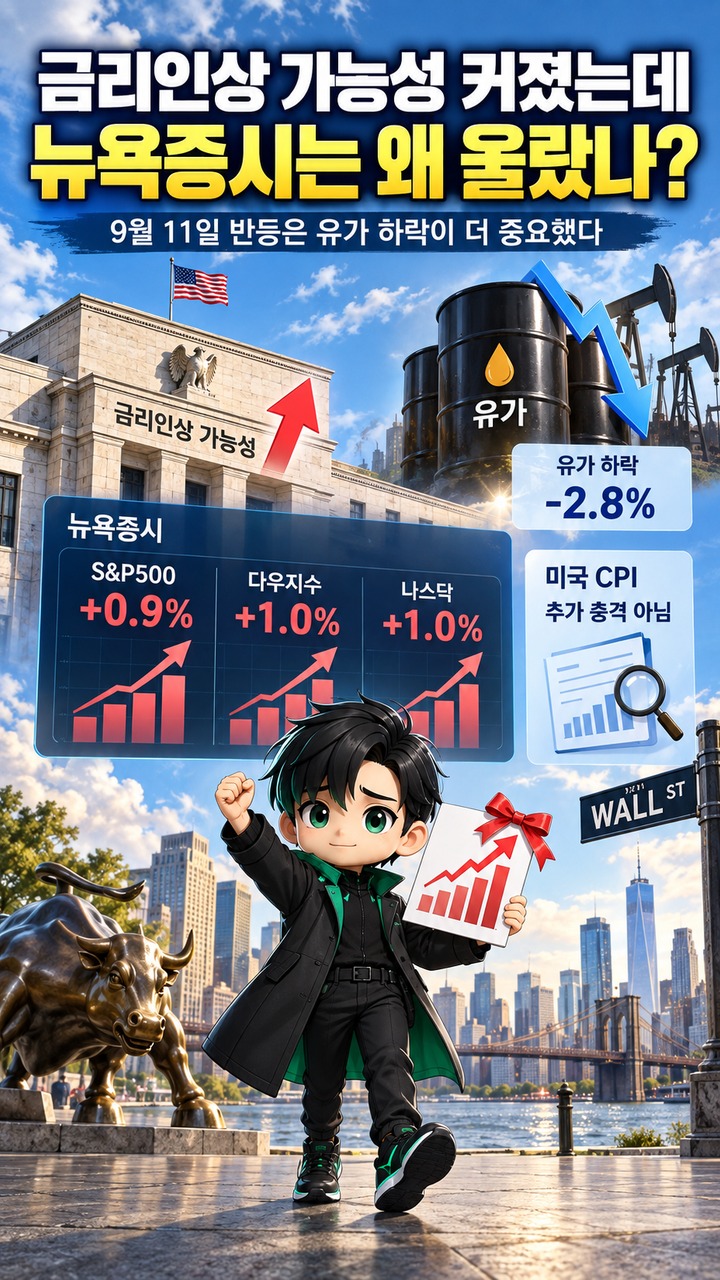
U.S. stocks rose on September 11 despite an increase in the likelihood of a Federal Reserve rate hike. This was not because higher interest rates were good news, but because falling oil prices eased inflation concerns and the CPI report did not deliver an additional shock beyond what the market could absorb.

On September 11, the S&P500 gained 0.9%, the Dow rose 1.0%, and the Nasdaq Composite advanced 1.0%, ending a 4-session losing streak. Yet on the same day, the bond market priced in an even greater likelihood of a Federal Reserve (Fed) rate hike in September.
At first glance, these movements appear contradictory. Why did stocks rise when concerns about higher interest rates were growing?
The Rule That Higher Interest Rates Mean Lower Stock Prices Does Not Always Hold
Rising interest rates generally put pressure on the stock market. They increase companies' borrowing costs and raise the discount rate used to calculate the present value of future earnings.

However, stock prices do not move based solely on whether interest rates are high or low.
The stock market is more sensitive to whether new information is better or worse than existing expectations than to changes investors have already anticipated.
On September 11, the possibility of a rate hike was not a new development. Strong employment data, persistent inflation, and elevated oil prices had already prompted markets to rapidly price in the possibility of a rate increase in September.
By contrast, one of the newly observed developments that day was a decline in oil prices.
Looking at that day's stock market movements, the easing of oil-related pressures and reduction in uncertainty appear to have had a stronger influence than the increased probability of a rate hike.
First Reason: Falling Oil Prices Eased the Most Immediate Inflation Fears

On September 11, Brent crude oil prices fell approximately 3%. As crude prices retreated from their earlier surge, concerns that energy-driven inflation could accelerate further also eased somewhat.
This distinction matters.
According to the U.S. Bureau of Labor Statistics (BLS), the U.S. Consumer Price Index (CPI) for August increased 0.4% from the previous month and 3.4% from a year earlier. Gasoline prices, in particular, rose 3.9% over the month, accounting for more than 1 out of 3 of the overall monthly CPI increase.
In other words, what markets feared at the time was not simply that interest rates would rise.
Higher oil prices → Renewed inflation → Additional Fed tightening → Higher Treasury yields → Pressure on corporate valuations
That was the chain of events investors were worried about.
Consequently, the decline in oil prices meant more than just cheaper commodities. It could be interpreted as a sign that the scenario of simultaneously worsening inflation and interest rates had, at least temporarily, been interrupted.
Second Reason: CPI Was High, but It Did Not Deliver an Additional Shock Large Enough to Upend the Market
The CPI for August rose 3.4% year over year, matching July.
Headline CPI increased 0.4% month over month, while core CPI, which excludes food and energy, rose 0.3%. The annual increase in core CPI was 2.4%.
These figures did not indicate that inflationary pressures had disappeared.
Indeed, immediately after the release, interest rate futures markets sharply increased the implied probability of a rate hike in September. Reports citing CME FedWatch at the time indicated that the probability of a 0.25%-point increase reached approximately 90% during intraday trading.
However, the stock market also offered a different interpretation.
Although elevated CPI was negative news, inflation had not delivered a shock substantially worse than investors had feared. One phenomenon frequently seen in U.S. equities is that markets react more strongly to numbers that are worse than expected than to numbers that are simply bad.
This time, inflationary pressures were confirmed, but the results did not completely break the market's expectations. The reduction in uncertainty instead provided a source of short-term relief for stock prices.
Third Reason: The Rebound Followed 4 Consecutive Days of Declines
There is another reason why the gains on September 11 should not immediately be interpreted as the beginning of a new upward trend.
Before rising that day, the S&P500 had declined for 4 consecutive trading sessions. The pressures from higher interest rates and oil prices had already been reflected in stock prices over several days.
After a prolonged decline, stocks can rebound when negative developments fail to become worse than expected and selling pressure subsides.
In fact, despite the gains on September 11, the major indexes were still down for the week as a whole.
| Index | September 11 | Weekly |
|---|---|---|
| S&P500 | +0.9% | -0.8% |
| Dow | +1.0% | -1.6% |
| Nasdaq | +1.0% | -0.7% |
| Russell 2000 | +0.4% | -2.4% |
Therefore, although the single-day move looked like a strong rebound, the broader weekly picture suggested that much of the advance was simply a partial recovery from earlier losses.
Does This Mean the Market No Longer Views Rate Hikes as Negative News?
That would be a difficult conclusion to justify.
Higher interest rates can increase corporate financing costs and put pressure on equity valuations. If rates remain elevated longer than expected, growth stock valuations could face even greater pressure.
The key lesson from September 11 is not that rate hikes suddenly became positive for stocks, but that investors focused more on which of several negative factors had turned out to be less severe than expected.
For example, if the probability of a rate hike has already been priced in at 80~90%, investors may shift their attention away from the rate increase itself and toward the next set of questions.
What matters more is whether the Fed raises rates only once, signals further increases, revises its inflation forecasts upward, or changes its projected path for future interest rates.
Watching Only the Rate Decision at the September 16 FOMC Meeting Is Not Enough
The Federal Reserve's Federal Open Market Committee (FOMC) meeting for September is scheduled for September 15~16, local time. The policy decision is scheduled for 16 at 2 p.m., followed by a press conference at 2:30 p.m.
At this meeting, investors should examine several factors beyond the headline policy rate.
First, the actual size of any interest rate adjustment.
Second, how much room the Fed leaves for additional rate increases.
Third, how significantly the projected inflation path changes in the Fed's economic and interest rate forecasts.
Fourth, whether the Fed views higher oil prices as a temporary supply shock or a persistent inflation risk.
In particular, the renewed increase in oil prices after September 13 makes it difficult to assume that the rebound on September 11 will simply continue. If developments in the Middle East and crude oil prices become volatile again, inflation and Treasury yields could also come under renewed pressure.
Investors Need to Watch More Than Just Rate Hike Probabilities
The most important lesson from these market movements is that directly linking the probability of a rate hike to stock prices on a 1-to-1 basis can lead to a misleading interpretation of the market.
Even if the probability of a rate increase rises, the impact on stocks may be limited if investors have already anticipated it sufficiently. Conversely, if oil prices, long-term Treasury yields, or expectations for further Fed tightening deteriorate more than expected, stocks could become volatile again even if the rate decision itself matches forecasts.
Going forward, investors should therefore monitor at least international crude oil prices, yields on 10-year U.S. Treasury securities, expectations for additional rate hikes, and the Fed's inflation forecasts together.
The same principle ultimately explains why U.S. stocks rose on September 11.
Stocks did not rise because the possibility of a rate hike disappeared. Rather, falling oil prices and easing uncertainty had a greater impact that day than the negative implications of higher interest rates, which markets had already priced in to a considerable extent.
However, a single-day rebound does not guarantee further gains. If the September FOMC meeting or international oil prices change the market outlook again, equities could be repriced rapidly.
※ This article is provided for informational purposes to help readers understand market developments and does not constitute investment advice or a recommendation to buy any particular security or asset. Readers are responsible for their own investment decisions and the associated risks.