

FSS Automates AI-Powered Crypto Market Surveillance: How Does It Detect Suspicious Price Surges and Second-by-Second Trading?
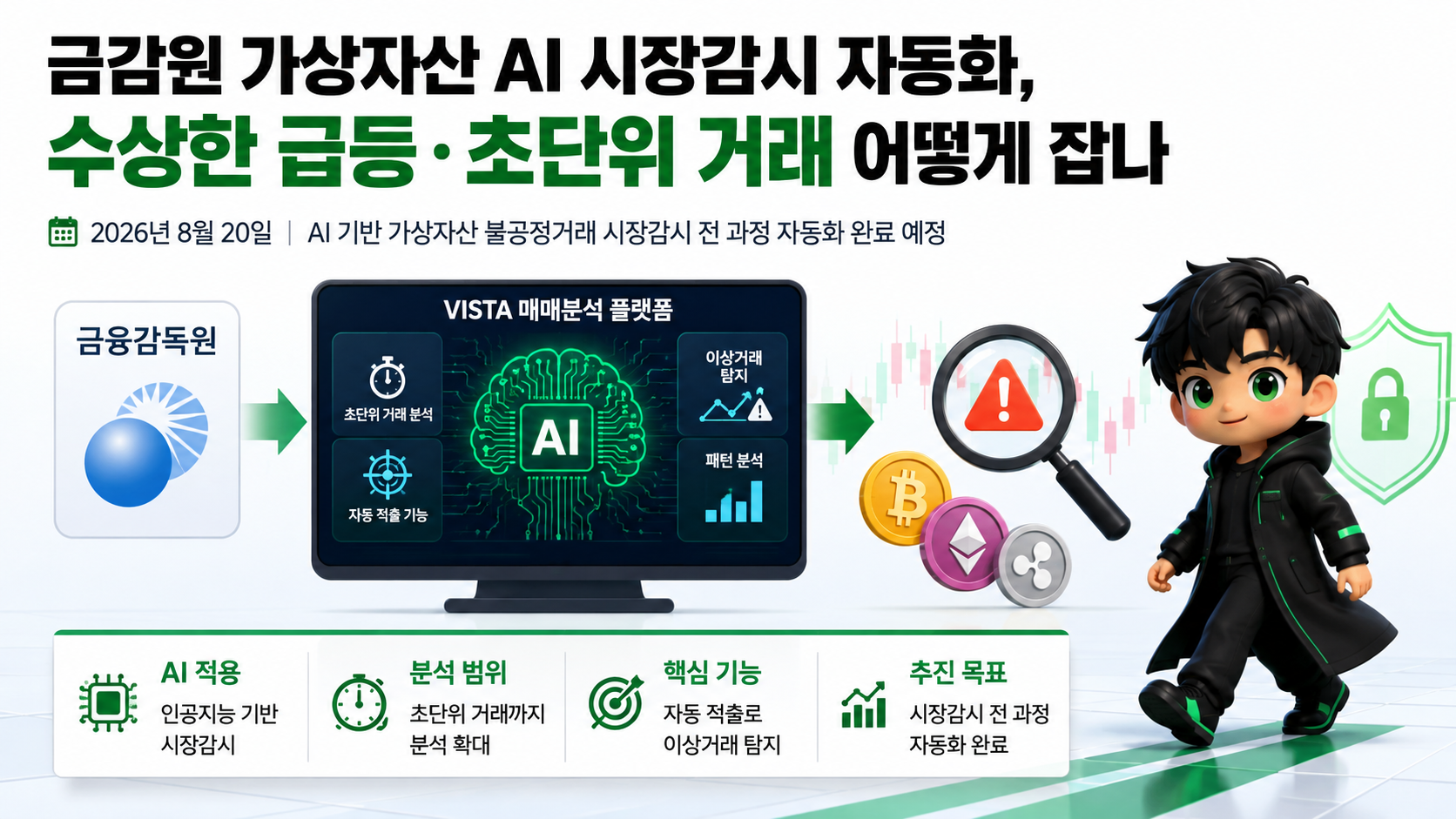
South Korea's Financial Supervisory Service (FSS) is stepping up efforts to apply artificial intelligence to surveillance of unfair trading in virtual assets. The financial authorities' weekly press schedule for 2026-08-20 includes a planned release titled 'Completion of AI-Based Automation of the Entire Market Surveillance Process for Unfair Trading in Virtual Assets.' The FSS previously introduced an automated detection feature into its proprietary trading analysis platform, VISTA, capable of analyzing transactions down to the second.

The important distinction is that AI does not automatically classify a cryptocurrency's price increase as suspicious trading. Instead, the system analyzes large volumes of data on periods of sharp price increases or declines, order patterns, and executed trades to quickly identify trading intervals that warrant investigation for suspected market manipulation.
The information is current as of 2026-08-20 at 12:49 p.m. Korea Standard Time.
AI Does Not Automatically Determine That a Price Movement Constitutes Unfair Trading
The FSS's use of AI does not operate on the assumption that a sudden price increase must be illegal. Rather, it breaks down virtual asset trading data into detailed intervals, identifies periods of abnormal trading, and helps narrow the scope of transactions requiring investigation. Whether unfair trading actually occurred is determined through subsequent investigations and legal procedures.

Virtual assets trade 24 hours a day, and even a single asset can generate enormous numbers of orders and executed transactions within a short period. When programmatic API orders are added to the mix, investigators face practical limitations in manually examining charts and determining exactly which periods should be investigated.
This was also the central focus of the VISTA enhancements announced by the FSS earlier this year. VISTA stands for Virtual assets Intelligence System for Trading Analysis. It is a trading analysis platform used in investigations of unfair virtual asset trading, processing large volumes of transaction data and calculating indicators associated with abnormal trading.
Previously, investigators had to analyze the data and manually identify periods in which market manipulation was suspected. The automated analysis feature was designed to examine potential investigation periods in much greater detail.
In other words, the process is not:
Cryptocurrency price surge → AI declares the activity illegal
Instead, it is more accurately understood as:
Trading data generated → Numerous time intervals analyzed → Suspicious trading intervals identified → Investigation
Even Suspicious Trading Lasting Only a Few Seconds Can Be Analyzed Separately
One notable technique adopted by the FSS is 'Sliding Window Grid Search.' This approach divides an entire trading period into smaller intervals of varying lengths and automatically analyzes each interval for abnormal trading activity.
For example, even when market manipulation is suspected, the activity does not necessarily occur in convenient units such as a day or a week.
Orders may be concentrated within a few seconds, suspicious transactions may appear intermittently across multiple periods, or particular trading patterns may recur over an extended period.
The challenge is that the number of possible combinations of time intervals to analyze increases rapidly.
Even with only 10 minutes of data, analysts could continuously change the scope of analysis, examining intervals such as 'the first 10 seconds,' 'the next 10 seconds,' '30-second intervals,' or '1-minute intervals.' Actual market datasets are vastly larger, making it difficult for humans to examine every possible combination manually.
The FSS has implemented parallel processing using high-performance GPUs, establishing a system capable of analyzing hundreds of thousands or more intervals measured in seconds. When its performance was tested against previously completed investigations, the system reportedly identified suspicious periods already established by investigators and discovered additional intervals warranting examination, according to information released at the time.
The significance of this change is not that AI makes final decisions instead of human investigators.
Rather, computers can comprehensively analyze time intervals that investigators previously had to identify manually, helping narrow the scope of an investigation.
Repeated Buying and Selling Through Automated Programs Is Also Subject to Market Surveillance
In virtual asset markets, APIs allow programs to submit repeated orders at frequencies that would be difficult for humans to achieve through manual clicks. An API is a communication interface that allows software to connect to an exchange's systems and automatically process activities such as placing orders and retrieving information.
Using an API for trading does not itself constitute unfair trading. The concern arises when such tools are used to create the appearance of active trading or repeatedly submit orders intended to artificially influence price formation.
In April 2026, the FSS presented examples related to surveillance of unfair virtual asset trading, including repeatedly executing small market buy and sell orders while separately submitting buy orders at elevated prices, and repeatedly placing API orders to move prices toward a targeted level.
There is therefore an important distinction for ordinary investors to understand.
Simply 'using an automated trading program' is not inherently problematic. However, repeatedly placing orders to artificially influence trading volume or prices is a separate matter.
Because virtual asset prices and trading volumes can change dramatically within short periods, traders cannot necessarily escape responsibility simply by claiming that a program executed the transactions automatically.
In 2025, financial authorities also warned that buying virtual assets in advance, encouraging other investors to purchase them, and then selling the holdings after prices rise could constitute unfair trading. They further stated that being unaware of the relevant laws does not, by itself, change whether a violation has occurred.
Exchange Surveillance and FSS AI Investigations Serve Different Roles
One question that often confuses investors is whether the FSS directly monitors all virtual asset trading nationwide in real time.
The virtual asset market operates under a framework in which continuous surveillance by exchanges works alongside investigations and supervision by financial authorities.
Exchanges continuously monitor abnormal transactions involving unusual price or trading volume movements. When unfair trading is suspected, they notify financial authorities in accordance with applicable procedures. Financial authorities then analyze the transaction records and other evidence they obtain to investigate potential violations.
Since last year, the FSS has consistently urged exchanges to invest in abnormal transaction detection systems and strengthen their market surveillance capabilities. Separately, it has announced plans to enhance its own investigative framework using AI, on-chain analysis, and other technologies.
Accordingly, it would be incorrect to interpret the current automation initiative as AI completely replacing market surveillance conducted by exchanges.
The exchanges' role in monitoring abnormal trading and the FSS's role in analyzing transaction data and conducting investigations should be considered separately.
Not Every Surging Cryptocurrency Becomes an 'AI-Flagged Coin'
A cryptocurrency is not automatically determined to be involved in unfair trading simply because its price jumps sharply within minutes.
Virtual asset prices can move dramatically for many reasons, including broader market fluctuations, the release of genuine information, changes in liquidity, and shifts in buying and selling demand. Therefore, a single price-change percentage cannot establish whether unfair trading has occurred.
Market surveillance must consider multiple types of data together, including prices, recurring order and execution patterns, changes in trading volume, and trading relationships among particular accounts.
For this reason, investors should be cautious about accepting online claims such as 'It suddenly rose 30%, so it must be a manipulated coin' or 'Trading volume exploded, so it must be market manipulation' without verifying the facts.
Conversely, limited price movement does not necessarily mean that trading activity is legitimate.
Coordinated transactions involving multiple accounts or repeated orders placed within short periods can be difficult to identify from price charts alone. One reason automated analysis is needed is that humans struggle to identify these high-volume, repetitive trading patterns manually.
Ultimately, a sharp price increase can provide a clue for further analysis, but it is not, by itself, the criterion for determining whether trading activity is illegal.
Future Developments Could Link Account Relationships, Text Analysis, and On-Chain Data
The FSS's plans announced earlier this year went beyond simply identifying periods of sharp price increases. Its phased enhancement roadmap included clustering analysis to identify groups of potentially suspicious accounts, text analysis using large language models (LLMs), and support for tracing fund flows through on-chain data.
Clustering involves analyzing trading patterns across multiple accounts and grouping accounts that may be connected. It can be particularly useful for examining coordinated trading involving multiple accounts, rather than straightforward transactions conducted by a single person through one account.
LLM-based analysis was proposed as a way to examine textual information, such as news reports and market rumors, that cannot easily be represented directly as numerical data.
On-chain analysis involves examining the movement of virtual assets recorded on a blockchain. Because an exchange's internal order and execution records differ from blockchain-based fund movement data, analyzing both sources together can broaden the scope of an investigation.
However, these capabilities should not be interpreted as meaning that AI can automatically detect every instance of market manipulation in real time or determine penalties without human investigation.
The central development confirmed so far is the automation and enhancement of large-scale data analysis used to detect abnormal transactions and support investigations.
What Should Individual Investors Pay Attention to Differently?
Stronger AI-powered market surveillance does not mean investors must press a new button when trading or complete a separate reporting procedure.
Instead, as before, investors should avoid mistaking activities such as placing orders intended to artificially move prices, repeatedly trading to inflate volume, or encouraging others to buy an asset before selling their own holdings for legitimate investment strategies.
Those using automated trading APIs should pay particular attention to the conditions under which their programs submit and cancel orders. Automation does not eliminate the significance of the actual trading patterns generated by those programs.
Another point to remember concerns cryptocurrencies experiencing rapid price increases.
Investors should not automatically assume that a cryptocurrency surging within a short period is 'a coin the FSS will soon catch.' Conversely, the fact that an asset is being traded normally on an exchange does not mean every transaction involving it has been verified as legitimate.
Virtual asset market surveillance distinguishes between identifying warning signs and proving that unfair trading has occurred.
The most accurate way to understand this AI automation initiative is as an expansion of the speed and scope of the process used to identify investigative leads within enormous volumes of trading data.
When trading virtual assets, investors are better served by looking beyond an asset's percentage price increase. They should also consider whether trading volume has changed abnormally, whether the exchange has issued trading caution notices or deposit and withdrawal announcements, and whether verifiable information exists to explain the price movement.
※ This article is provided for informational purposes to help readers understand market developments and does not constitute investment advice or a recommendation concerning any particular asset. Final investment decisions and responsibility rest with the individual investor.