

Ministry of Land Designates 353 Outlying Islands as New Foreign Land Transaction Permit Zones…What Changes for Ulleungdo, Heuksando, and Udo?
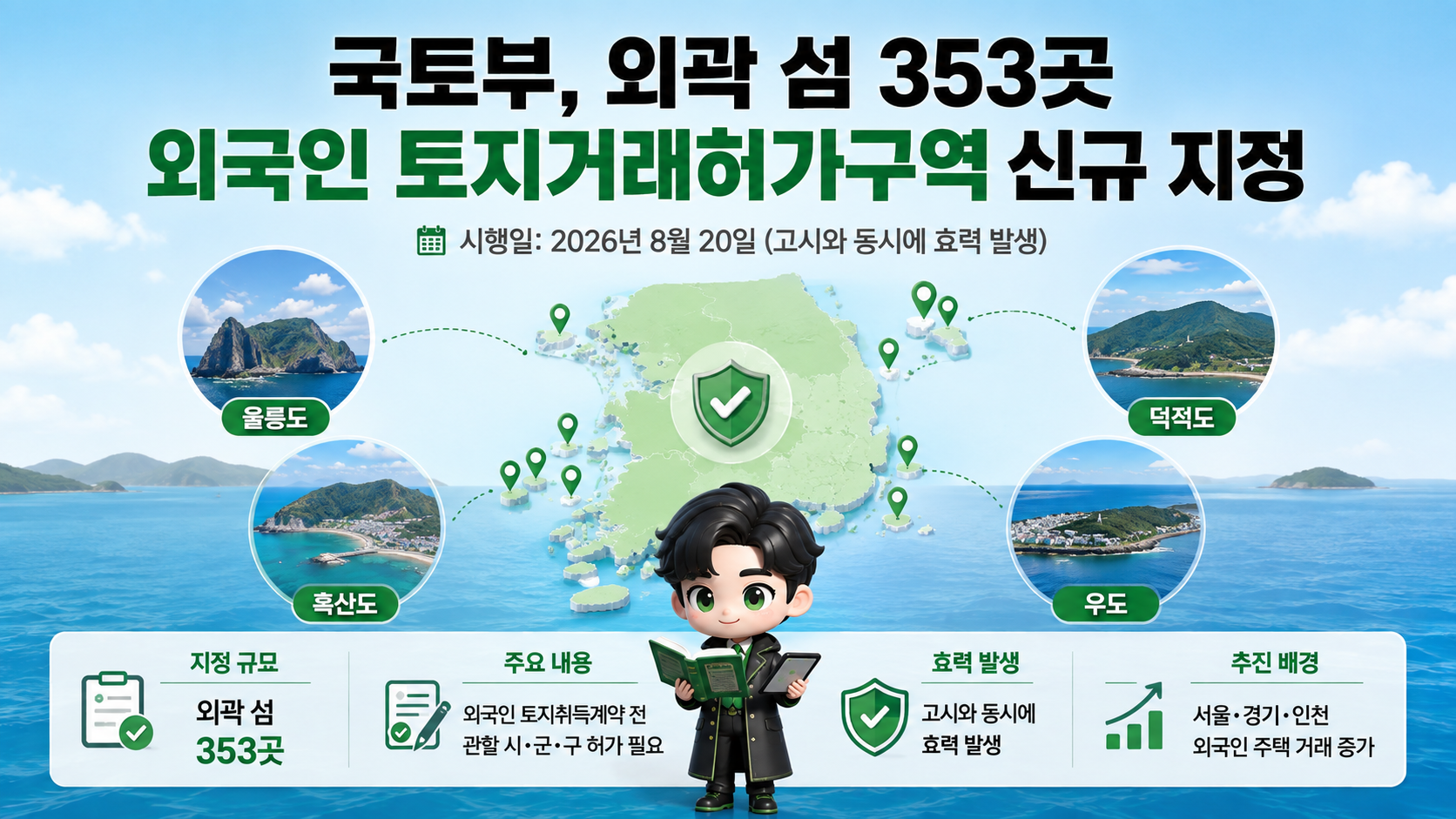
The Ministry of Land, Infrastructure and Transport designated 353 outlying islands, including Ulleungdo, Daeheuksando, Deokjeokdo, and Udo, as new foreign land transaction permit zones on 2026-08-20. On the designated islands, foreign nationals must obtain permission from the relevant city, county, or district before entering into a land acquisition contract. The designation takes effect immediately upon official notification.
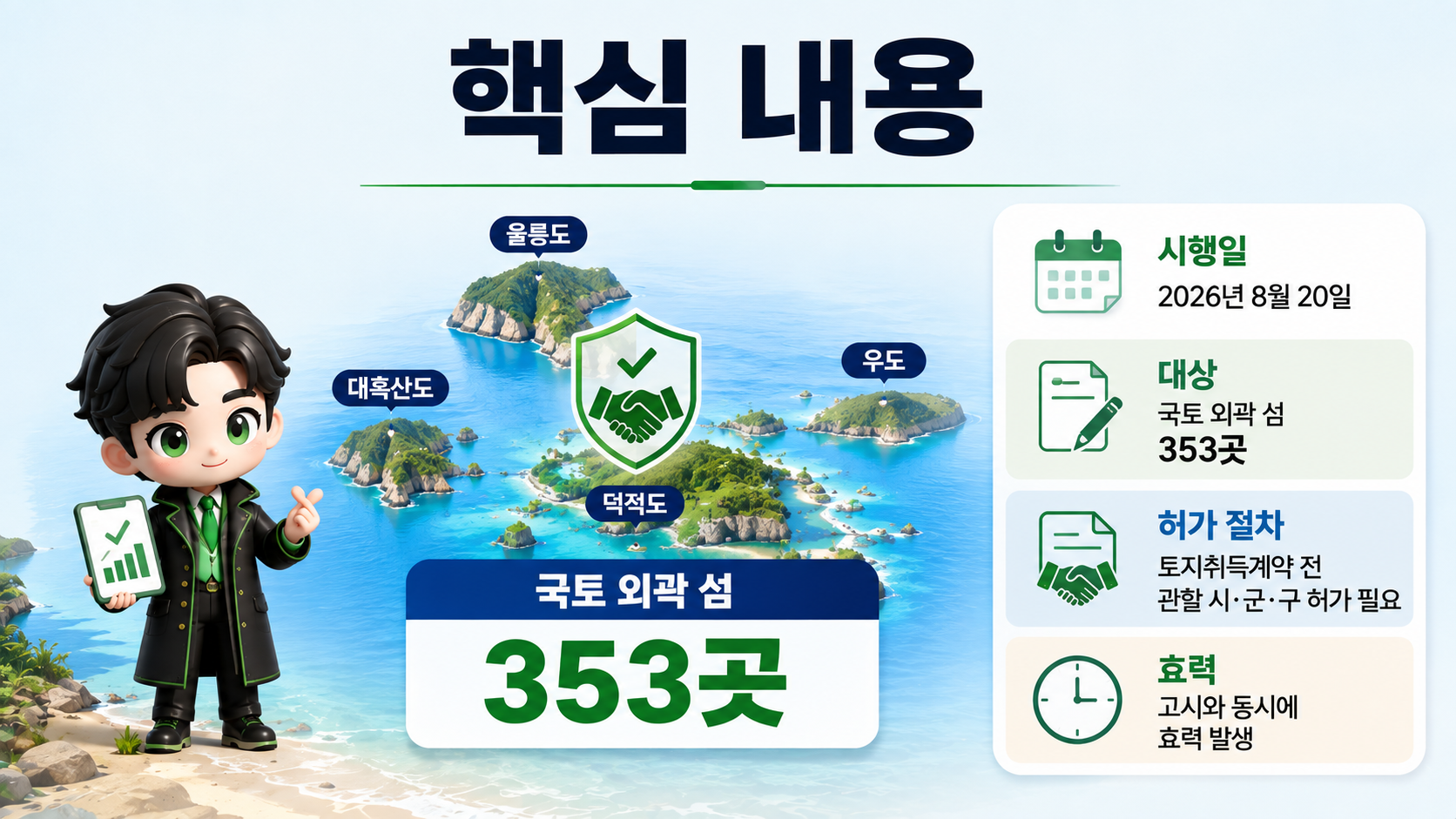
This measure should be distinguished from the existing land transaction permit zones covering foreign residential property transactions in Seoul, Gyeonggi, and Incheon. While the metropolitan-area system primarily applies to residential property transactions, the new island designations establish a system for reviewing land acquisitions in strategically important outlying areas in advance, where preventive management is necessary for national defense purposes.
The information was verified as of 2026-08-20 at 6:59 p.m. Korea Standard Time.
What Does the New Designation of 353 Islands Mean?
The most important figure in this announcement is 353. Rather than designating only a handful of tourist destinations or selected coastal parcels, the government reviewed continuous cadastral maps and other records for the 353 islands included in the new designation and designated every land parcel on each island as part of a permit zone.
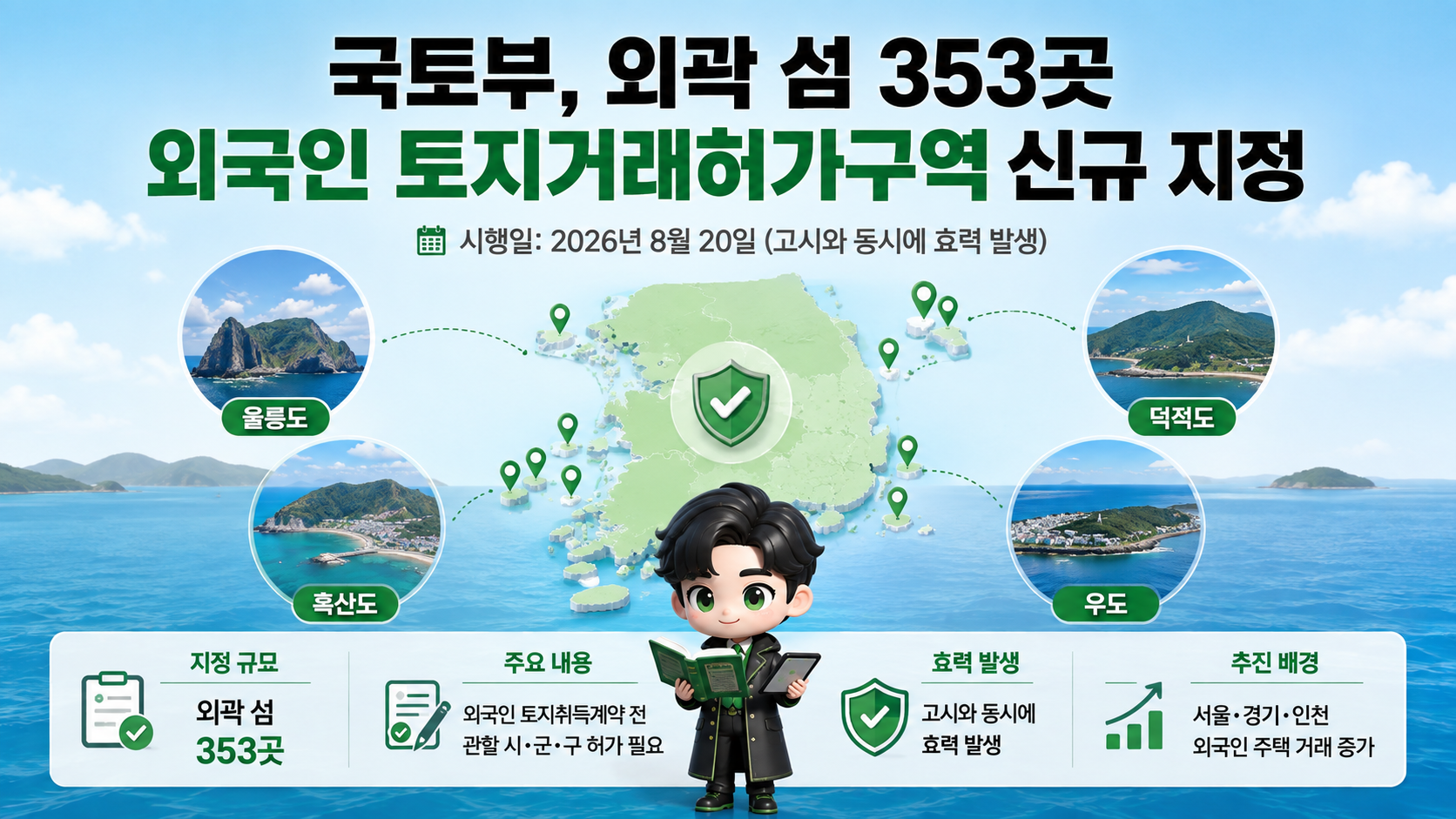
Representative locations confirmed in the announcement include Ulleungdo in North Gyeongsang Province, Daeheuksando in Sinan County, South Jeolla Province, Deokjeokdo and Jawoldo in Ongjin County, Incheon, Udo and Hachujado in Jeju, and Daenanjido in Dangjin, South Chungcheong Province.
Among the major islands whose areas were disclosed, Ulleungdo is the largest at 72.3 km². Daeheuksando covers 21.2 km², Deokjeokdo 20.8 km², Jawoldo 7.1 km², Udo 6.2 km², Daenanjido 4.5 km², and Hachujado 4.2 km².
The figure 353 should not be interpreted as meaning that 353 cities, counties, or districts have newly become subject to restrictions. The designation applies to outlying island areas, with the land parcels included in each island's permit zone identified individually.
This is not the first implementation of such a system. It is the third designation of foreign land transaction permit zones covering outlying islands, following earlier designations on December 2014 and February 2025. The previous two rounds had already designated 25 locations, including territorial sea baseline reference points and West Sea 5 islands.
The newly designated 353 islands represent 328 more locations than the existing 25, or approximately 14.1 times as many. This is simply a comparison of the number of designated locations, not their total land area or the severity of the restrictions.
Author's calculation:
353 - 25 = 328 locations
353 ÷ 25 ≈ 14.12 times
How Will the Land Purchase Process Change for Foreign Nationals on These Islands?
The biggest change is that foreign buyers can no longer proceed by signing a contract first and reporting the transaction afterward. Foreign nationals seeking to acquire land in the designated areas must apply for permission from the city, county, or district with jurisdiction over the property before signing a land acquisition contract.
Upon receiving an application, the relevant local government will consult with administrative agencies, including the Ministry of National Defense and the National Intelligence Service, before deciding whether to grant permission. In other words, foreign nationals seeking to purchase land in these areas must first verify whether the specific parcel falls within a foreign land transaction permit zone before entering into a contract.
In actual transactions, following the correct sequence is essential.
Verify the target property → Identify the relevant city, county, or district → Apply for land acquisition permission → Receive the permit decision → Sign the contract after approval
Because the designation takes effect immediately upon official notification, anyone planning a future transaction should check the property's current designation status again immediately before proceeding. Rather than relying solely on an island's name, buyers should verify the exact cadastral lot number of the property they intend to purchase.
This does not mean that all land transactions by South Korean nationals are now subject to a permit requirement. The announcement concerns the designation of foreign land transaction permit zones that apply when foreign nationals acquire land in the designated areas.
Will a Contract Remain Valid If It Is Signed Without Permission?
If a foreign national who is required to obtain permission signs a land acquisition contract without securing that permission, the contract is void. This should not be treated as a minor reporting omission that can simply be corrected by submitting a late application.
Violations may result in imprisonment for up to 2 years or a fine of up to KRW 20,000,000.
Accordingly, verifying whether a property falls within a permit zone before preparing a contract has become important not only for buyers but also for sellers and real estate intermediaries.
This is particularly relevant in places such as Ulleungdo and Udo, where an entire island is commonly perceived as a single residential or tourist area. It may be tempting to determine whether a property is covered based only on the island's name. However, because the new designation was made after reviewing all parcels on the designated islands, checking the precise address and cadastral lot number is more accurate for actual transactions.
When a foreign national is participating as a buyer, confirming the permit requirements with the relevant local government before paying a deposit or signing the main contract can help prevent unnecessary contractual disputes.
Why Should This Be Distinguished From the Metropolitan-Area Foreign Land Transaction Permit System?
The metropolitan-area foreign land transaction permit zones introduced on August 2025 and the new island designations share the same terminology, but their reasons for designation and the transactions they cover are not identical.
The existing metropolitan-area designation was introduced to regulate residential property transactions by foreign nationals throughout Seoul and in major areas of Gyeonggi and Incheon. At the time, the properties subject to the permit requirement included detached houses, multi-household houses, apartments, row houses, and multi-unit residential buildings.
By contrast, the designation of 353 islands announced on 2026-08-20 is linked to national defense and the strategic management of outlying territories. Following consultations with relevant ministries, the National Intelligence Service requested that the Ministry of Land, Infrastructure and Transport designate the islands as permit zones. The ministry then finalized and officially announced the designation after deliberation by the Central Urban Planning Committee.
Consequently, treating news about an 'extension of foreign land transaction permit requirements' and the 'new designation of 353 islands' as a single measure can create confusion about their respective scopes.
In the metropolitan area, the central issue is extending the designation period of existing permit zones. For the islands, the key development is the addition of 353 newly designated locations.
In particular, the designation of the 353 islands was confirmed at the time of announcement as a new designation taking effect immediately upon official notification. The effective date of the new island designation should not be assumed to be the same as the extension period for existing metropolitan-area permit zones.
The Designation Is Not Limited to Ulleungdo, Heuksando, and Udo
Although Ulleungdo, Udo, and Heuksando are frequently highlighted in news headlines, they are not the only locations affected by the restrictions. They are simply familiar examples among the 353 newly designated islands.
Major confirmed locations include Ulleungdo, Daeheuksando, Deokjeokdo, Jawoldo, Seodo, Boreumdo, Udo, Hachujado, and Daenanjido.
The designated areas also vary considerably in size. Comparing Ulleungdo at 72.3 km² with Daeheuksando at 21.2 km² shows that Ulleungdo's designated area is approximately 3.4 times larger.
Author's calculation:
72.3 km² ÷ 21.2 km² ≈ 3.41 times
However, a larger designated area does not mean that stricter permit standards apply. The published area figures are intended to compare the geographical size of the designated regions. Whether permission is granted for an individual property depends on the actual application and the assessment conducted by the relevant administrative authorities.
Therefore, anyone planning a real estate transaction on a particular island should prioritize checking whether the specific land parcel is included in the latest official designation, rather than whether the island was prominently mentioned in news coverage.
What Should You Check First Before Entering Into a Land Transaction With a Foreign National?
Following this measure, the first things to verify in a potential transaction are the buyer's nationality and the property's location. If the buyer is a foreign national and the property is included in one of the newly designated permit zones, the permission process must be completed before signing the contract.
In practical terms, three checks are essential before entering into a contract.
Whether the buyer is subject to foreign land transaction permit requirements
Whether the exact cadastral lot number of the intended property is included in a newly designated permit zone
What documents and procedures are required by the city, county, or district with jurisdiction over the property
Buyers and sellers should avoid signing a contract before the permit requirement has been clarified. A land acquisition contract entered into without the required permission may be void.
Another important distinction is that the designation does not amount to a blanket prohibition preventing foreign nationals from purchasing land on the affected islands. Instead, the system requires prior permission from the relevant local government before a contract is signed.
Anyone preparing an actual land transaction should go beyond simply checking the island names mentioned in news reports. The most important step is to confirm the designation status of the specific cadastral lot and the applicable permit procedures with the relevant city, county, or district before entering into a contract.
※ This article is provided for informational purposes to help readers understand market developments and does not constitute investment advice or a recommendation to buy any particular security or asset. All final investment decisions and responsibilities rest with the individual investor.