

Why Did I Take a Loss After Selling Korean Stocks at My Purchase Price? How to Calculate the Break-Even Price Including Fees and Securities Transaction Tax in 2026
Even if you sell Korean stocks at the same price you bought them for, your account may still show a loss. Brokerage fees apply when you buy and sell, and securities transaction tax is also deducted when you sell. As of 2026, the taxes related to selling KOSPI and KOSDAQ stocks are 0.20%, so you need to account for trading costs to calculate your true break-even price. The price of a stock
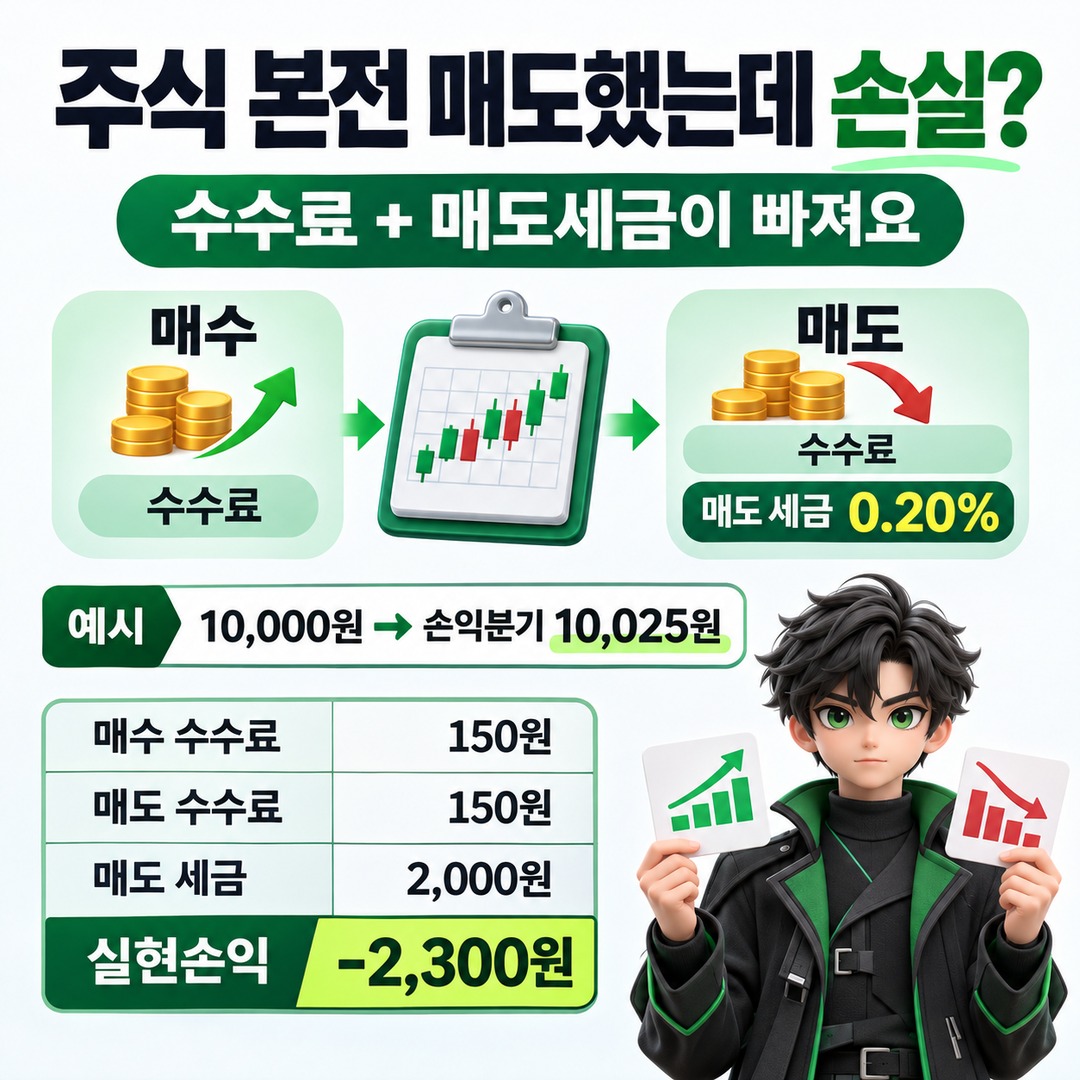
Even if you sell Korean stocks at the same price you bought them for, your account may still show a loss. Brokerage fees apply when you buy and sell, and securities transaction tax is also deducted when you sell. As of 2026, the taxes related to selling KOSPI and KOSDAQ stocks are 0.20%, so you need to account for trading costs to calculate your true break-even price.
1. Why You Lose Money Even When the Purchase and Sale Prices Are the Same
When a stock’s price is the same as its purchase price, that means you have broken even on the price alone, before trading costs. To know your actual investment gain or loss, you must subtract the purchase fee, sale fee, and taxes incurred when selling.
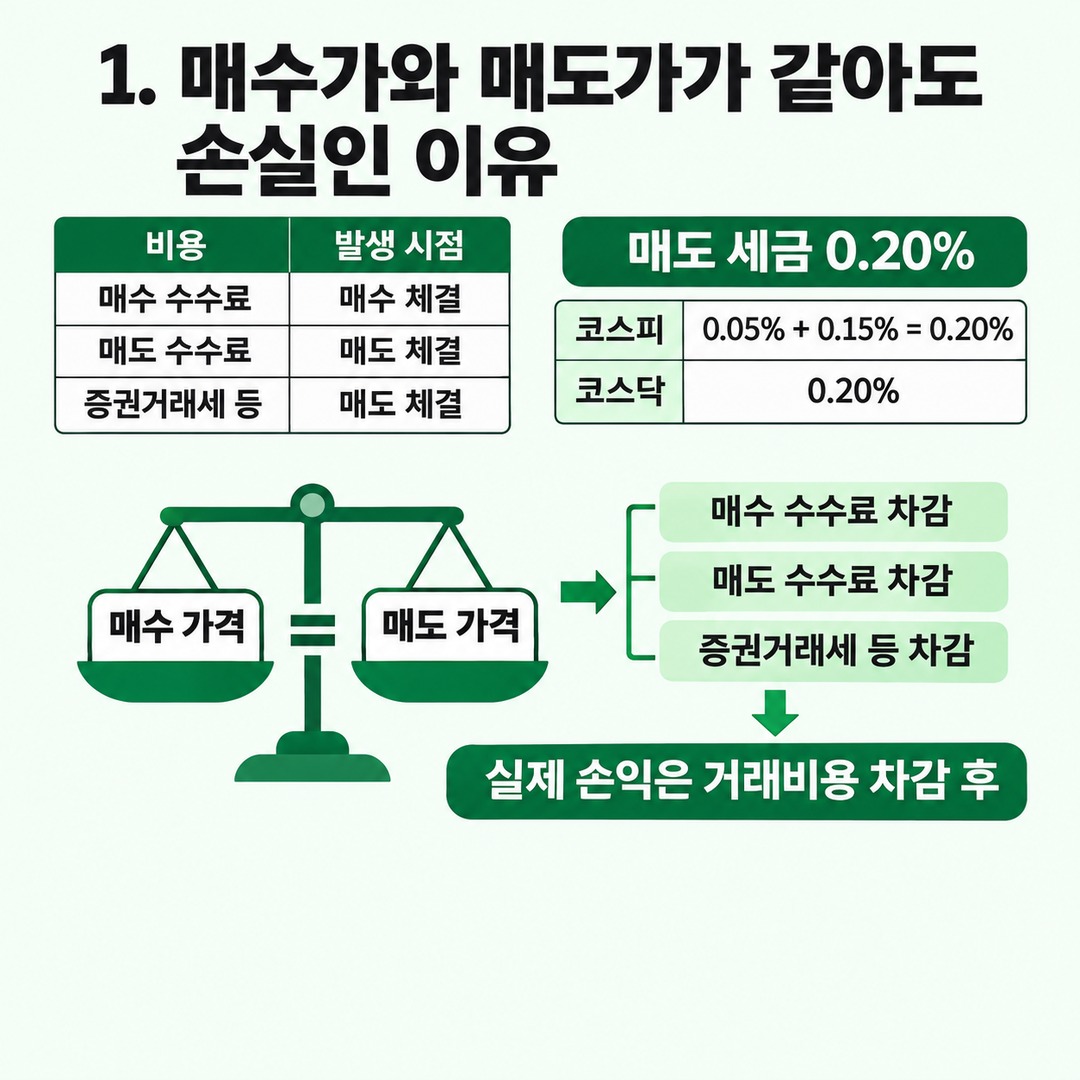
The typical trading cost structure for domestically listed stocks is as follows.
| Item | When It Applies | Calculation Basis |
|---|---|---|
| Purchase fee | When the buy order is executed | Purchase amount |
| Sale fee | When the sell order is executed | Sale amount |
| Securities transaction tax, etc. | When the sell order is executed | Sale amount |
The tax rates applicable to transfers from 2026-01-01 onward are as follows.
| Market | Securities Transaction Tax | Special Tax for Rural Development | Total |
|---|---|---|---|
| KOSPI | 0.05% | 0.15% | 0.20% |
| KOSDAQ | 0.20% | None | 0.20% |
For KOSPI stocks, the securities transaction tax and the Special Tax for Rural Development combine to make 0.20%. For KOSDAQ stocks, the securities transaction tax itself is 0.20%.
Therefore, for ordinary stock sales in both markets, you should account for 0.20% of the sale amount as tax.
2. How Much Difference Does It Make to Calculate Profit or Loss Using the Actual Sale Amount?
Suppose you buy 100 shares of stock at KRW 10,000 per share. If the sale price is also KRW 10,000, the profit or loss from the price change is KRW 0.
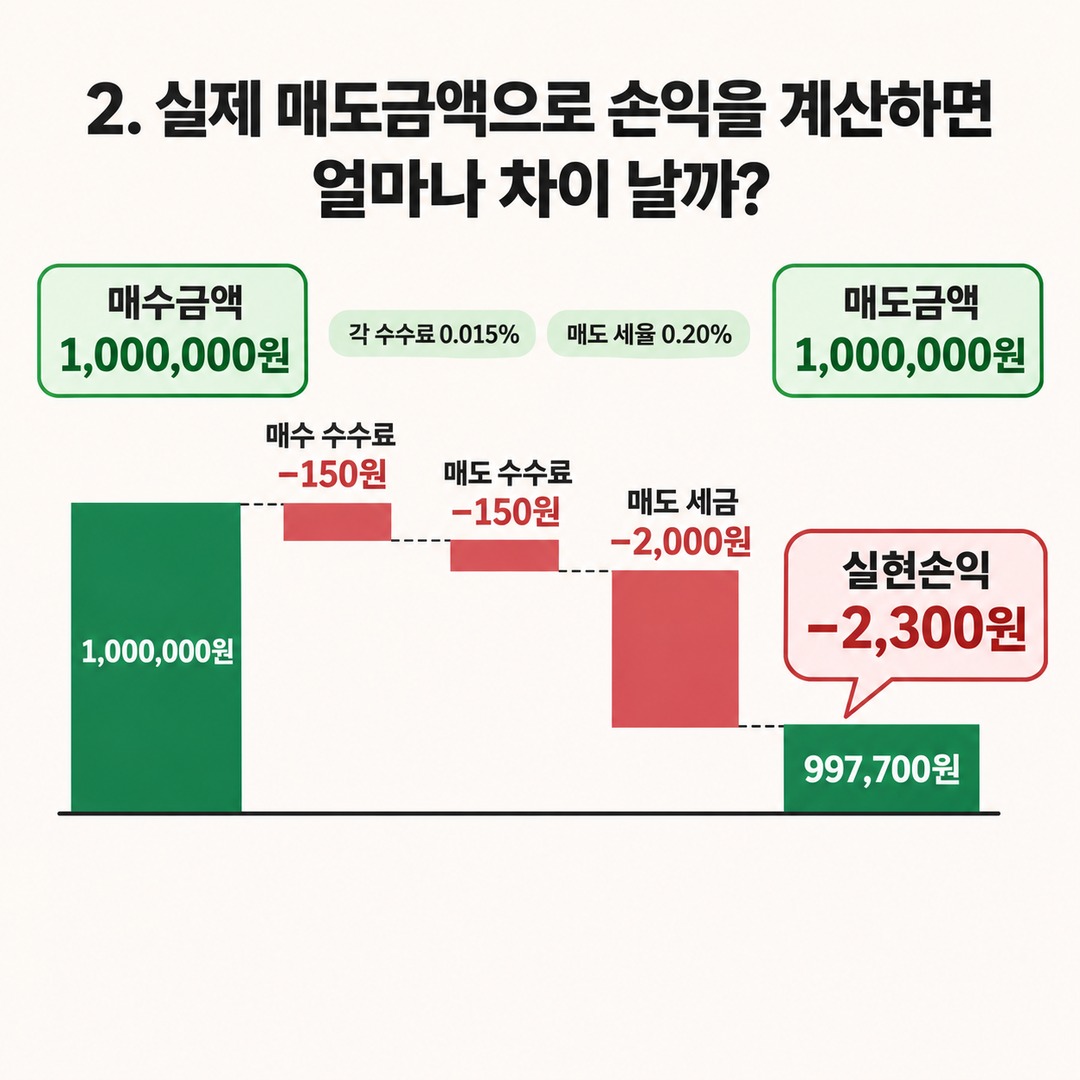
However, the actual result changes if we assume an online brokerage fee of 0.015% for each purchase and sale.
Calculation example · KRX ordinary domestic stocks · Fee rate is an assumption for illustration
| Item | Amount |
|---|---|
| Purchase amount | KRW 1,000,000 |
| Purchase fee 0.015% | KRW 150 |
| Sale amount | KRW 1,000,000 |
| Sale fee 0.015% | KRW 150 |
| Sale tax 0.20% | KRW 2,000 |
| Final realized profit/loss | -KRW 2,300 |
In other words, even if the stock price returns to where it started, the calculation shows a loss of KRW 2,300 in the actual account.
The key point is that securities transaction tax is calculated based on the actual sale amount, not the purchase amount.
3. How to Calculate the Break-Even Sale Price Including Fees and Taxes
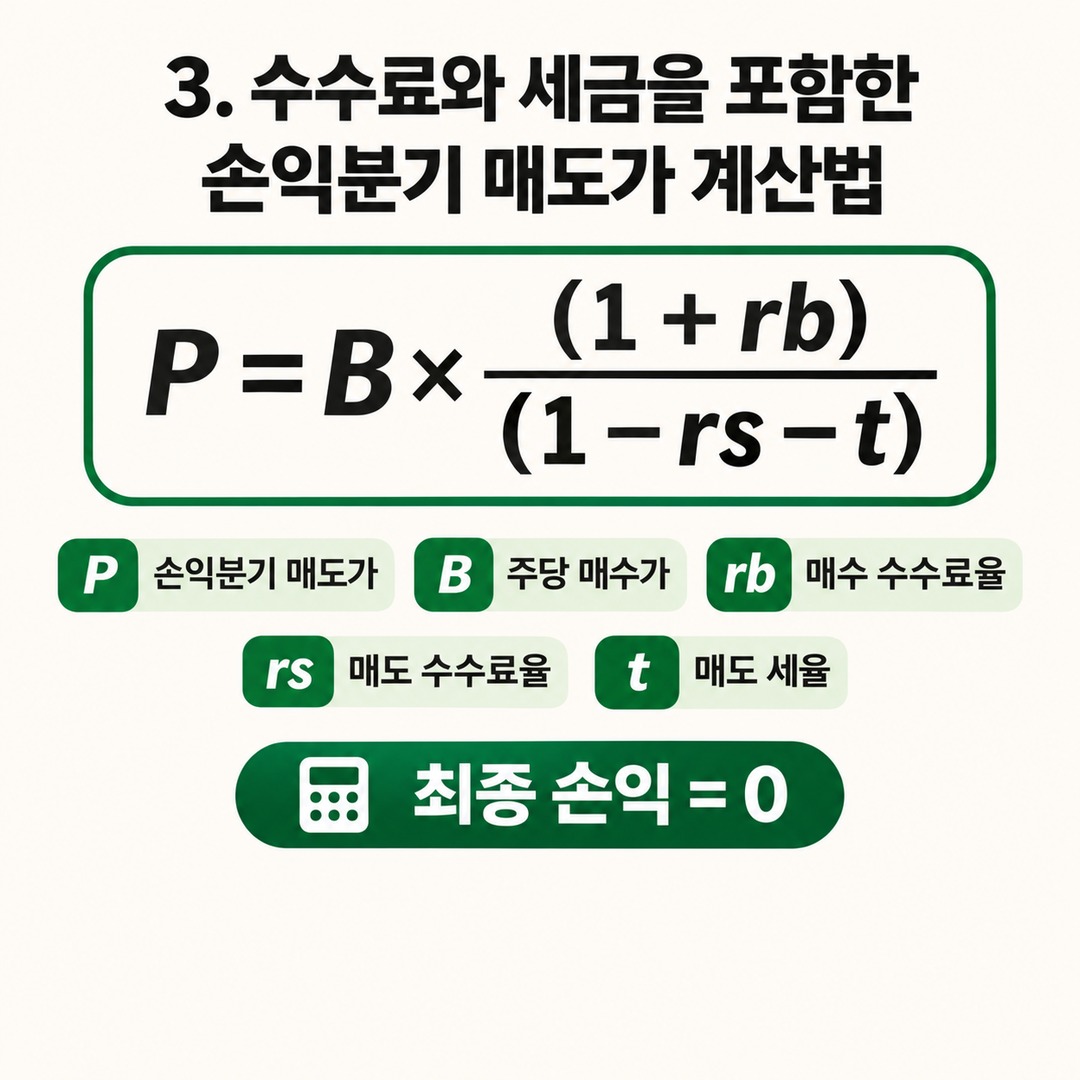
The break-even sale price is not the price at which the purchase amount and sale amount are equal. It is the price at which the final profit or loss is KRW 0 after paying all purchase and sale fees, as well as the tax on the sale.
Assuming standard percentage-based fees, you can calculate it using this formula.
Break-Even Sale Price Formula
P=B(1+rb)1−rs−t- P: Break-even sale price
B: purchase price per share
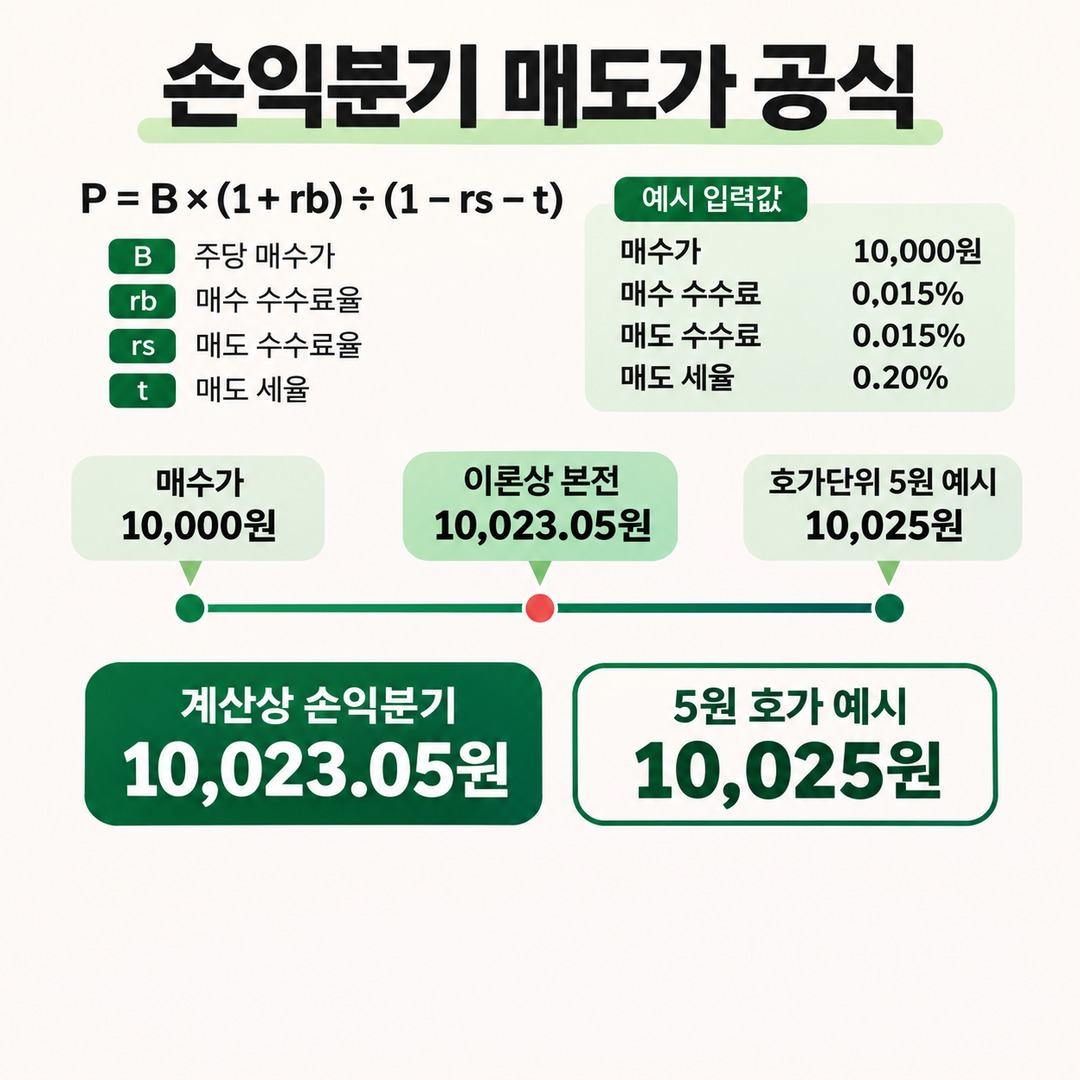
rb: purchase fee rate
rs: sale fee rate
t: sale tax rate
Substituting the conditions used above gives the following:
Purchase price: KRW 10,000
Purchase fee: 0.015%
Sale fee: 0.015%
Sale tax rate: 0.20%
P=10,000×1.000150.99785Calculation result
KRW 10,023.05
Author's calculation · Theoretical break-even price
In theory, you need to sell at about KRW 10,023.05 per share to cover the trading costs.
For an actual order, the price must be adjusted to the applicable tick size. For example, if the tick size at that price level is KRW 5, then prices starting at KRW 10,025 exceed the calculated break-even point.
So you should not assume that selling for just KRW 1 – KRW 2 more than your purchase price means you have broken even.
4. Does the Break-Even Point Change When Brokerage Fees Differ?
Even when trading the same stock at the same price, the actual costs can vary depending on the brokerage and trading channel.
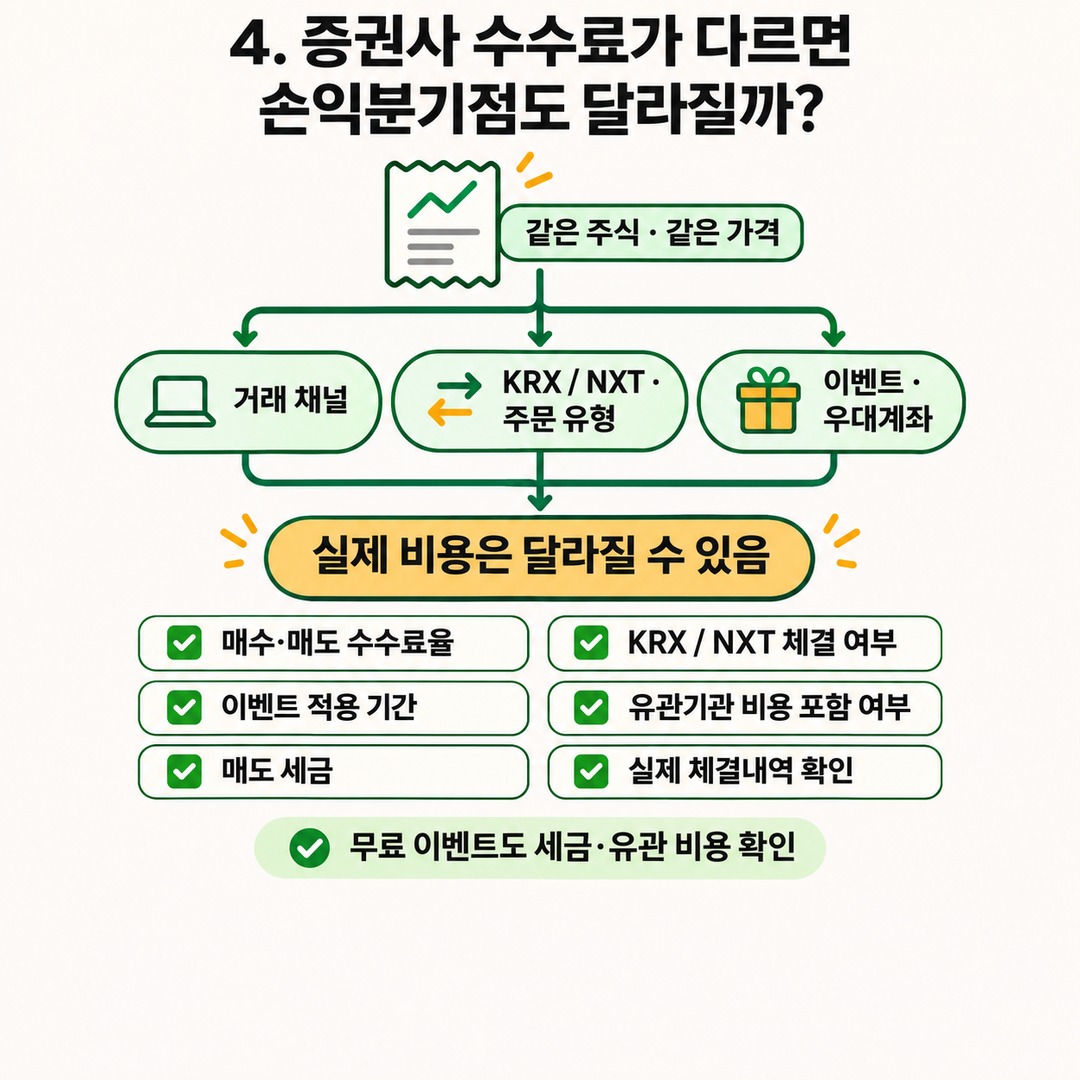
That is because each brokerage has different fees for online, mobile, and in-branch trades, and the availability of promotions or preferred-account rates also varies.
For example, brokerage fee schedules show differences such as these:
Samsung Securities: Fees vary by trading channel and transaction amount
Shinhan Securities: Related institution charges vary depending on whether an order is executed on KRX or NXT and on the order type
Kiwoom Securities: Fee rates vary by trading platform, with separate rates also applying to partner platforms
In particular, an advertised zero-commission promotion may not mean that related institution charges and taxes are also entirely free.
Before trading, it is a good idea to check the following:
1. Purchase fee rate
2. Sale fee rate
3. Whether the order is executed on KRX or NXT
4. Period during which the promotional fee applies
5. Whether related institution charges are included
6. Taxes charged on sale
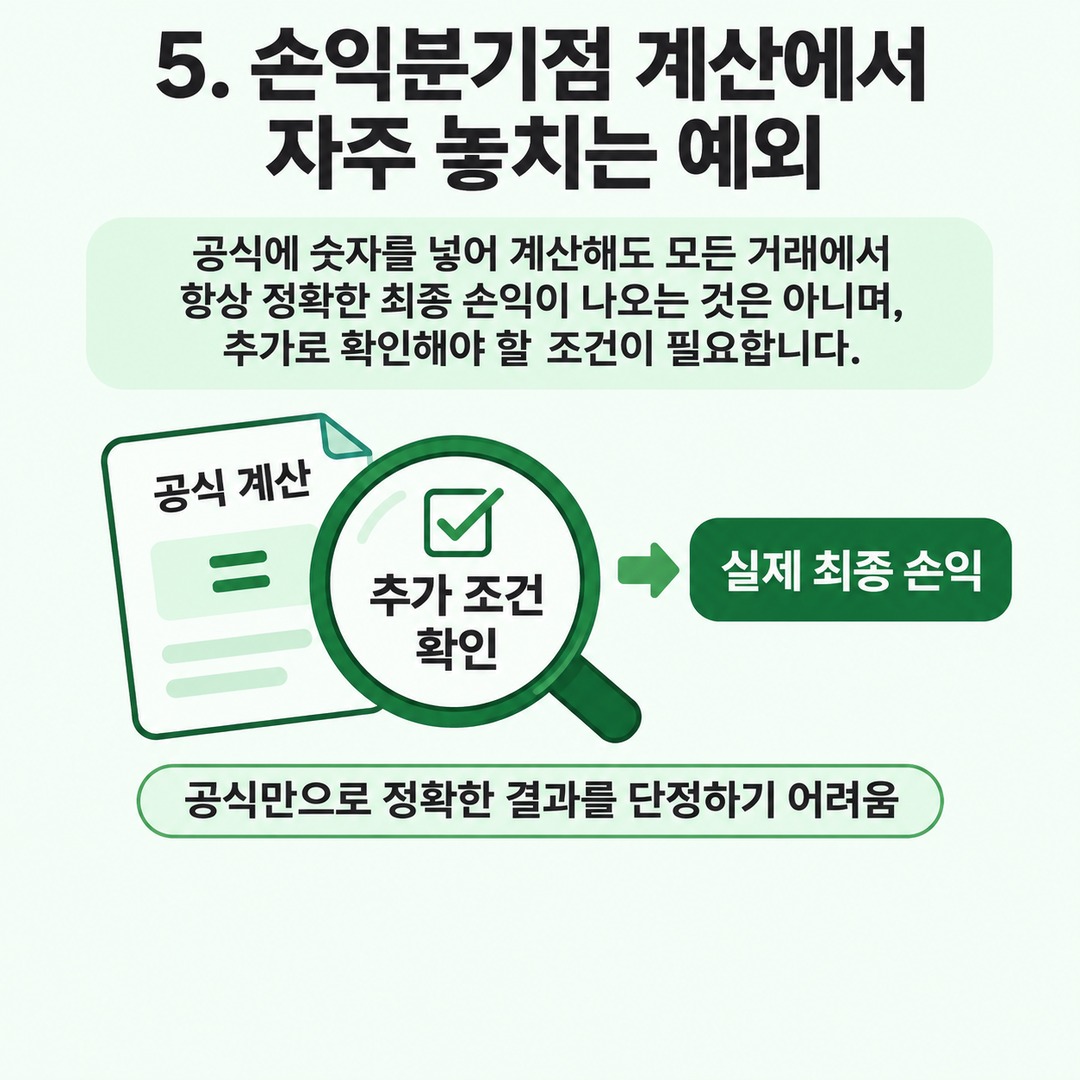
You can check the actual amount charged in your brokerage app’s transaction history or execution details, then compare it with the fee rate assumed by the calculator to see whether they differ.
5. Exceptions Often Overlooked When Calculating the Break-Even Point
Simply entering numbers into the formula will not accurately calculate the final profit or loss for every trade.
You also need to check for conditions such as the following.
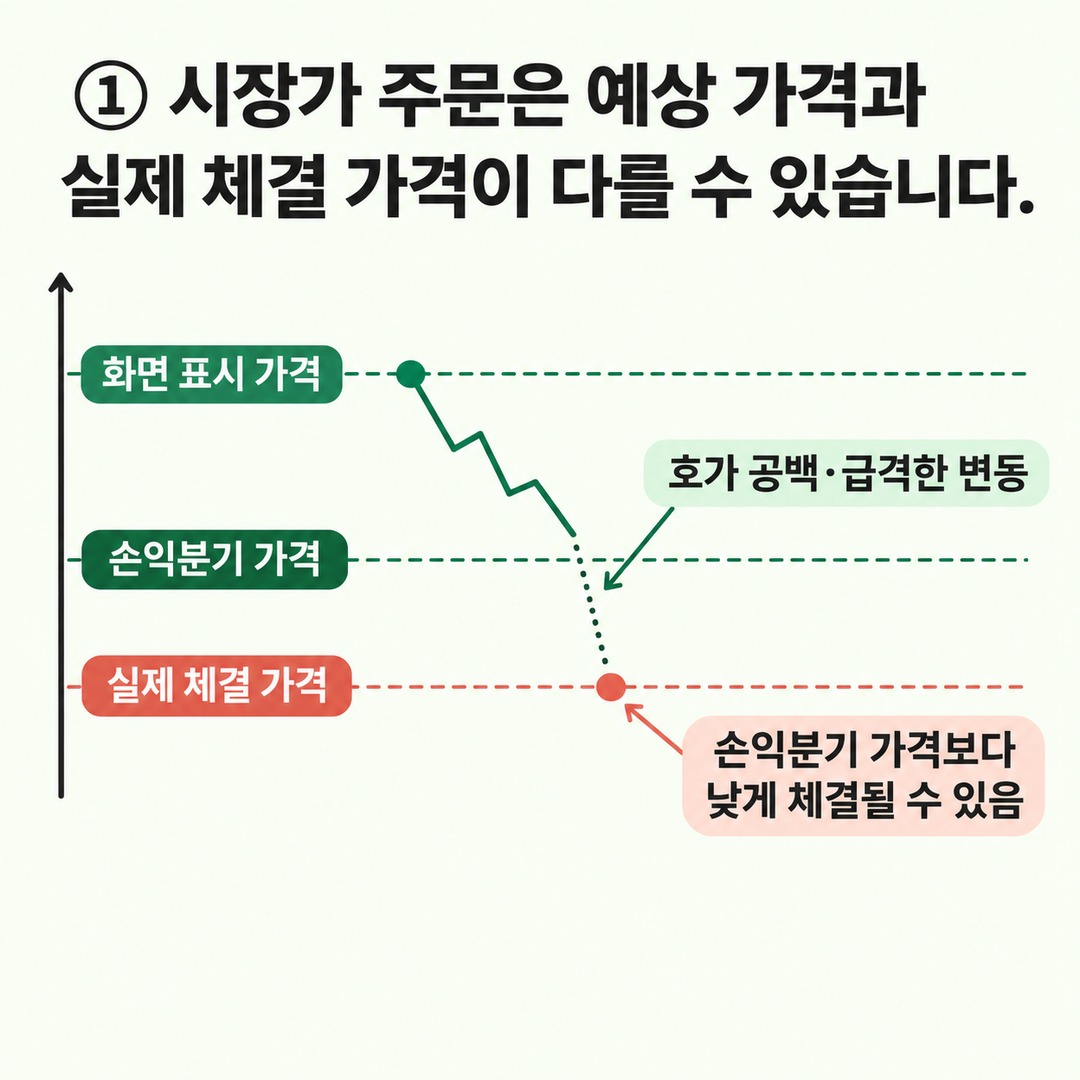
① With a market order, the expected price may differ from the actual execution price.
Your order may execute at a price lower than the one displayed when you press the sell button. If there is a gap in the order book or a sharp price swing, you could sell below the break-even price that accounts for trading costs.
② For split purchases and sales, check the execution amounts separately.
If you bought shares in multiple transactions, do not calculate the break-even point using only the initial purchase price.
Add up the actual purchase execution amounts and fees, then calculate the sale execution amounts and taxes separately.
③ ETFs are taxed differently from ordinary stocks.
The tax treatment of capital gains on domestically listed ETFs may differ depending on whether they are domestic stock-type ETFs or other ETFs. Do not apply the 0.20% securities transaction tax for ordinary listed stocks to every ETF.
④ Actual execution prices and how costs are rounded to the nearest won also matter.
Fees and taxes may differ by a few won depending on each brokerage’s calculation and rounding methods. Check your brokerage transaction history for your exact realized profit or loss.
6. 5 Things to Check Before Selling
Before deciding to sell at a loss or at break-even, check the following to reduce the risk of overlooking trading costs.
Have you checked the purchase amount and actual average purchase price?
Are purchase fees included?
Have you checked the sale fee rate?
Have you accounted for the sale tax 0.20%?
Have you considered the difference between the expected execution price and the actual execution price?
Trading costs can affect the planned loss amount, especially in short-term trades with a small loss limit.
When setting a stop-loss price, it is important to look beyond the chart price and consider the amount that will actually remain in your account after the sale.
Conclusion: Break-Even Depends on Realized Profit or Loss After Costs, Not on the Purchase Price
For Korean stocks, you should not assume you have broken even just because the purchase and sale prices are the same.
As of 2026, ordinary KOSPI and KOSDAQ stocks are subject to tax amounting to 0.20% of the sale amount, in addition to purchase and sale fees that vary by brokerage.
So the actual break-even price is slightly higher than the purchase price.
However, a break-even point that includes trading costs does not guarantee future returns or determine when to sell. The outcome may vary depending on the actual execution price, fees, taxes, and market conditions.
※ This article is for reference in understanding market trends and is not a recommendation to invest in any particular stock or asset. You are responsible for your own final decisions and investments.