

Google Shuts Down 449 Korean-Language Political YouTube Channels, With 367 Concentrated in May…Channel Names and Operators Remain Undisclosed
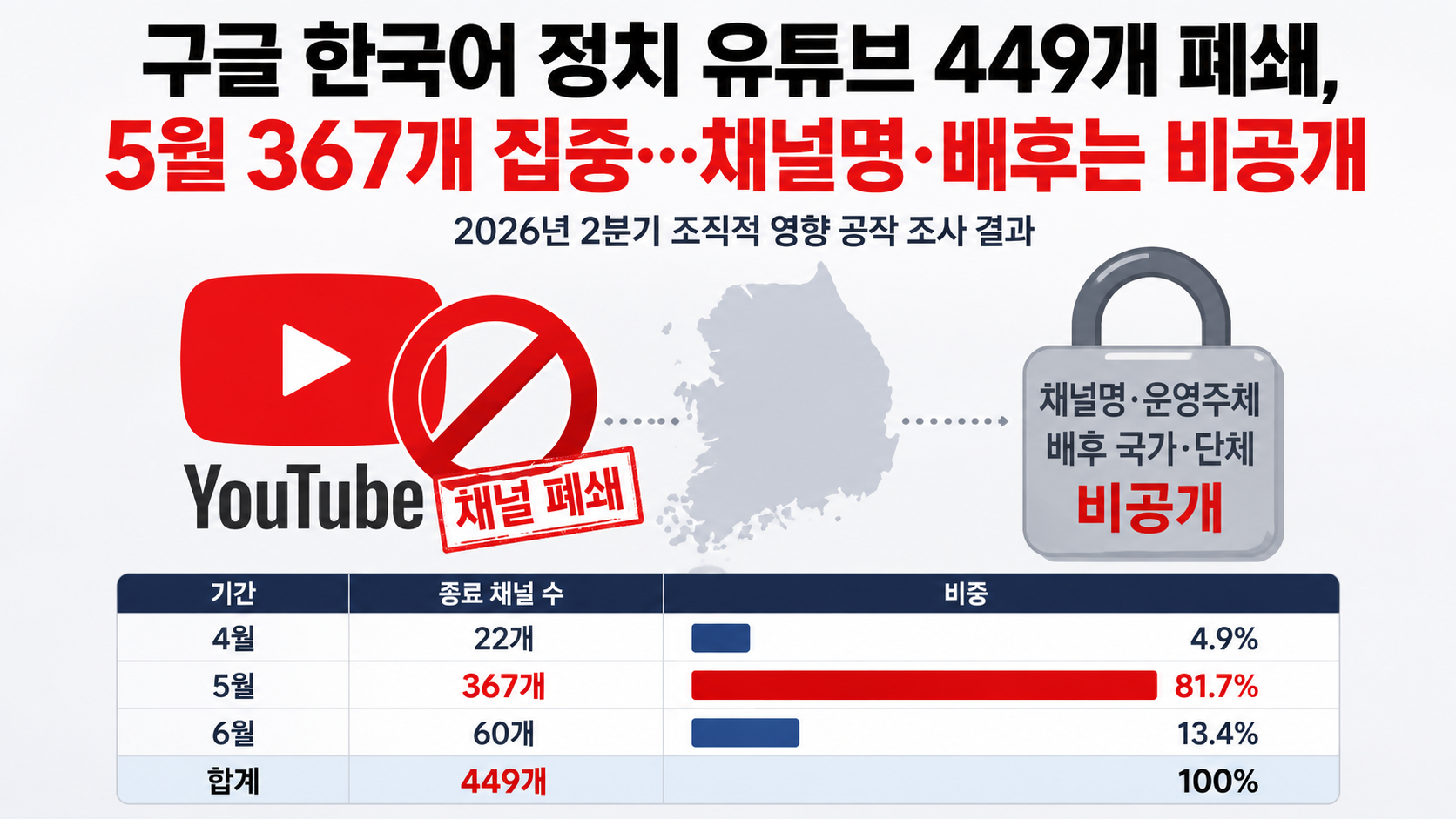
Google has been confirmed to have terminated 449 YouTube channels featuring Korean-language political content during its investigation into coordinated influence operations in the 2 quarter of 2026. The breakdown was 22 channels in April, 367 in May, and 60 in June, with approximately 81.7% of the total concentrated in May. However, the names of the 449 channels, their operators, and the countries or organizations behind them have not been disclosed.
An important distinction must be made from the outset. This figure does not mean '449 YouTube channels operated by South Koreans.' It refers to 449 YouTube channels that published Korean-language content. Google disclosed the number of channels, the general nature of their content, and when action was taken. It is not possible to determine how many individuals or organizations operated them.
The information was verified as of 2026-08-16 at 23 Korea Standard Time.
What Were the 449 Channels Google Actually Shut Down?
The 449 figure represents the number of Korean-language YouTube channels Google terminated between April 2026 and June during investigations into 'coordinated influence operations.' It would be incorrect to assume that all 449 channels were shut down simply because they posted political videos.
A month-by-month examination of Google's 'Influence Operations Bulletin Q2 2026,' released on July 31, shows the following actions involving Korean-language content.
| Action Period | Korean-Language Channels Terminated | Content Described in the Official Report |
|---|---|---|
| April | 22 channels | Support for South Korean politicians and criticism of South Korean political parties |
| May | 367 channels | Support for and criticism of the government and political parties across several separate campaigns |
| June | 60 channels | Content criticizing the South Korean government or political parties |
| Total | 449 channels | Subjects of coordinated influence operations investigations |
The official report records each group as a separate campaign. Counting the Korean-language entries directly reveals 1 campaigns in April, 7 in May, and 3 in June, for a total of 11 campaign entries.
Therefore, the figure 449 cannot be interpreted as 449 individual operators or 449 independent organizations. The confirmed unit of measurement is strictly 'terminated YouTube channels.'
What Does It Mean That 367 Channels Were Shut Down in May Alone?
In May, 367 of the total 449 channels were terminated. According to the author's calculation, 367 ÷ 449 × 100 = approximately 81.7%, meaning that more than 4 out of 5 of the Korean-language enforcement actions in the 2 quarter were concentrated in May.
The number rose sharply from 22 channels in April to 367 in May, before falling to 60 in June.
Because the nationwide local elections in 2026 took place on June 3, the enforcement actions in May coincided with the period immediately preceding the elections. However, Google's currently published report provides no basis for concluding that 'the 449 channels were created to manipulate the local elections' or that 'election interference was confirmed.'
The official document identifies the months in which campaigns and channels sharing particular types of content were terminated. It does not provide a separate explanation of why so many enforcement actions were concentrated in May.
The monthly figures must also be understood as the number of channels terminated during each month. They do not mean that the channels first became active or reached their peak activity in May.
Channels Criticizing the Government Were Not the Only Ones Shut Down
Interpreting these actions solely as enforcement against a particular political viewpoint is also inconsistent with the official evidence. The entries for May alone include campaigns criticizing the South Korean government as well as campaigns supporting it.
The largest individual Korean-language campaign involved 142 channels sharing content critical of the South Korean government.
However, the same month also included separate campaigns involving 53 channels criticizing both the government and political parties, 43 channels supporting the government while criticizing a particular political party, and 37 channels supporting both the government and a particular political party. Another campaign involving 21 channels shared content both supporting and criticizing the government.
Two additional campaigns sharing pro-government content were recorded separately, involving 20 and 51 channels, respectively.
In other words, the evidence cannot be reduced to a simple formula such as 'criticize the government → channel removed; support the government → channel remains active.' Channels publishing politically opposing content appeared together on the enforcement list for the same quarter.
In June, the report also recorded three separate campaigns: 22 channels criticizing both South Korean political parties and the government, 13 channels criticizing the government, and another 25 channels criticizing the government and political parties. Together, these three entries totaled 60 channels.
Does 'Coordinated Influence Operations' Mean Political Opinions Themselves?
No. Google's use of the term coordinated influence operations should not be equated with the act of supporting or criticizing a particular opinion itself.
Google's Threat Analysis Group (TAG) has previously explained that its investigations into influence operations do not focus on determining whether content posted on a platform is right or wrong. Instead, it analyzes technical signals, detection criteria, and behavioral patterns to identify coordinated inauthentic activity.
Put simply, an individual uploading a political video, or several people independently expressing similar views, is a different investigative matter from multiple accounts or channels conducting planned activities in a coordinated and interconnected manner.
Google's report for the 2 quarter of 2026 also distinguished the Korean-language channels as separate 'campaigns' rather than combining them into a single undifferentiated list.
Because of this distinction, interpretations such as 'YouTube removed the channels because they criticized the government' or 'the channels were shut down because they supported the government' cannot be established from the official evidence alone. The actual enforcement list includes content representing opposing political viewpoints.
Why Can't the Names of the Shut-Down Channels or the Countries Behind Them Be Identified?
The publicly available report does not identify the individual names of the 449 Korean-language channels. It also does not specify their operators or the countries or organizations behind them. Therefore, it would be inappropriate to arbitrarily associate a particular political YouTube channel that recently disappeared with the 449 channels in this report.
This becomes clearer when the Korean-language entries are compared with cases involving other countries in the same report.
For some campaigns, Google explicitly identified national connections using descriptions such as 'linked to Russia,' 'linked to China,' and 'linked to the United States.' By contrast, the Korean-language entries stated that the content was in Korean and concerned the South Korean government, political parties, or politicians, but did not include comparable country-of-origin attributions.
Accordingly, the currently verifiable facts are as follows.
449 Korean-language YouTube channels were terminated.
The actions were taken during coordinated influence operations investigations conducted from 4 to June in 2026.
The content included both support for and criticism of the South Korean government, political parties, and politicians.
The identities of the affected channels have not been disclosed.
The identities of those operating the 449 channels have not been disclosed.
Publicly available materials do not identify the countries or organizations behind the Korean-language campaigns.
The expression 'Korean-language channels' is also important. It does not establish that the channel operators were South Korean nationals or that their actual locations of operation were in South Korea.
What Remains Unknown About the 449 Channel Shutdowns May Be More Important
Although the number is substantial, the actual extent of their influence on public opinion cannot be calculated from this report alone. This is because the report does not disclose the subscriber counts, view counts, impressions, comment volumes, or operating periods of the individual 449 Korean-language channels.
It also does not disclose how many operators created the 449 channels, whether several organizations operated them independently, or whether any of the channels were operated from overseas.
Therefore, '449 channels' must not be treated as equivalent to '449 individuals involved in manipulating public opinion.'
The same principle applies to their relationship with the local elections. It can be confirmed that 367 channels were terminated in May, immediately before the local elections on June 3. However, the timing alone does not establish that the channels were intended to interfere with the elections.
More precisely, the central finding supported by currently available public information is that Google terminated 449 Korean-language YouTube channels featuring South Korean political content during its coordinated influence operations investigations in the 2 quarter of 2026, with 367 of those channels concentrated in the enforcement actions taken in May.
What Additional Disclosures Would Help Clarify the Scope of the Case?
The most important information to emerge next would be additional details about the operators and the relationships among the campaigns, rather than simply the names of the channels. At present, only the 11 Korean-language campaign entries, the number of channels, and the general nature of their content can be identified.
If additional information becomes public, three areas deserve particular attention.
First, whether the operators or affiliated organizations behind each campaign can be identified. The current report does not identify who was behind the Korean-language campaigns.
Second, whether the operating periods and actual audience reach of individual channels will be disclosed. Without view counts or subscriber figures, it is difficult to assess their influence based solely on the number 449.
Third, whether there will be official confirmation that particular political YouTube channels were included in these enforcement actions. At this stage, linking individual channels mentioned online to the 449 channels remains unverified speculation.
When examining this case, the most important consideration is to distinguish what has been confirmed from what remains undisclosed, rather than focusing solely on the large figure of '449 channels.' Google's official materials confirm investigations into coordinated influence operations involving channels publishing Korean-language political content and the resulting terminations. They do not establish the identities of individual operators, who was behind the campaigns, or the actual scale of their influence.
---