

National Fire Mobilization Order for Gyeongnam Drought: How Severe Is the Situation That Requires 200 Fire Trucks?
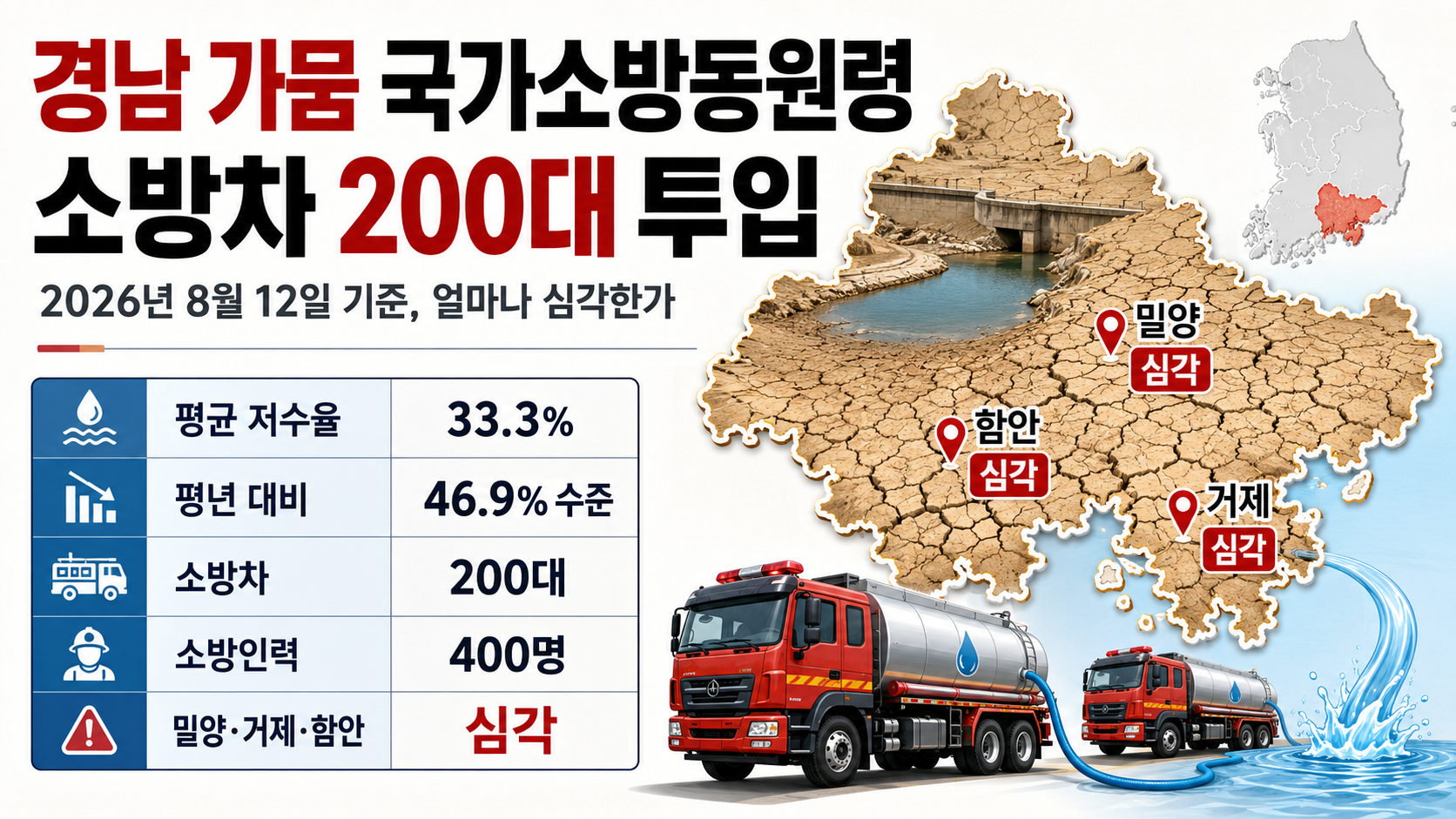
As of 2026-08-12, the drought in Gyeongnam has gone far beyond a simple shortage of rainfall. The average water storage rate at agricultural reservoirs in Gyeongnam has fallen to 33.3%, approximately 46.9% of the usual level, while Miryang, Geoje, and Haman have reached the highest agricultural water drought alert level, 'Severe.' 200 water tanker trucks and 400 firefighters were deployed from 16 cities and provinces nationwide because Gyeongnam's own emergency water supply resources could no longer adequately meet demand.
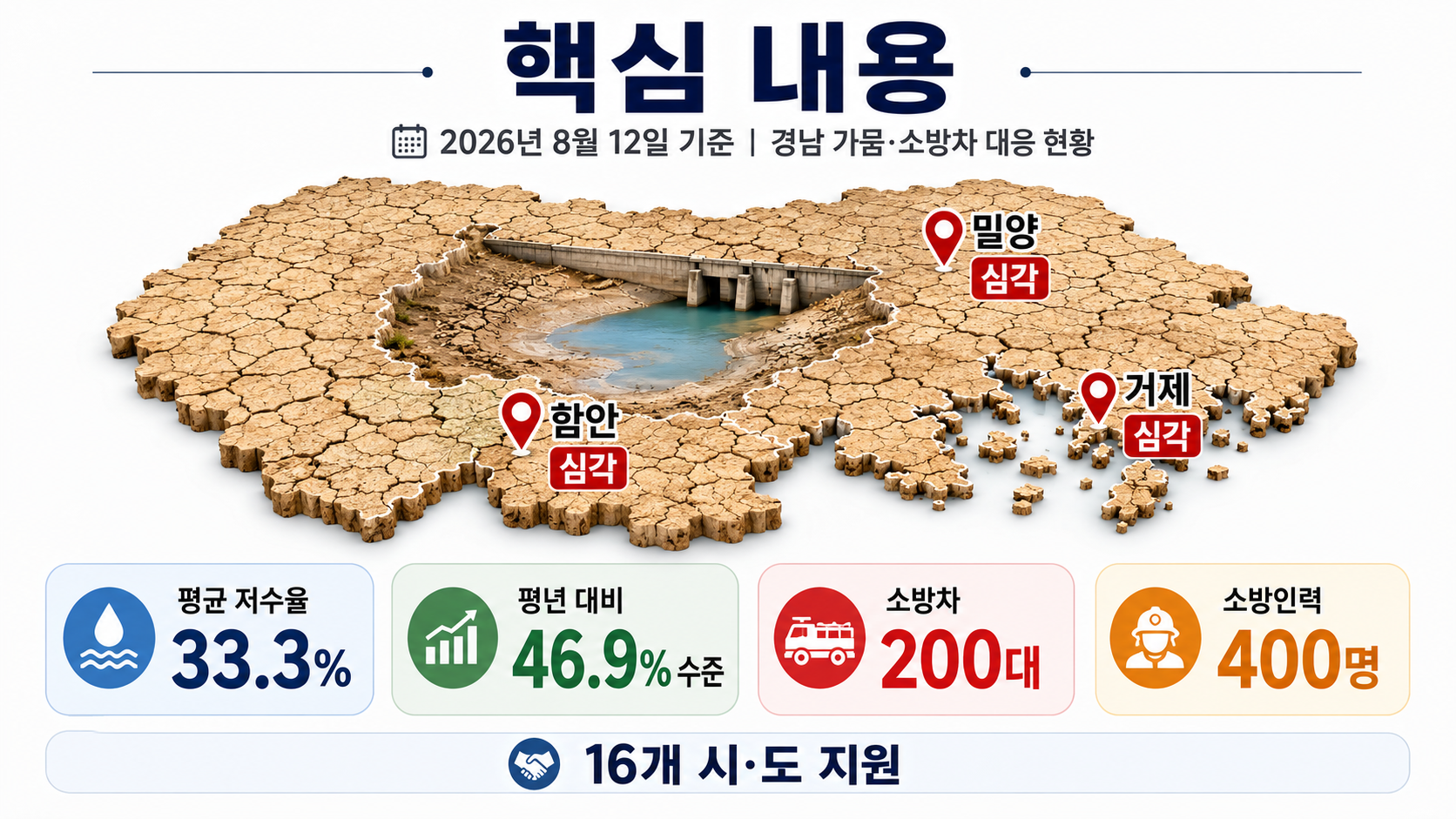
More importantly, agricultural water shortages are already causing crop damage, and some islands and villages have begun restricting household water supplies. However, this does not mean that water service has been suspended across all cities in Gyeongnam. Regional water supply networks and major water sources are generally operating normally, so a crisis in agricultural water supplies does not necessarily mean a complete shutdown of household water services.
Why Was a National Fire Mobilization Order Issued?
A national fire mobilization order is a measure that deploys firefighting personnel and equipment from other cities and provinces when a disaster cannot be adequately handled by one region's firefighting resources or when nationwide assistance is considered necessary. What makes this mobilization unusual is that firefighting resources from across the country were dispatched not to extinguish fires, but to supply agricultural and household water to drought-stricken areas.
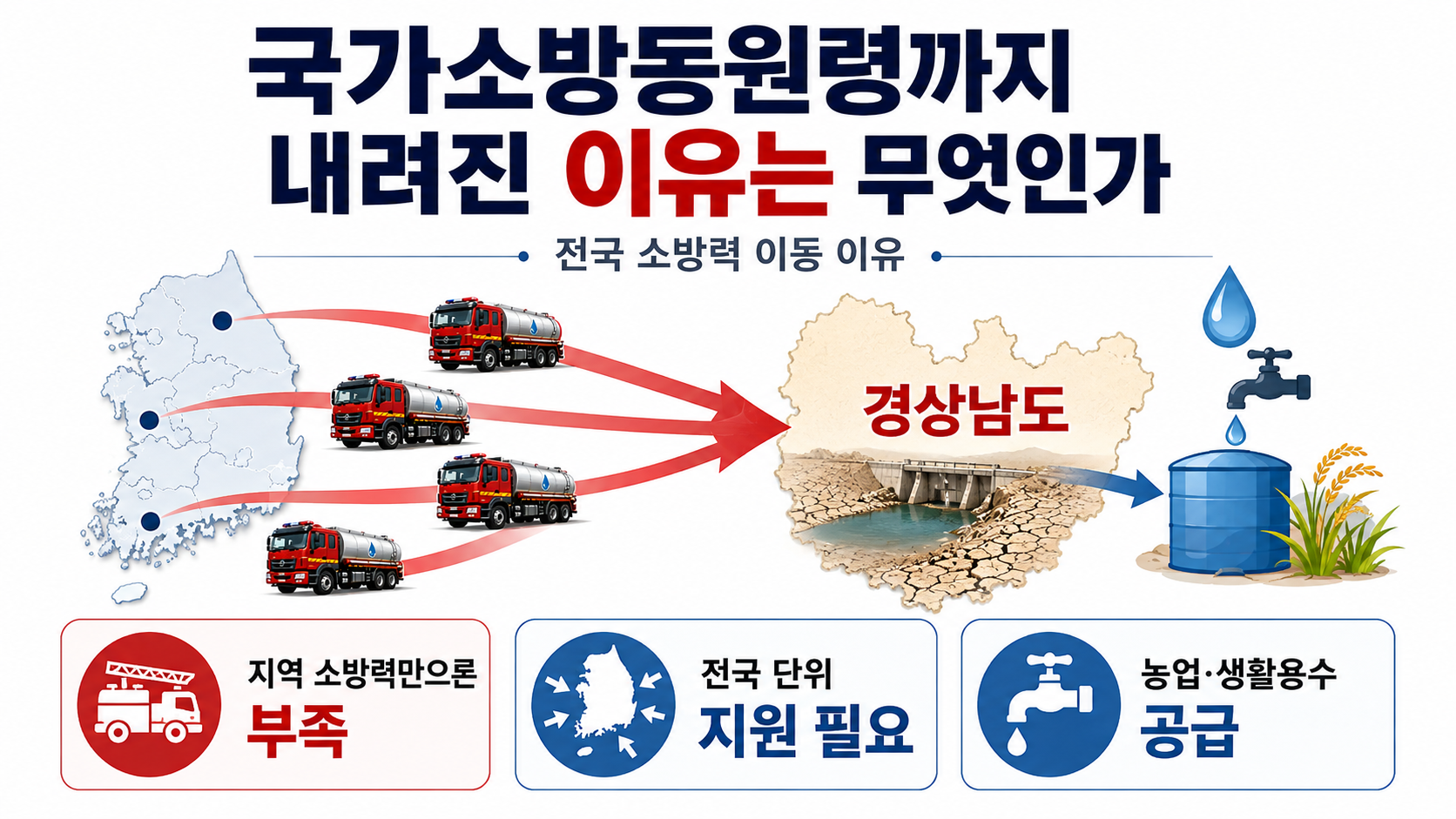
The Gyeongnam Fire Headquarters determined that the prolonged drought had made it difficult to provide sufficient water to affected areas using its own fire trucks and requested nationwide assistance from the National Fire Agency. The agency issued a national fire mobilization order at 8 p.m. on August 11, deploying 200 water tanker trucks and 400 firefighters from 16 fire headquarters, including Seoul, Busan, Daegu, Incheon, Gwangju, Daejeon, Ulsan, Sejong, Gyeonggi, Northern Gyeonggi, Gangwon, North Chungcheong, South Chungcheong, North Jeolla, South Jeolla, and North Gyeongsang.
National fire mobilization orders issued specifically because of drought are uncommon. Following the drought in Gangneung in August 2025, this mobilization in Gyeongnam has been confirmed as the second such case. In other words, the deployment of 200 fire trucks is not merely a precautionary measure. Rather, it indicates that local government and existing firefighting resources could no longer adequately handle water supply demand, making nationwide assistance necessary.
How Low Is Gyeongnam's Reservoir Storage Rate of 33.3%?
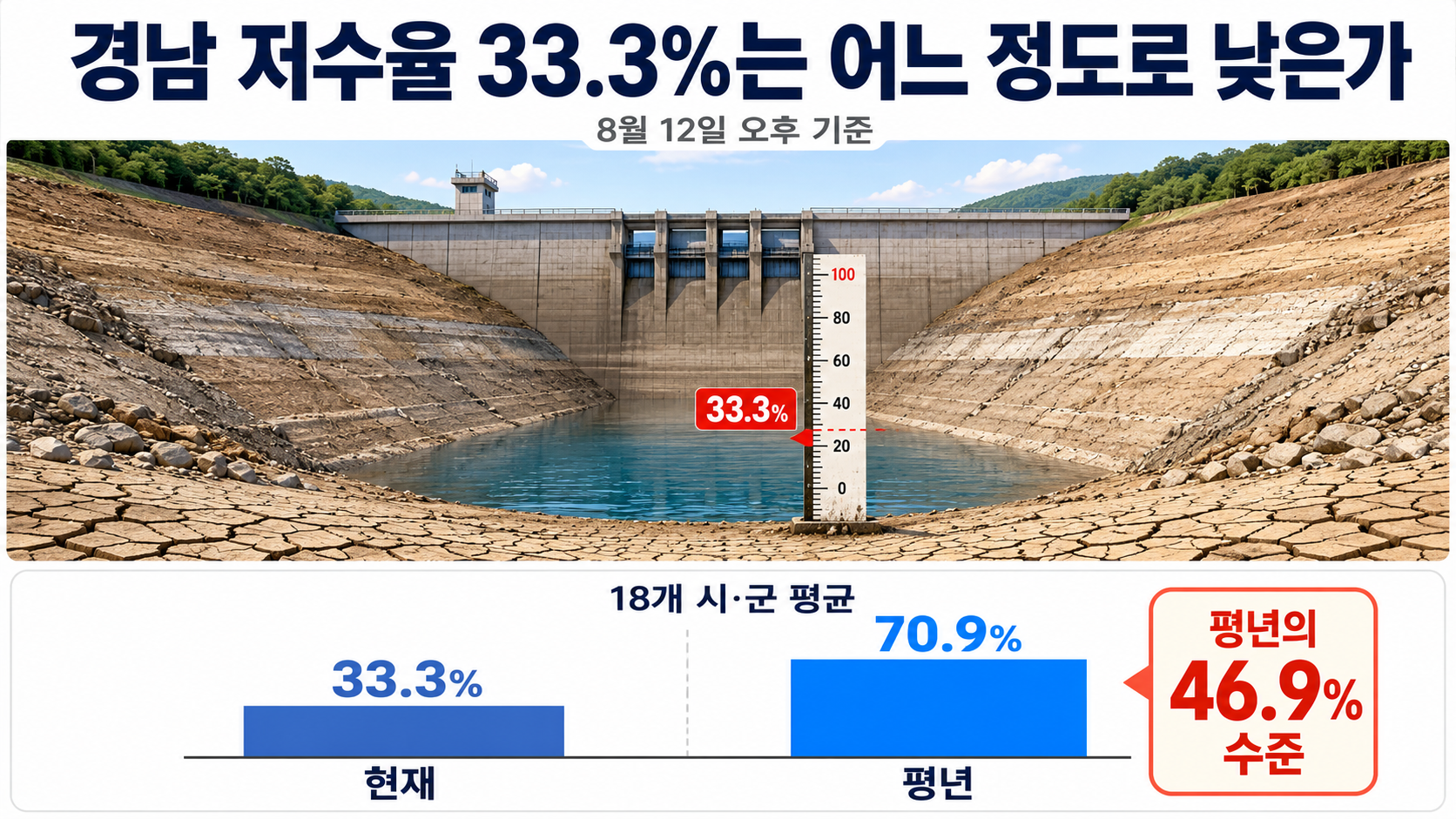
As of the afternoon of August 12, the average water storage rate at agricultural reservoirs across 18 cities and counties in Gyeongnam stood at 33.3%. Compared with 70.9% during the same period in a typical year, this means the current storage rate is only 46.9% of its usual level.
The author's calculations make the difference even clearer.
Subtracting the current 33.3% from the usual 70.9% produces a difference of 37.6% percentage points. Measured against the normal reservoir storage rate, the current level is approximately 53.0% lower.
The situation is particularly serious in Miryang. Its agricultural reservoir storage rate is 25.7%, compared with a typical level of 74.5%. This means the current level is only about 34.4% of normal. Miryang, Geoje, and Haman are at the highest, 'Severe,' level among the 4 agricultural drought alert stages. As of August 12, these were also the only three cities and counties nationwide classified at that level.
Among Gyeongnam's 18 cities and counties, Hamyang is the only area that has not entered a drought alert stage. 17 cities and counties, or approximately 94.4% according to the author's calculations, are currently under drought response measures. With Tongyeong also moving into the 'Alert' stage, the number of areas at that level has increased to 10.
Readers may notice that different reports give Gyeongnam's reservoir storage rate as 33.5% or 33.3%. These figures do not necessarily describe different drought conditions. Rather, the figures were updated as reservoir water consumption and reporting times changed, even within the same day. The National Fire Agency's announcement used 33.5%, while a subsequent compilation reflecting the Agricultural Drought Management System on the afternoon of 12 confirmed 33.3%. When assessing the latest situation, checking the reference time alongside the figures is more accurate than comparing the numbers alone.
How Much Water Did 200 Fire Trucks Actually Deliver?
The 200 water tanker trucks assembled from across the country did not simply remain on standby. They began delivering water on the morning of 12. Over 7 hours, from 9 a.m. to 4 p.m., they completed 356 delivery trips and supplied a total of 2,545 tons of water. Agricultural water accounted for most of the total, at 2,503 tons, while 42 tons were used for livestock facilities, road spraying, and other purposes.
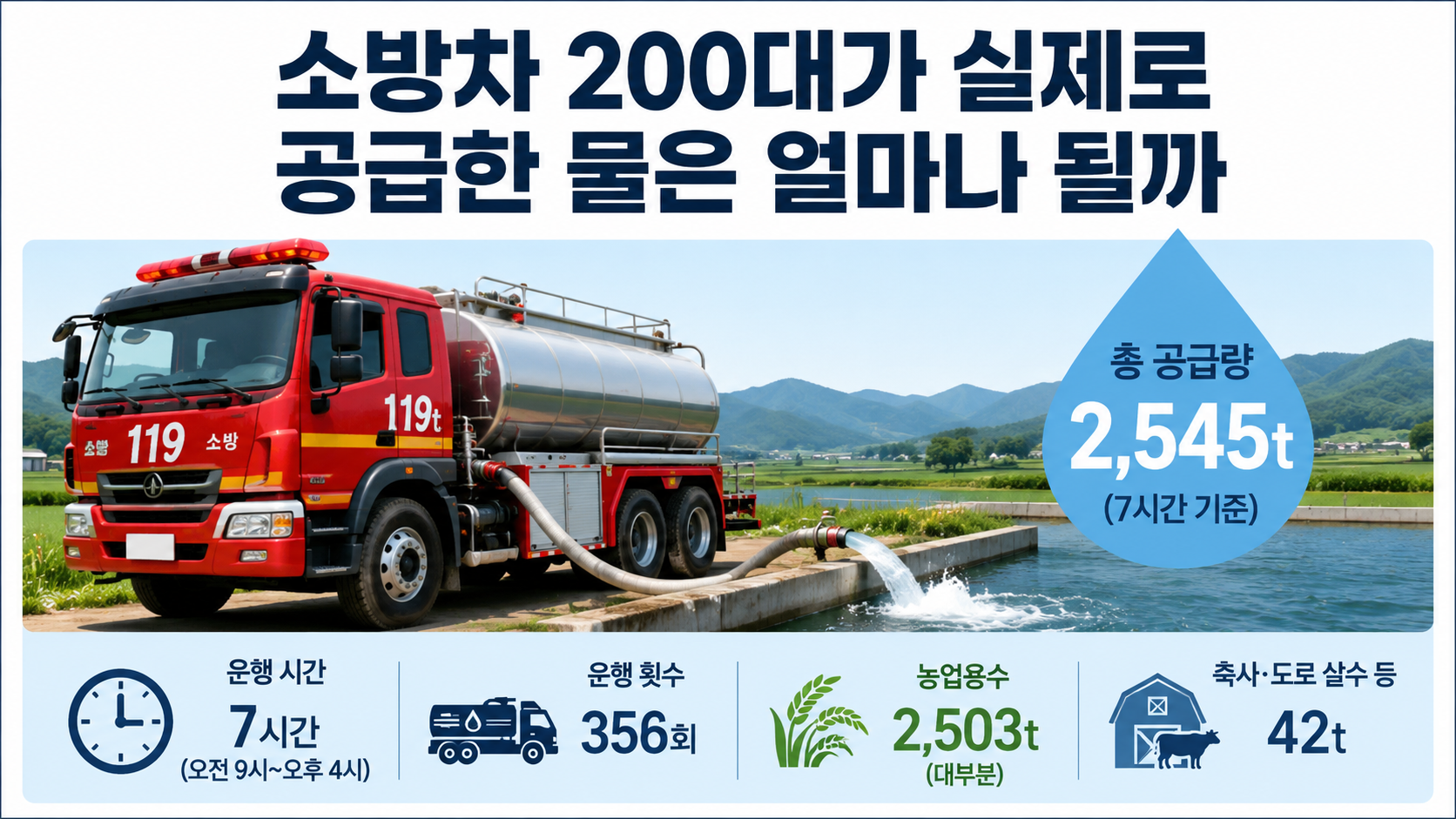
According to the author's calculations, the average amount of water supplied per delivery was approximately 7.15 tons.
2,545 tons ÷ 356 trips ≈ 7.15 tons
Agricultural water accounted for approximately 98.3% of the total supply.
2,503 tons ÷ 2,545 tons × 100 ≈ 98.3%
These figures also reveal the primary purpose of the national fire mobilization order. The operation is not intended to replace municipal tap water supplies for entire cities. Instead, it is an emergency water delivery operation focused on sustaining locations with immediate water needs, including farmland and livestock facilities affected by declining reservoir and river water levels.
The vehicles were not concentrated in a single location. Miryang, where the drought is particularly severe, received the largest deployment of 40 trucks. Jinju, Sacheon, and Gimhae each received 20 trucks, while Yangsan received 18. The remaining vehicles were also distributed across 14 areas according to drought severity and requests for water deliveries. Each of the main medium-sized water tanker trucks can carry approximately 6,000–12,000 liters of water.
In Miryang, a high-capacity drainage pump system was installed along the Miryang River to reduce the time needed to fill water tanker trucks. The equipment can supply water to 5 tanker trucks simultaneously, with a maximum delivery capacity of 8,000 liters per minute. The strategy involves not only increasing the number of water delivery vehicles but also shortening the time required for water intake, tank filling, and transportation to farmland, allowing more water to be delivered within the same period.
How Much Crop Damage Has Already Occurred?
As of August 12, the area of farmland affected by drought in Gyeongnam had reached 2,121 hectares. Damage has been confirmed not only to rice crops but also to fruit trees, including sweet persimmons, pears, and apples, as well as field crops such as beans, sesame, and peppers.
The affected area reported the previous day was 1,955.6 hectares. Although differences in reporting times must be considered, a direct comparison of the two published figures indicates an increase of 165.4 hectares in approximately one day, equivalent to roughly 8.5% according to the author's calculations. This shows that the drought has progressed beyond simply lowering reservoir levels and is now causing an expanding area of actual crop damage.
Cumulative rainfall in Gyeongnam over the past 6 months was also only about 60% of the normal level. In particular, insufficient summer rainfall combined with extreme heat reduced water flowing into reservoirs while evaporation and agricultural water consumption continued. This explains why a brief rain shower does not immediately restore reservoir water levels.
Is the Drought Severe Enough to Disrupt Household Water Supplies?
Household water supplies have not been cut off throughout Gyeongnam. Major water sources, including Namgang Dam, Yeoncho Dam, and Gucheon Dam, as well as regional water supply systems drawing from the Nakdong River, continue to operate normally. As a result, there are not yet major restrictions on household and industrial water supplies across large urban areas.
The problem is concentrated in areas not connected to regional water supply networks. On islands and in villages in Tongyeong, Miryang, Yangsan, Hadong, and Geoje that depend on groundwater or small-scale water supply facilities, 27 locations are experiencing scheduled water restrictions or receiving water through supply vessels and bottled water deliveries. The number had been reported as 26 through the previous day, but increased to 27 in the afternoon tally on 12.
Miryang Dam is a particularly important location to monitor for household water supply conditions. Its reservoir storage rate has fallen to 31.8%, placing it at the 'Alert' stage for household water drought. To secure water for household use, Miryang Dam has been gradually reducing agricultural water supplies since early August.
Therefore, describing the current situation as 'tap water is being cut off throughout Gyeongnam' would be an exaggeration. Conversely, claiming that 'this is only an agricultural water problem with no effect on daily life' would also be inaccurate. The most accurate assessment is that areas served by regional water supply networks are generally receiving normal service, while locations dependent on small-scale water systems and groundwater are already experiencing restrictions on household water use.
Will Rain on 13–14 End the Drought?
It is difficult to expect the drought to be completely resolved in a short period. Gyeongnam Province estimates that approximately 200 mm of rain will be needed in the near future to sufficiently moisten dry farmland and restore substantial inflows into agricultural reservoirs.
According to the Korea Meteorological Administration's short-term forecast issued at 5 p.m. on August 12, rainfall of 10–40 mm was expected on 13 along the southern coast of Busan, Ulsan, and Gyeongnam and in eastern inland Gyeongnam. Showers of 5–40 mm were forecast for central and western inland Gyeongnam. There was also a possibility of showers of 5–40 mm across Busan, Ulsan, and Gyeongnam on 14.
Rainfall itself could help slow the decline in reservoir storage rates and reduce crop damage. However, showers can vary considerably between locations, and the amount of water currently needed is substantial. Therefore, the existence of a rain forecast alone should not be taken as evidence that the drought has ended.
After the rain, it will be important to check how much reservoir storage rates actually increase, whether drought alert levels in Miryang, Geoje, and Haman are lowered, and whether the number of areas facing water restrictions decreases. Because water needs time to flow into reservoirs from surrounding catchment areas after rainfall, changes observed one or two days later may be more meaningful than figures recorded immediately after the rain stops.
What Should Be Monitored Going Forward?
Three indicators can provide a relatively quick assessment of whether drought conditions are genuinely improving.
The first is Gyeongnam's average agricultural reservoir storage rate. The most basic indicator is whether it rebounds from 33.3% as of August 12 or continues to decline.
The second is whether Miryang, Geoje, and Haman remain at the 'Severe' drought alert level. Miryang is particularly vulnerable because its reservoir storage rate is only approximately 1/3 of its normal level, making a return to normal conditions unlikely through short-term rainfall alone.
The third is the number of locations facing restrictions on household water supplies. With water restrictions or alternative water deliveries currently in place at 27 locations, whether this figure rises or falls provides the most direct indication of the drought's impact on residents' daily lives.
The 200 water tanker trucks are scheduled to continue supplying water through 13. The delivery of 2,545 tons during the first 7 hours on 12 demonstrates that the operation is clearly helping replenish urgently needed agricultural water supplies. However, water deliveries by fire trucks alone cannot restore hundreds of reservoirs to normal levels. Ultimately, emergency water deliveries and the securing of alternative water sources will need to continue until sufficient rainfall and reservoir inflows recover.
This is also the significance of the national fire mobilization order. 200 fire trucks were not dispatched because water supplies had been cut off throughout Gyeongnam. Rather, agricultural reservoir storage rates had fallen below half their normal levels, and household water supplies had begun to be affected in some areas. As a result, the situation has escalated to the point where nationwide firefighting resources are being used to deliver water directly to affected communities before the damage becomes more severe.
---