

Why Did the KOSPI Rise When Individuals, Foreign Investors, and Institutions All Sold? The Identity of KRW 1,593,600,000,000 in Net Buying by Other Corporations
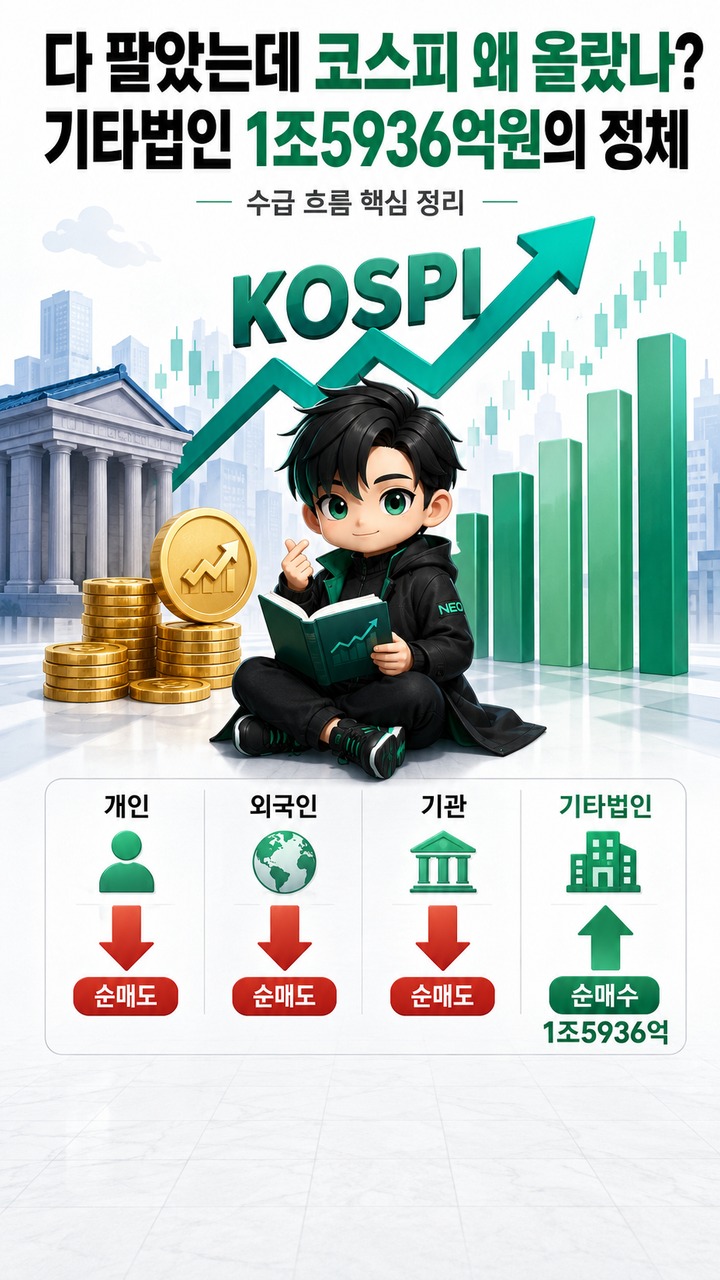
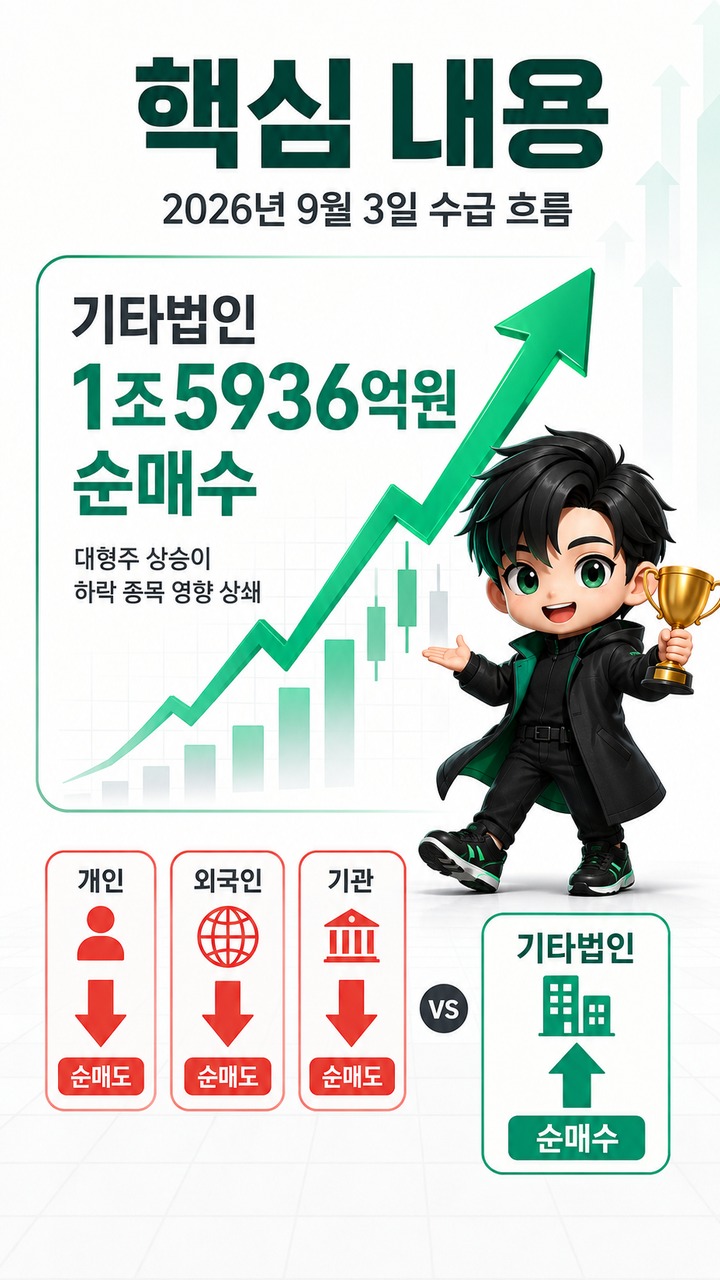
The reason the KOSPI rose on 2026-09-03 despite net selling by individual, foreign, and institutional investors was that other corporations, an investor category easily overlooked when examining buyers, recorded net purchases of KRW 1,593,600,000,000, while gains in major stocks and sectors offset the impact of declining stocks. However, net buying amounts alone do not determine whether an index rises or falls.
On September 3, the KOSPI fluctuated sharply between 6,682.97 and 6,439.49 during the session before closing at 6,579.48, up 16.76 points (0.26%) from the previous trading day.
Who Bought When Individuals, Foreign Investors, and Institutions All Sold?
The answer is other corporations.
Investor trading data for the KOSPI market on September 3 showed net selling of KRW 955,000,000,000 by individuals, KRW 419,500,000,000 by foreign investors, and KRW 215,200,000,000 by institutions. In contrast, other corporations recorded net purchases of KRW 1,593,600,000,000.
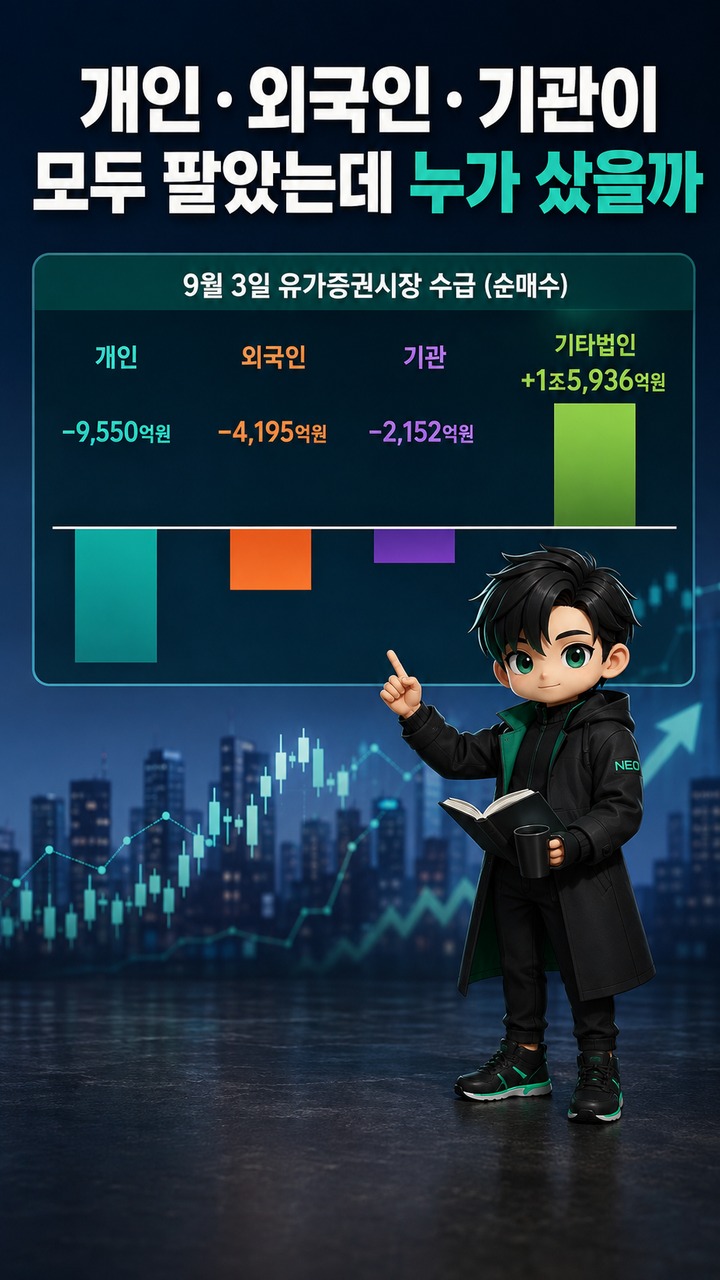
Adding together the net selling by the three investor groups gives the following result.
Individuals: KRW 955,000,000,000
Foreign investors: KRW 419,500,000,000
Institutions: KRW 215,200,000,000
= KRW 1,589,700,000,000 in net selling
Meanwhile, other corporations recorded KRW 1,593,600,000,000 in net buying.
According to the author's calculation, the difference between these two amounts was just KRW 3,900,000,000.
Therefore, if you looked only at individuals, foreign investors, and institutions on an investor trading screen and wondered, "Everyone is selling, so who on earth bought all those shares?" including other corporations in the data makes the day's trading figures almost completely reconcile.
Who Are Other Corporations?
Other corporations are generally an investor classification covering transactions by ordinary corporations and other entities that are not included in the individual, foreign investor, or institutional categories, such as financial investment firms, insurers, investment trusts, and pension funds.
On September 3, share buybacks by Samsung Electronics and SK Hynix contributed significantly to the substantial net buying recorded by other corporations.
Samsung Electronics has been purchasing treasury shares for employee stock compensation, while SK Hynix has also been conducting share repurchases for cancellation. As a result, other corporations recorded net buying for 12 consecutive trading sessions through that day.
Consequently, when examining recent KOSPI trading flows, checking only the traditional three categories of individuals, foreign investors, and institutions may cause investors to overlook the market's actual buying and selling structure.
Do Share Buybacks Always Push Stock Prices Higher?
No, they do not.
Share buybacks create actual buying demand in the market and can help support stock prices, but prices can still fall if selling pressure is stronger than that buying demand.
In fact, despite other corporations recording KRW 1,593,600,000,000 in net purchases on September 3, Samsung Electronics closed down 0.20% and SK Hynix ended the session down 1.05%.
On the previous day, September 2, other corporations also recorded net purchases exceeding 1 trillion and 6 hundred billion won, yet Samsung Electronics and SK Hynix each declined by around 4%. This illustrates that share buybacks cannot always overcome selling pressure.
Rather than treating share buybacks as a guaranteed signal of rising prices, it is more accurate to interpret them as evidence that a certain level of sustained buying demand currently exists in the market.
Why Did the KOSPI Finish Higher Even Though Samsung Electronics and SK Hynix Fell?
The KOSPI is not determined by just two stocks.
On September 3, Samsung Electronics and SK Hynix declined, but LG Energy Solution rose 5.18%, Hyundai Motor gained 1.46%, and Hanwha Aerospace advanced 2.15%. KB Financial Group increased 5.20%, while Shinhan Financial Group climbed 3.62%. At the sector level, gains of 3.45% in construction, 3.40% in financials, and 2.69% in transportation equipment also supported the index.
In other words, the day's index performance reflected the simultaneous occurrence of:
Semiconductor weakness + strength in several major stocks and the financial, construction, and transportation equipment sectors.
Samsung Electronics and SK Hynix have particularly large market-capitalization weights and therefore exert considerable influence on the index. However, a decline in these two stocks does not necessarily mean the KOSPI must fall.
Why Don't Net Buying Amounts and KOSPI Movements Follow a 1-to-1 Relationship?
This is where one of the most common misunderstandings arises.
The KOSPI is not an index calculated by adding together the net purchases of individuals, foreign investors, and institutions.
The KOSPI moves based on changes in the market capitalization of listed stocks. What matters is how much individual stocks rise and how heavily those stocks are weighted in the index by market capitalization.
For example, if Investor A sells KRW 100,000,000 worth of shares, there must be an investor on the other side who buys those shares. Looking at the market as a whole, selling cannot exist without corresponding buying.
However, stock prices change depending on whether trades are executed at prices higher or lower than those of the previous day.
That is why the following two statements can both be true at the same time.
"Foreign investors were net sellers during the day."
And:
"The KOSPI rose."
This is possible because other investor groups may absorb the shares sold by foreign investors, while the final trading prices of several major stocks may still be higher than the previous day's levels, allowing the index to rise.
Four Things to Check When Analyzing Trading Flows by Investor Type
When reviewing daily trading flows, it is more useful to consider several factors together rather than concluding where the market is headed solely because foreign investors bought or sold.
First, examine all buying and selling participants, including other corporations. This is particularly important during periods of large-scale share buybacks, as seen recently.
Second, check which stocks attracted the buying. Even with the same KRW 1,000,000,000,000, purchases concentrated in the largest stocks by market capitalization do not have the same impact on the index as purchases spread across hundreds of stocks.
Third, distinguish between the cash equity market and the futures market. On September 3, foreign investors were net sellers in the KOSPI cash market but recorded net purchases of KRW 252,800,000,000 in the KOSPI 200 futures market.
Fourth, do not interpret a single day's trading flows as a broader trend. When transactions for specific purposes, such as share buybacks or index rebalancing, account for unusually large amounts, the day's trading figures may give an impression that differs from ordinary market sentiment.
The Key Figures to Watch in Trading Flows on September 3
If you simply describe the KOSPI on September 3 as having risen even though individuals, foreign investors, and institutions all sold, the situation may seem contradictory.
However, including other corporations makes the structure clear.
The combined net selling by individuals, foreign investors, and institutions was KRW 1,589,700,000,000, while other corporations recorded KRW 1,593,600,000,000 in net buying. Share repurchases by Samsung Electronics and SK Hynix were reflected heavily in the other-corporations category.
However, this does not mean buying by other corporations will continue to push the KOSPI higher. The size and duration of share buybacks, the intensity of selling by foreign and institutional investors, interest rates, exchange rates, and stock price movements across sectors can all change.
Therefore, in markets where trading flows differ from their usual patterns, as they have recently, checking who is selling and who is absorbing those shares is more helpful for understanding market movements than focusing on a single foreign-investor net buying figure. Meta Description
This article explains why the KOSPI rose on September 3 despite net selling by individuals, foreign investors, and institutions, focusing on KRW 1,593,600,000,000 in net purchases by other corporations and the share buyback activities of Samsung Electronics and SK Hynix.
Tags or Labels / Thumbnail Text
Everyone Was Selling, So Who Bought 1.59 Trillion?
※ This article is provided for informational purposes to help readers understand market movements and does not constitute an investment recommendation for any particular stock or asset. All investment decisions and responsibilities rest with the individual investor.
Related Articles
KOSPI Closes at 6,579.48 on September 3: Signals Remaining After an Intraday Swing of 243 Points